
What Is Myopia? An Introduction to Nearsightedness
Introduction
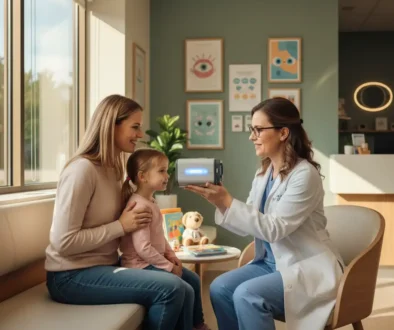
Myopia (nearsightedness) is a common vision condition where nearby objects appear clear, but distant objects look blurry. While nearly 50% of the population is affected, early detection in children is critical to slowing its progression. At Frame & Focus Eye Care, Dr. Sarah Zaver specializes in pediatric myopia management for families in Richmond and Sugar Land, using advanced technology to protect your child’s long-term eye health.
Our practice specializes in pediatric myopia management, offering evidence-based treatments designed to slow progression and protect your child’s long-term vision health.
Schedule a Pediatric Myopia Evaluation in Richmond
What Is Myopia?
Myopia, also known as nearsightedness, is an eye disorder due to a refractive error. People with this condition see nearby objects well but have trouble seeing faraway objects. Distant objects often appear blurry or fuzzy instead. If you have myopia, you won’t be able to see highway signs clearly until they are only a few feet away.
It is a distance and eye focus disorder. It usually develops in childhood and adolescence, eventually settling around the 20s to 40s. An ophthalmologist or optometrist can diagnose it through an eye exam. While it seems a problematic eye condition, it can be corrected easily with eyeglasses, contact lenses, or surgery.
Types of Myopia
The common types of myopia are mild, moderate, and severe nearsightedness. If you have less than three diopters of myopia, you have low myopia or mild nearsightedness. If it’s three to six diopters, you have moderate nearsightedness. High myopia, also known as severe nearsightedness, is when you have more than six diopters.
There are also clinical types of myopia. Congenital myopia is when myopia has been present since birth. The second one, simple myopia, is the most common, with the onset being around eight to 12 years of age. Then, pathological myopia is a rapidly progressive type, and acquired myopia resulting from medications or other irregular conditions.
Causes of Myopia
A nearsighted child is likely to have at least one parent with myopia. Currently, experts are still trying to figure out what causes it. However, they believe it is a combination of hereditary and environmental factors. You might inherit it, but you can develop it when your lifestyle creates the right conditions. For instance, you can develop it if your work always has you in front of your computer.
Signs and Symptoms of Myopia
A nearsighted person will likely notice that they:
- Constant headaches
- Have eye strain or dry eyes
- Often squint to see things clearly
- Blink excessively
- Have blurry or fuzzy vision when looking at faraway objects
- Feels tired when playing sports, driving, or looking at faraway objects
Other things that also indicate that someone has myopia include:
- Short attention span
- Poor school grades
- Often holding items close to their face
- Sit close to the television
If you have these symptoms or notice someone showing these indicators, scheduling an eye exam as soon as possible is great.
How Myopia Is Diagnosed
Diagnosis at Frame & Focus Eye Care goes far beyond simply determining if a child needs glasses. Dr. Sarah Zaver utilizes a comprehensive approach to identify myopia even before a child realizes their vision is blurry.
The process begins with understanding what to expect during an eye exam. While a standard visual acuity test (reading the Snellen chart) is a starting point, children often overcompensate for vision issues using their strong focusing muscles. To get an accurate reading, we may use an objective refraction test.
Crucially, for effective myopia management, we look at the physical health of the eye. This includes Optomap retinal screening, which allows us to see a wide-field view of the retina without necessarily needing dilation. This technology helps us monitor how the stretching of a myopic eye affects long-term ocular health, ensuring we detect any common eye disorders early.
Treatment Options for Myopia
At Frame & Focus, we believe in Myopia Management, not just “correction.” While traditional glasses help a child see, they don’t stop the eye from continuing to grow longer. We offer several evidence-based treatments designed to slow this progression:
-
Orthokeratology (Ortho-K): These specialized lenses are worn only at night to gently reshape the cornea while your child sleeps. They wake up with clear vision and can go about their day without glasses or daytime contacts.
-
MiSight® 1-Day Lenses: As part of our specialty contact lens offerings, these are specifically designed to slow myopia progression in children.
-
Prescription Eyewear: For those who prefer glasses, we provide high-quality eyeglasses for children that are durable enough for Richmond’s active students.
-
Surgical Consultations: For older patients whose vision has stabilized, we provide LASIK surgery consultations to determine if they are candidates for the procedure.

Living With Myopia: Daily Impact and Management
Managing myopia is a daily commitment that extends into the classroom and the home. In our digital age, understanding computer vision syndrome is essential for parents, as increased screen time can impact dry eye and worsen nearsightedness.
Management Tips for Richmond Families:
-
Outdoor Time: Recent research highlights the importance of myopia management through lifestyle changes. Spending at least two hours outdoors daily is one of the most effective lifestyle changes to support myopia management.
-
The 20-20-20 Rule: To reduce strain during homework or gaming, look at something 20 feet away for 20 seconds every 20 minutes.
-
Vision Habits: Ensure your child maintains a healthy distance from digital devices to prevent “pseudomyopia” or temporary worsening of focus.
When to See an Eye Care Professional
Early intervention is the “Straight Talk” advice Dr. Zaver gives every family. You should schedule a kids’ eye exam or a pediatric eye exam if you notice your child:
-
Squinting or head tilting to see the TV or signs.
-
Complaining of frequent headaches, which could also be a sign of a Neurolens evaluation.
-
Sitting too close to screens or holding books inches from their face.
-
Experiencing a sudden decline in school performance or sports coordination.
Resources and Citations
Based on research findings from leading ophthalmology journals and public health studies, this article draws from the following authoritative sources:
Primary Research Sources
1. Global Myopia Prevalence Statistics Global prevalence, trend, and projection of myopia in children and adolescents from 1990 to 2050: a comprehensive systematic review and meta-analysis. British Journal of Ophthalmology, 2024
A recent comprehensive analysis published in the British Journal of Ophthalmology found that the global prevalence of childhood myopia affects approximately one-third of children and adolescents, with projections indicating this will reach 39.80% by 2050. This landmark study analyzed data from 276 studies across 50 countries, providing the most current and comprehensive global perspective on myopia trends.
2. Outdoor Time and Myopia Prevention Research: Is Spending More Time Outdoors Able to Prevent and Control Myopia in Children and Adolescents? A Meta-Analysis of Ophthalmic Research, 2024
This 2024 meta-analysis of 12,922 participants aged 6-16 years demonstrated that compared to 3.5 hours of outdoor time per week, increases to 7, 16.3, and 27 hours per week corresponded with respective reductions in myopia onset risk of 20%, 53%, and 69%
If your child experiences a sudden change in vision, redness, or pain, do not wait—contact us immediately for emergency eye care.
Protect your child’s future vision today. Contact Frame & Focus Eye Care to schedule a consultation at our Richmond, TX clinic. Whether you are in Pecan Grove, Sugar Land, or Rosenberg, we are here to provide the personalized care your family deserves.
FAQs
-
Myopia is a common vision condition where the eyeball is too long or the cornea is too curved. This causes light to focus in front of the retina, making distant objects appear blurry.