UV Protection for Your Eyes: Why It Is Important, and How to Choose the Right Sunglasses
Introduction
Choosing the right UV protection involves selecting lenses that block 100% of UVA and UVB rays (UV 400) to prevent long-term damage like cataracts and macular degeneration. While many believe dark tints equal better safety, true protection comes from the lens material and specialized coatings rather than color alone. At Frame & Focus Eye Care, we provide the “Straight Talk” on how to shield your vision from Texas sun—whether through polarized lenses for glare or impact-resistant polycarbonate for kids.
View Our UV-Protective Collection
The Sun’s Hidden Dangers
The sun’s rays provide warmth and light. But among these are harmful ultraviolet rays. Invisible to the naked eye, UV radiation consists of UVA, UVB, and UVC rays. The Earth’s atmosphere absorbs UVC rays. UVA and UVB rays, on the other hand, can reach your eyes and cause significant damage over time.
Understanding the Risks
Exposure to UV radiation without proper protection can lead to various eye problems. These include cataracts, macular degeneration, and pterygium, a growth on the eye surface. It can also cause some types of eye cancer. These risks are not limited to sunny days or warm climates. UV rays can penetrate clouds and haze, so your eyes are still at risk even on overcast days.
Choosing the Right Sunglasses
It is essential to select sunglasses that provide adequate UV protection. Look for labels. Choose sunglasses that offer 100% UV protection or block UVA and UVB rays up to 400 nanometers.
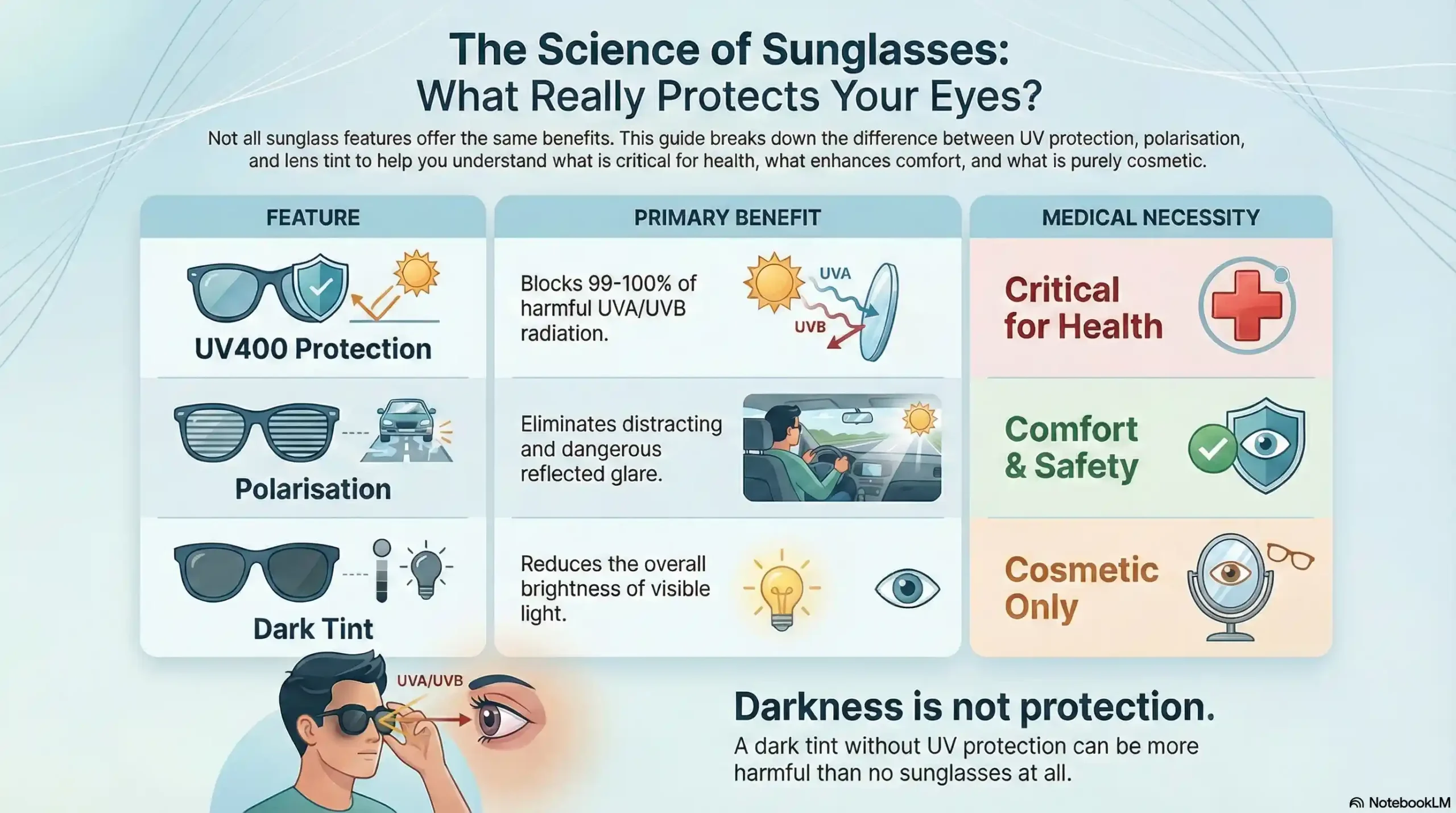
Check to ensure you are getting the right level of sun protection. Consider sunglasses with polarized lenses. Polarization does not directly block UV rays, but it reduces glare. It also improves visual comfort by filtering out horizontal light waves.
Lens color preferences are subjective, but some tints can enhance contrast and depth perception. Gray, green, and brown lenses are popular choices. They provide natural color perception without distorting the colors.
Lens Material Matters
The material of the sunglass lenses also plays a crucial role in eye protection and overall comfort. Glass lenses offer excellent optical clarity and scratch resistance. However, they can be heavier and more prone to breakage.
Polycarbonate lenses are lightweight, impact-resistant, and provide inherent UV protection. They are an ideal choice for sports and outdoor activities. Trivex lenses are like polycarbonate lenses but offer a higher optical clarity. They are an excellent option for those looking for lightweight and impact-resistant lenses.
How Sunglasses Protect Your Eyes from Harmful UV Rays
Sunglasses act as a physical and clinical shield for your eyes. While the sun’s rays provide essential warmth and light, they also emit invisible UVA and UVB radiation that can reach the eye and cause significant damage over time.
A quality pair of sunglasses isn’t just a fashion accessory—it’s a tool for prevention. Proper UV protection helps safeguard against serious conditions such as:
-
Cataracts: A clouding of the eye’s natural lens.
-
Macular Degeneration: A leading cause of vision loss as we age.
-
Pterygium: Non-cancerous growths on the white of the eye.
During a comprehensive eye exam, Dr. Zaver can detect early signs of UV damage using retinal photography. To stay safe, always choose sunglasses labeled 100% UV Protection or UV 400, which block the most harmful wavelengths.
Polarized vs. UV-Protected Sunglasses: Key Differences
One of the most common questions we hear is: “Are polarized lenses the same as UV protection?” The short answer is no. At Frame & Focus, we believe in “Straight Talk”—explaining the science so you can make the best choice for your lifestyle.
-
UV Protection: This is a clear treatment (or inherent in the material) that filters out harmful radiation. Think of it as “sunscreen for your eyes.”
-
Polarization: This is a filter that blocks horizontal light waves to eliminate glare from surfaces like water, roads, or car hoods.
While polarization does not block UV rays on its own, it significantly reduces squinting and eye strain. For the best experience, we recommend combining both features in your prescription sunglasses.
UV Protection for Children’s Eyes: Why It Matters More
Protecting the next generation is a core part of our pediatric eye care mission. Children are actually at a higher risk for UV damage than adults because their ocular tissues are more transparent, allowing more radiation to reach the back of the eye.
Since UV damage is cumulative, the “Family Guardians” of Richmond should start sun safety habits early. For active kids, we recommend polycarbonate lenses. These are:
-
Inherent UV blockers.
-
Impact-resistant for sports and play.
-
Lightweight for all-day comfort.
Common Myths and Mistakes About Sunglasses and UV Safety
Don’t let these common misconceptions compromise your vision:
-
Myth: Darker lenses provide better protection. The darkness of the tint has nothing to do with UV blockage. In fact, dark lenses without UV filters can be worse because they cause your pupils to dilate, letting even more harmful light in.
-
Myth: You don’t need sunglasses on cloudy days. UV rays penetrate clouds and haze. Protection is a year-round necessity in Texas.
-
Mistake: Choosing “one-size-fits-all” frames. Poorly fitted sunglasses allow light to leak in through the sides. At our optical boutique, we ensure your frames are professionally fitted to provide maximum coverage.
Resources and Citations
Primary Medical and Scientific Sources
American Academy of Ophthalmology – UV Eye Protection Guidelines Source: UV Light and Your Eyes
This comprehensive resource from the AAO provided the foundational medical evidence regarding UV radiation’s impact on eye health, including the specific wavelength ranges (UVA and UVB) and their effects on ocular tissues. The academy’s research-backed guidelines informed our recommendations about 100% UV protection standards and the importance of year-round eye protection, even on cloudy days.
The Vision Council – Sunglass Standards and Consumer Protection Source: Sun Safety and Protective Eyewear
The Vision Council’s industry research and consumer education materials provided crucial information about sunglass lens standards, including the 400-nanometer protection threshold and polarization benefits. Their studies on consumer behavior and UV protection awareness helped shape our recommendations for choosing quality protective eyewear and understanding the difference between fashion sunglasses and medically appropriate UV protection.
Proper Fit and Coverage
The right fit and coverage are essential for sunglasses to provide optimal UV protection. Choose sunglasses that fit your face and cover your eyes completely. Wraparound styles offer added protection by blocking UV rays from entering through the sides.
Choose sunglasses with adjustable nose pads and temples. Doing so will help ensure a comfortable fit. It helps prevent discomfort or slipping during extended wear. People who wear prescription glasses can opt for prescription sunglasses. They can also consider getting clip-on or fit-over sunglasses that they can wear over regular glasses.
Remember to prioritize UV protection for children as well. Make informed decisions to enjoy the sun while keeping your eyes safe and healthy for years.
Is your vision protected? If you have experienced sudden changes in vision or eye pain after time in the sun, we offer emergency eye care with same-day appointments.
Ready to see the difference? Visit Frame & Focus Eye Care in Richmond, Texas, to explore our collection of high-quality, UV-protective eyewear.
Book Your Appointment Online or call us at (832) 930-7797 today.
-
UV light causes long-term damage, increasing your risk for serious eye conditions like cataracts, macular degeneration, and even growths on the eye’s surface.