What to Expect During an Eye Exam
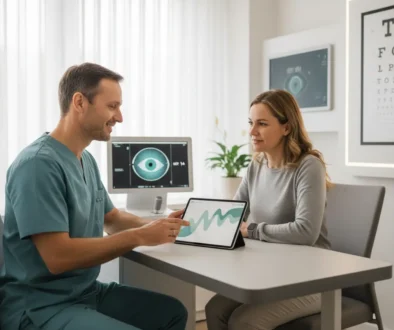
A comprehensive eye exam typically takes 60 to 90 minutes and involves a series of tests to evaluate both your vision clarity and internal eye health. From visual acuity charts to pupil dilation and glaucoma screenings, this guide breaks down exactly what to expect during your appointment at Frame & Focus Eye Care.
[Schedule Your Comprehensive Eye Exam in Fairhope]
Key Takeaways: Your Vision Health Checklist
-
Proactive Disease Detection: The exam is vital for detecting silent, serious eye diseases like glaucoma, cataracts, and diabetic retinopathy, often before symptoms appear.
-
Time Commitment: Plan for 90 minutes if dilation is required. Rushing can compromise the thoroughness of your ocular health assessment.
-
Beyond 20/20: Testing includes more than just clarity (acuity); it checks crucial functions like depth perception (Stereopsis), eye muscle coordination, and alignment.
-
Prescription Technology: Techniques like Retinoscopy and Autorefraction are critical for children or those who can’t verbalize their vision needs, ensuring accurate, customized lens power.
-
Post-Exam Caution: Always bring sunglasses and consider arranging a driver, as dilated pupils lead to light sensitivity and blurry near vision for several hours.
-
Not All Tests are Equal: The exact tests performed are always customized based on your age, health history, and the date of your last examination.
The parts of a comprehensive eye examination vary according to the patient’s age, date of last exam, and other factors. Not all parts of the eye exam may be needed or performed, but the first part of the eye exam will include documenting medical history. Here are some eye and vision tests that are likely to be encountered during a comprehensive eye exam:

1- Visual Acuity Tests
Visual acuity tests measure the sharpness of vision and are usually performed using a projected eye chart to measure the distance visual acuity and a hand-held small acuity chart to measure the near vision (for reading).
2- Color Blindness Test
A screening test that checks the color vision is often performed early in a comprehensive eye exam to rule out color blindness.
3- Cover test to check eye alignment.
A test used to assess strabismus or a more subtle binocular vision problem that could cause eye strain or amblyopia (lazy eye).
4- Ocular Motility (Eye Movements) Testing
Ocular motility testing is performed to determine how well eyes can follow a moving object and/or quickly move between and accurately fixate on two separate targets.
5- Stereopsis (Depth Perception) Test
This is used to test the perception of depth and 3-dimensional structure obtained on the basis of visual information deriving from two eyes by individuals with normally developed binocular vision.
6- Retinoscopy
This test is used to estimate which lens powers will best correct distance vision. Based on the way the light reflects from the eye, the doctor is able to obtain an approximation of the eyeglass prescription. This test is useful for children and patients who are unable to accurately answer the doctor’s questions.
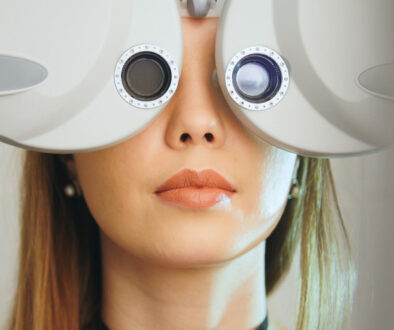
7- Manual refraction with a phoropter.
This is the test used to determine the exact eyeglass prescription.
8- Autorefractors and Aberrometers
An autorefractor or aberrometer may be used to automatically estimate the eyeglass prescription. This helps determine an eyeglass prescription for young children and other patients who may have trouble sitting still, paying attention, and providing the feedback that the doctor needs to perform accurate manual refraction. They also save time as they take only a few seconds.
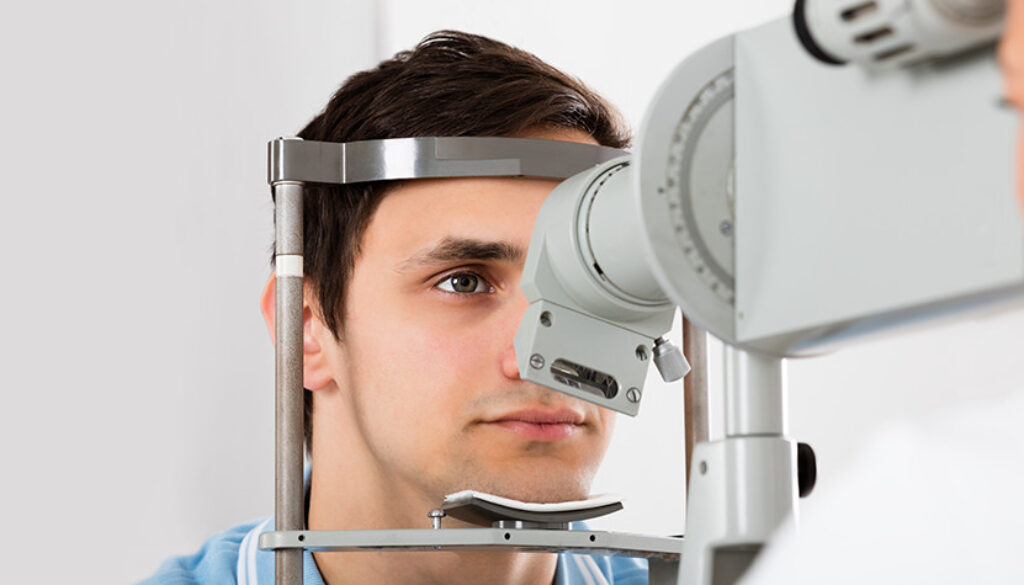
9- Slit-lamp exam
A slit lamp is a binocular microscope (or biomicroscope) used to examine the structures of the eye under high magnification, including eyelids, cornea, conjunctiva, iris, and lens. With the help of a hand-held lens, the doctor may also use the slit lamp to examine structures located farther back in the eye, such as the retina and optic nerve.
The slit lamp exam can be used to detect a wide range of eye conditions and diseases, including cataracts, macular degeneration, corneal ulcers, and diabetic retinopathy etc.
10- The Glaucoma Test
Testing for glaucoma typically begins with measuring the pressure inside the eyes. This can be done by the “puff-of-air” test, based on the eye’s resistance to the puff of air; the machine calculates intraocular pressure (IOP).
High eye pressure patients may be at risk for or have glaucoma. The test is completely painless, and the tonometer does not touch your eye.
11- Pupil Dilation
To obtain a better view of the eye’s internal structures, the eye doctor instills dilating eye drops to enlarge the pupils, which usually takes about 20-30 minutes to start working. When pupils are dilated, eyes will be sensitive to light (because more light is getting into the eyes), and you may notice difficulty focusing on objects up close. These effects can last for several hours, depending on the strength of the drops used.
12- Visual Field Test
This test checks for the possible presence of blind spots (scotomas) in the peripheral (side) vision by performing a visual field test. These blind spots can originate from eye diseases like glaucoma or may help identify specific areas of brain damage caused by a stroke or tumor.
How long will the appointment take?
A comprehensive eye exam can take 1 hour or longer, depending on the number and complexity of tests required to fully evaluate vision and the eye’s health. If the eyes are dilated, at least a 90-minute appointment should be planned.
Can I drive after my eyes are dilated?
Many patients can drive themselves after having their eyes dilated, but it is important to remember that their eyes will be sensitive to light, and vision may be blurry, so you should wear sunglasses after your exam.
Citations & Resources
-
American Optometric Association (AOA): Recommended Examination Frequency for Pediatric and Adult Patients
-
National Eye Institute (NEI): Comprehensive Eye Examination Fact Sheet
-
Prevent Blindness: Understanding the Glaucoma Test and Intraocular Pressure (IOP)
By streamlining the introduction and clarifying the time commitment, we transform this page from a generic medical article into a high-utility patient resource. The addition of a visual roadmap and a localized CTA addresses the current 0% CTR by providing immediate value and a clear next step for Fairhope residents. These low-risk adjustments leverage your existing high-quality medical content while realigning the page with modern search intent.
Ready to experience a clearer view? [Schedule your comprehensive eye exam at Frame & Focus Eye Care today] to ensure your vision and eye health are in expert hands.
FAQs
-
A comprehensive exam includes Visual Acuity, Color Blindness, Ocular Motility (eye movements), Retinoscopy (prescription estimate), Slit-lamp exam, and the Glaucoma Test.