Multifocals vs. Bifocals: Differences Explained by Eye Doctors
Introduction
Are you finding yourself holding menus at arm’s length or squinting at your smartphone screen? If you’re over 40, you’re likely experiencing presbyopia—a natural age-related condition affecting 128 million Americans, representing nearly 90% of adults over 45. According to 2025 data, presbyopia prevalence ranges from 83.0% to 88.9% for adults aged 45 and older in the United States.
At the heart of this decision lies a fundamental question: should you choose the time-tested reliability of bifocals or embrace the seamless technology of multifocals? This comprehensive guide to multifocals vs. bifocals, backed by the latest 2024-2025 research and expert insights from practising eye doctors, will help you make an informed decision about your vision correction needs.
Understanding Presbyopia: The Foundation
Presbyopia occurs when your eye’s natural crystalline lens loses its flexibility—a process that begins around age 40 and progressively worsens. Key Statistics:
- 1.8 billion people worldwide have presbyopia as of 2025
- Projected to affect 2.1 billion people by 2030
- 73 million millennials are now turning 40, driving unprecedented demand
- Presbyopia treatment market valued at $10.70 billion in 2025
Early Warning Signs:
- Difficulty reading small print on phones or computers
- Holding reading materials farther away for clarity
- Eye strain and headaches during close-up tasks
- Blurred vision when switching between near and far objects
Bifocals: The Time-Tested Solution
How Bifocals Work
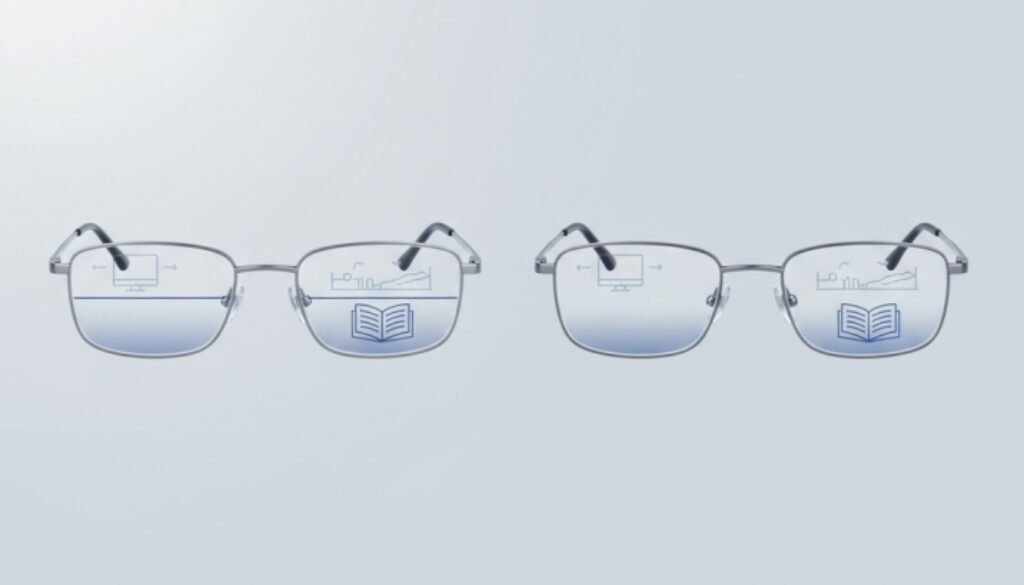
Bifocal lenses contain two distinct optical powers separated by a visible line. The upper portion corrects distance vision, while the lower segment enhances near vision. This design, credited to Benjamin Franklin in 1784, has provided reliable vision correction for over two centuries.
Types of Bifocal Designs:
- Flat-top bifocals: Rectangular reading segment
- Round bifocals: Circular near-vision area
- Executive bifocals: Full-width reading section
Advantages of Bifocals
1. Cost-Effectiveness Bifocals cost 30-50% less than progressive multifocals, with prices ranging from $200-600 compared to $400-1,500 for premium progressives.
2. Clear Zone Designation The visible line creates defined areas for different viewing distances, making it immediately obvious where to look for reading versus distance vision.
3. Faster Adaptation Most wearers adapt to bifocals within 1-2 weeks, as the distinct zones require a minimal learning curve.
4. Larger Reading Area The dedicated near-vision segment provides substantial space for reading and close work.
Disadvantages of Bifocals
- A visible line can be cosmetically unappealing
- The image jumps when moving between zones
- Limited intermediate vision for computer screens
- Depth perception issues during initial adaptation
Multifocals: The Modern Alternative
Progressive Lens Technology
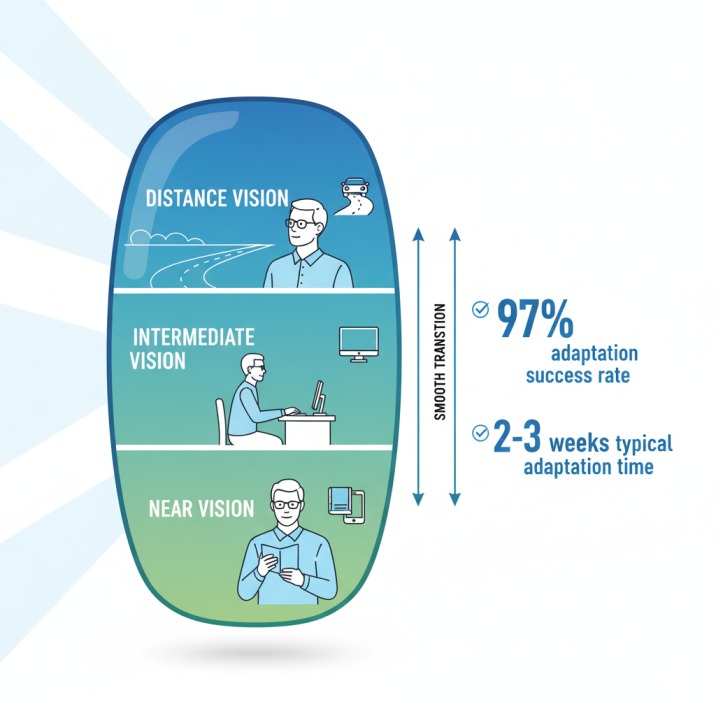
Multifocal lenses, often called progressive lenses, eliminate visible lines by creating a gradual transition between different prescription powers. This advanced technology incorporates three distinct vision zones:
- Distance zone (top): Driving, sports, far vision
- Intermediate zone (middle): Computer work, arm’s-length tasks
- Near zone (bottom): Reading, close-up activities
Types of Multifocal Designs
1. Standard Progressives ($175-450) Entry-level progressive lenses with basic power transitions.
2. Premium Progressives ($400-1,000+) Advanced freeform technology with wider viewing channels and reduced distortion.
3. Workplace Progressives ($300-600) Enhanced intermediate zones specifically for computer users.
Advantages of Multifocals
1. Seamless Vision Transition No visible lines or abrupt prescription changes create a natural viewing experience.
2. Complete Range of Vision Three viewing zones accommodate all modern visual demands, including digital device use.
3. Aesthetic Appeal Progressive lenses look identical to single-vision lenses, maintaining a youthful appearance.
4. Improved Depth Perception. Smooth transitions preserve natural spatial awareness.
Disadvantages of Multifocals
- Longer adaptation period (2-6 weeks)
- Peripheral distortion in lower-quality designs
- Higher cost (50-100% more than bifocals)
- Narrow reading zone requiring precise head positioning
Contact Lens Options: Bifocal vs. Multifocal
Bifocal Contact Lenses
- Annual Cost: $388-970 (national average $505)
- Design Types: Segmented or simultaneous vision
- Best For: Clear zone preference, budget considerations
Multifocal Contact Lenses
- Annual Cost: $216-548 (national average $279)
- Popular Brands: Acuvue Oasys, Air Optix Aqua, Biofinity
- Success Rate: 97% adaptation success when properly fitted
Contact Lens Advantages:
- Wider field of vision than glasses
- No weather interference
- Freedom for sports and active lifestyles
Scientific Evidence: 2024-2025 Research
Study 1: Multifocal Contact Lens Efficacy (Nature Scientific Reports, 2024)
A study of 22 presbyopic patients found significant vision improvement with multifocal contacts:
- 96.2/100 satisfaction for distance vision
- 91.9/100 for intermediate vision
- 85.0/100 for near vision
Study 2: Progressive Lens Success Rates (West Broward Research, 2025)
Clinical trials showed 97% adaptation success for progressive lenses when properly fitted, with most discomfort resolving within 2-3 weeks.
Study 3: Market Trends (CLEAR™ 2024 Report)
Contact lens presbyopia correction increased from 26.4% in 2000 to 61.1% in 2023, reflecting improved technology and patient satisfaction.
Choosing Between Multifocals and Bifocals
Choose Bifocals If You:
- Prioritise budget (30-50% cost savings)
- Prefer clear zone designation for specific tasks
- Have simple vision needs (reading and distance)
- Want faster adaptation (1-2 weeks vs. 2-6 weeks)
Choose Multifocals If You:
- Work extensively with computers (intermediate zone benefit)
- Value aesthetic appearance (no visible lines)
- Live an active lifestyle (seamless transitions)
- Drive frequently (better peripheral vision)
Professional Recommendations by Lifestyle
Office Workers: Multifocals with enhanced intermediate zones reduce digital eye strain and improve productivity.
Retirees: Bifocals provide excellent value for reading and television, with optional task-specific glasses.
Active Professionals: Multifocals offer seamless vision for dynamic activities and social interactions.
Cost Analysis: Investment vs. Value
Glass Lens Comparison
- Bifocal glasses: $200-600
- Standard progressives: $175-450
- Premium multifocals: $400-1,500
Contact Lens Annual Costs
- Daily multifocals: $300-800
- Monthly multifocals: $216-548
- Bifocal contacts: $388-970
Technology Advances: 2025 and Beyond
Digital Surfacing Technology: Modern progressive lenses use freeform manufacturing for customised surfaces and reduced distortion.
Blue Light Filtering: Integrated protection addresses digital device concerns.
Extended Depth of Focus (EDOF): New contact designs minimise sharp zone transitions.
Professional Fitting: Critical Success Factors
What to Expect
- Comprehensive assessment of visual history and lifestyle
- Precise measurements, including pupil size and frame positioning
- Follow-up protocol at 1, 2, and 6 weeks
Success Tips
- Wear consistently: Gradual increase from 2-4 hours daily
- Practice zone usage: Deliberately use different lens areas
- Optimal positioning: Hold reading materials 16-18 inches away
- Be patient: Allow a full adaptation period
Adaptation Timeline
Bifocal Adaptation (1-2 Weeks)
- Days 1-3: Practice eye movements between zones
- Days 4-7: Spatial awareness improves
- Weeks 1-2: Full comfort achieved
Multifocal Adaptation (2-6 Weeks)
- Week 1: Peripheral distortion may occur
- Weeks 2-3: Brain adaptation to zones
- Weeks 4-6: Complete comfort and natural usage
Red Flags: When to Reconsider
Avoid bifocals if you:
- Work extensively with computers
- Are concerned about cosmetic appearance
- Have an active lifestyle requiring frequent distance changes
- Have significant dry eye issues
- Cannot tolerate a 2-6 week adaptation
- Prioritise immediate, clear zones over gradual transitions
Additional Resources and Citations
1. BCLA CLEAR Presbyopia: Epidemiology and Impact (2024)
Source: Contact Lens and Anterior Eye Journal
2. Efficacy of a New Refractive Multifocal Contact Lens
Source: Nature Scientific Reports (April 2024)
3. Progressive or Bifocal Lenses? Expert Analysis
Source: West Broward Eyecare Associates (September 2025)
Conclusion
The choice between multifocals and bifocals depends on your visual needs, lifestyle, aesthetic preferences, and budget. While bifocals offer reliable, cost-effective correction, multifocals provide seamless vision transitions ideal for today’s digital lifestyle.
Recent research demonstrates that both options achieve excellent outcomes when properly fitted by experienced eye care professionals. Whether you choose multifocals or bifocals, the right vision solution will restore your visual freedom and confidence.
Schedule a comprehensive consultation with a qualified eye care provider to explore your options and make an informed decision about your visual future.
FAQs
-
Multifocals, also known as progressive lenses, offer a seamless, gradual power change for all viewing distances (near, intermediate, far). This transition avoids the noticeable “image jump” that occurs with bifocals.
Please note: None of the above should be considered medical advice. If you have any concerns about your vision, please contact us immediately or consult your primary care provider.