How Your Eyes Change with Age
Your vision changes on a predictable timeline. By age 40, the lens of the eye naturally hardens, making near focus difficult (Presbyopia). By 60, the retina receives significantly less light, impacting night driving and contrast sensitivity. While needing reading glasses is a normal part of this process, other symptoms—like wavy central vision or sudden flashes—are warning signs of conditions like Glaucoma or Macular Degeneration. This guide breaks down exactly what to expect in each decade of life.
Key Takeaways
-
Prioritize Ocular Health: Go beyond basic vision tests; the practice uses state-of-the-art technology for advanced, preventative eye exams and early disease detection.
-
Specialized Solutions: Find expert treatment for chronic conditions, including customized dry eye protocols, computer vision syndrome, and non-surgical Myopia Management for children.
-
Urgent Care Access: Benefit from same-day appointments for sudden eye emergencies, injuries, or urgent changes in vision, ensuring peace of mind when you need it most.
-
Value-Driven Eyewear: Access high-quality frames and specialty lenses with transparent pricing, including a popular “$99 Special” on prescription eyewear.
-
Experience the Difference: Join a 4.9-star rated practice praised by patients for a welcoming culture where the team, including Dr. Zaver, provides truly personalized care.
Several different factors influence how each of us will experience aging. Your genetics can play a pivotal role. Understanding your family history and making sure to communicate this with your health professional can be a great way to monitor changes and spot early signs and symptoms. Exposure to certain chemicals or environments, or specific trauma to our eyes, can also have an impact on how our eyes age. While the eyes can often recover from traumatic injury or exposure, they may still have a detrimental effect on your vision as you age.
Knowing at what age you start to have an increased risk of certain diseases or eye conditions can help you to be prepared when you meet with your optometrist.
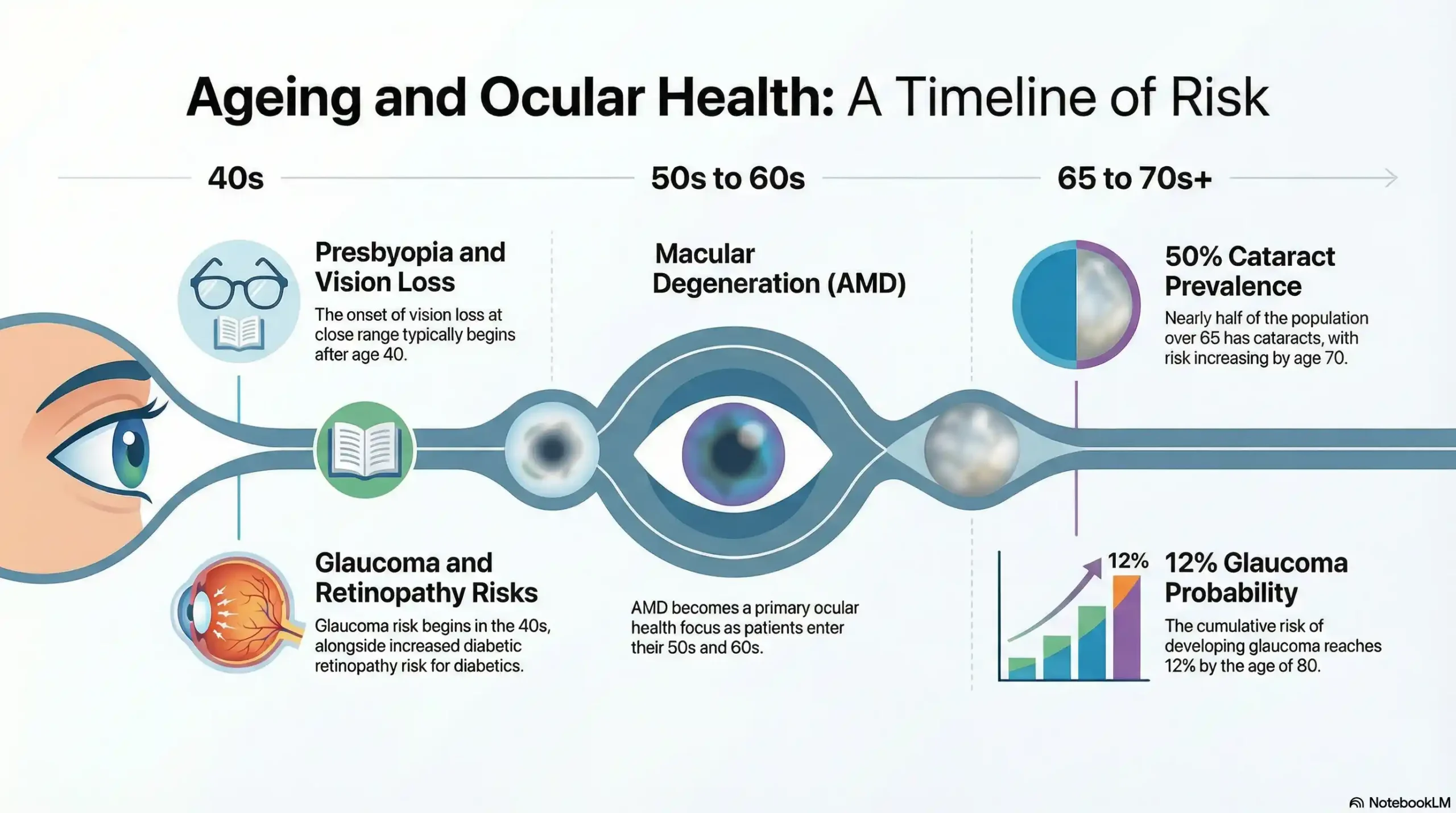
Here are some of the most common ailments that people experience when they age.
Presbyopia
Once you are over 40 years old, you may experience a loss of vision at close range. Presbyopia is a normal condition that occurs due to the hardening of the lens in your eye. In the early stages, you can often compensate for small changes to your vision, but as the condition progresses, you will likely need a corrective lens or choose a surgical procedure. Such as Lasik, corneal inlays, refractive lens exchange, and conductive keratoplasty.
Cataracts
Cataracts are technically a disease of the eye. However, they are so frequently seen in patients as they age that they are classified as a normal part of aging. While almost half of the population over 65 has cataracts, that number increases even more by age 70. While it can be frightening to begin losing your vision, cataract surgery is extremely successful and can restore up to 100% of the lost vision. If you notice even small changes to your vision, it is smart to talk to your doctor. Cataract surgery is best performed when the cataracts are small and can be more easily removed.
Noticing changes in your vision? Schedule a Senior Eye Exam in Richmond, TX to rule out serious conditions.
Macular Degeneration: Protecting Your Center of Vision
As we move into our 50s and 60s, a condition called Age-Related Macular Degeneration (AMD) becomes a primary focus of our preventative care. AMD is the leading cause of vision loss among older adults, affecting the macula—the small but vital central portion of the retina that allows you to see fine details clearly.
Understanding the Two Faces of AMD
Macular degeneration typically presents in one of two ways, and understanding the difference is key to preserving your independence:
-
Dry AMD (Atrophic): This is the most common form, accounting for about 80% of cases. It occurs when the tissues of the macula thin out over time and tiny protein deposits called drusen develop. While it progresses slowly, it can eventually lead to a blurred or “empty” spot in your central vision.
-
Wet AMD (Exudative): Though less common, this is a medical emergency. It happens when abnormal blood vessels grow underneath the retina and leak fluid or blood. This can cause rapid, severe vision loss.
The “Contrast Sensitivity” Gap: Why Reading in Dim Light Gets Harder
Many patients in Richmond notice they begin reaching for the flashlight on their phones just to read a dinner menu. This isn’t always a need for a stronger prescription; it is often a decline in contrast sensitivity.
Biologically, your pupil becomes smaller and less responsive to light, while your natural lens begins to yellow. A 60-year-old’s retina receives significantly less light than a 20-year-old’s. During a comprehensive eye exam, Dr. Zaver goes beyond basic vision charts to assess how your eyes handle glare and low-contrast environments.
-
Dr. Zaver’s Tip: High-definition lens coatings can cut through glare, restoring the “sharpness” you may feel you’ve lost while driving at night.
Glaucoma
The risk of developing glaucoma generally begins when you are in your 40s, with a near one percent chance, and increases throughout the decades, with a twelve percent chance by the time you are in your 80s.
Diabetic Retinopathy
Individuals who have diabetes may be affected by diabetic retinopathy. This disease occurs when blood sugar levels are elevated for an extended period, which causes damage to the eye. This damage may lead to permanent vision loss. Americans with diabetes over the age of 40 are at an increased risk, with about 40 percent of people with diabetes over this age displaying some degree of diabetic retinopathy.
Floaters and Flashes: Normal Aging or an Eye Emergency?
If you suddenly see a “cobweb” or “gnat” floating in your vision, you may be experiencing Posterior Vitreous Detachment (PVD). This occurs when the gel-like substance inside your eye (the vitreous) shrinks and pulls away from the retina.
While often harmless, a sudden increase in floaters or flashes of light can signal a retinal tear. Because we know these symptoms can be frightening, we offer emergency eye care in Richmond with same-day appointments to ensure your retina is secure.
The “Red Flag” Checklist:
-
A sudden shower of dozens of new floaters.
-
Persistent flashes of light in a dark room.
-
A shadow or “curtain” moving across your side vision
Other Aging-Related Issues
The previous examples are what we normally imagine when we think about age-related issues and our eyes, but there are other changes that also occur. Some of these can be treated with over-the-counter medications or eye drops, while others are a natural part of the aging process.
Dry eyes
Our bodies naturally decrease tear production as we age. This reduction can leave your eyes feeling dry. Fortunately, you can use an eye drop or artificial tears solution to keep your eyes moist and free from discomfort.
Peripheral vision loss
Our peripheral field of vision gradually decreases as we age. Researchers suggest that the rate is between 1-3 percent of that field of vision per decade of our life. This means that by the time you reach your 70s or 80s that your peripheral vision could be reduced by as much as 20 to 30 degrees.
Nutrition for Longevity: The “Eye-Healthy” Plate
You can protect your sight from the inside out. Research from the National Eye Institute highlights the importance of specific nutrients in slowing age-related decline:
-
Lutein & Zeaxanthin: Found in leafy greens, these act as “internal sunglasses” for your macula.
-
Omega-3s: Essential for managing dry eye syndrome, especially as our bodies produce fewer tears with age.
Seek Help
It’s important to know that you should not attempt to self-diagnose any changes to your eyes. If you experience a change in your vision, it is important to see your eye care professional immediately to prevent additional or unwarranted damage to your eyes and vision.
Article Resources & Trust Signals
For further information on Frame & Focus Eye Care, including specific service details, scheduling, and patient experiences, please use the following resources:
- How to Choose the Best Clinical Solution for Myopia Management – World Council of Optometry
- Dry Eye Assessment and Management Guidelines – American Optometric Association
When to Seek Professional Help
It is important not to self-diagnose changes in your vision. Whether you are interested in a LASIK consultation or simply need a more comfortable pair of glasses, our team is here to help.
Ready to prioritize your vision? Schedule your appointment with Dr. Zaver today.
FAQs
-
The difficulty is due to presbyopia, a natural hardening of the lens inside the eye. This loss of flexibility makes it challenging for the eye to focus on objects up close, which often starts around age 40.