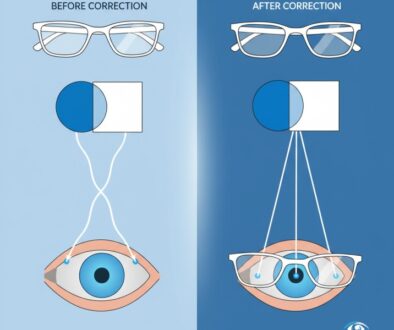

Astigmatism Prescription Explained | Frame & Focus Eye Care
What do CYL and Axis mean on an astigmatism prescription? CYL (Cylinder) measures the degree of astigmatism in your eye — how much your cornea curves unevenly. Axis is the angle (1–180°) that tells your optometrist the exact direction of that curve. Together, these two numbers ensure your lenses correct your astigmatism precisely. Neither number indicates severity alone; both must be read together.
You just left your eye exam. You’re holding a small slip of paper covered in numbers, abbreviations, plus and minus signs — and it might as well be written in another language. You can make out your name at the top. After that? Things get blurry fast.
If that sounds familiar, you are far from alone. At Frame & Focus Eye Care in Richmond, TX, one of the most common questions Dr. Sarah Zaver hears after an exam is some version of: “Can you explain what these numbers actually mean?” That question is completely reasonable. Your prescription is a precise medical document, and understanding it puts you in control of your eye health.
This guide will walk you through every number on your astigmatism prescription — in plain language, no optometry jargon required. By the time you finish reading, CYL, Axis, SPH, ADD, and PD will no longer feel like a secret code. They will feel like exactly what they are: a clear, personalized roadmap to sharper, more comfortable vision.
What Is Astigmatism? A Plain-Language Starting Point
Your eye is ideally shaped like a perfect sphere — smooth and round in every direction, like a basketball. Light entering a perfectly round eye focuses cleanly onto a single point on your retina, producing a sharp, clear image.
Astigmatism happens when the cornea or lens of your eye is shaped more like a football than a basketball — curved more steeply in one direction than another. Because of that uneven curve, light entering your eye focuses at multiple points instead of one, creating images that appear blurry, stretched, or distorted at any distance.
The result is a collection of symptoms that many people simply learn to live with — without realizing there is a straightforward fix. Frequent headaches, eye strain after reading, difficulty seeing clearly at night, and general visual fatigue are all classic signs of uncorrected astigmatism. These are not minor inconveniences. As the team at Frame & Focus likes to say, vision issues are out here trying to ruin our lives — and astigmatism is one of the most common culprits.
The good news: Astigmatism is one of the most common refractive errors in the world, and in the vast majority of cases, it is completely and reliably correctable.
Regular vs. Irregular Astigmatism — What’s the Difference?
Most people have regular astigmatism, where the cornea curves unevenly but in a consistent, predictable pattern. This type responds beautifully to standard glasses and contact lenses.
Irregular astigmatism is less common and involves a more complex, unpredictable corneal surface — often resulting from injury, scarring, or conditions like keratoconus. Irregular astigmatism typically requires a specialty contact lens fitting rather than standard correction. If Dr. Zaver detects signs of irregular astigmatism during your comprehensive eye exam, she will walk you through your options clearly and without alarm.
How to Read Your Astigmatism Prescription — The Full Breakdown
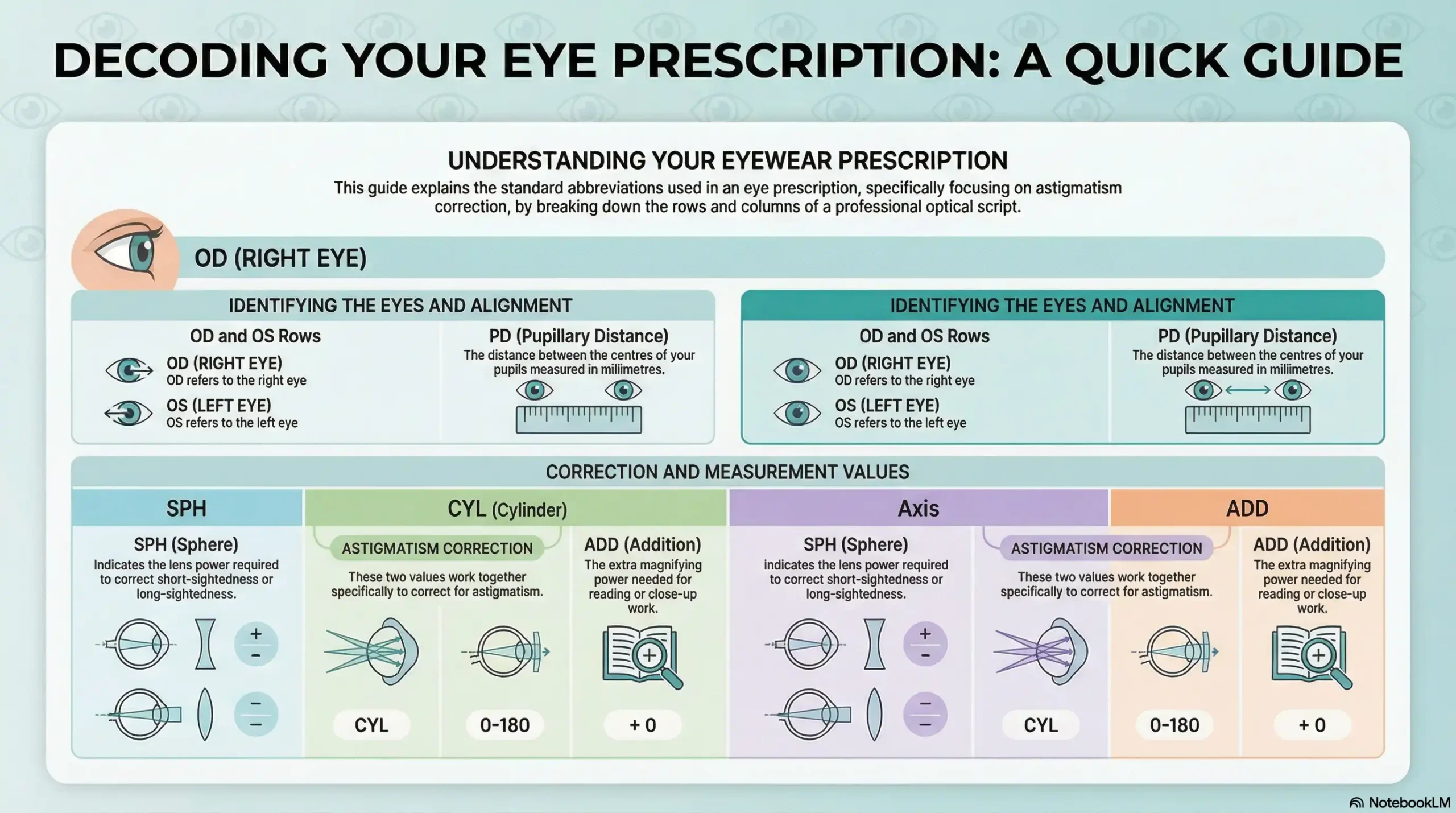
Before diving into CYL and Axis, it helps to understand the basic layout of every eye prescription. Your prescription is divided into sections for each eye, labeled with Latin abbreviations that have been standard in optometry for centuries.
OD (Oculus Dexter) refers to your right eye. OS (Oculus Sinister) refers to your left eye. Occasionally you will see OU (Oculus Uterque), which refers to both eyes together. Within each eye’s row, you will find a series of values — each one measuring a specific aspect of how your eye focuses light.
Here is what each value means.
SPH (Sphere) — Your Base Vision Correction
The SPH value is the starting point of your prescription. It measures the basic focusing power your lenses need to correct nearsightedness or farsightedness — before astigmatism even enters the picture.
A minus (−) SPH value means you are nearsighted: you see nearby objects clearly but struggle with distance. A plus (+) SPH value means you are farsighted: distance may be manageable, but close-up work causes strain. The higher the number — in either direction — the stronger the correction your lenses need to provide for that base refractive error.
CYL (Cylinder) — The Astigmatism Number
This is the number that confuses patients most, and it is the most important value on your prescription if you have astigmatism.
CYL stands for Cylinder, named after the shape of the lens used to correct astigmatism — a cylindrical lens that adds focused power in one specific direction only, compensating for the uneven curve of your cornea. The CYL value measures the degree of your astigmatism: how much additional cylindrical power your lenses need to bring your vision into focus.
Like SPH, CYL values carry a plus or minus sign. This is where patients sometimes get confused — the sign does not indicate “good” or “bad.” It is simply a notation convention that differs between practitioners and lens laboratories. What matters is the number itself and how it works together with your Axis value.
A common question: “Is my CYL number bad?” Here is the straight talk answer. A CYL of −0.25 or −0.50 represents mild astigmatism. Values around −1.00 to −2.00 are moderate. Values above −2.50 are considered more significant — but significant does not mean untreatable. The overwhelming majority of CYL values, even higher ones, are fully correctable with properly fitted glasses or contact lenses.
Axis — The Direction of Your Astigmatism
If CYL tells your lenses how much correction to apply for your astigmatism, Axis tells them exactly where to apply it.
The Axis is expressed as a number between 1 and 180, representing degrees on a circle — essentially a compass direction for your cornea’s steepest curve. An Axis of 90 means the steepest curve runs vertically. An Axis of 180 (or 0) means it runs horizontally. Numbers in between represent diagonal orientations, sometimes called oblique astigmatism.
One of the most important things to understand: your Axis number is not a severity score. A patient with an Axis of 180 does not have worse astigmatism than a patient with an Axis of 45. The Axis simply tells the lab which direction to orient your cylindrical lens correction so that it lines up perfectly with your cornea. Without the correct Axis, even a perfectly calculated CYL value would fail to correct your vision properly.
This is precisely why professional lens fitting matters. Even a small error in Axis orientation — just a few degrees off — can result in blurry, uncomfortable vision or persistent headaches, even with an otherwise accurate prescription.
ADD & PD — The Remaining Prescription Values
ADD (Addition) appears on prescriptions for patients who need bifocal, progressive, or reading lenses — most commonly adults over 40 experiencing presbyopia, the natural age-related loss of close-focus flexibility. The ADD value specifies how much additional magnifying power is added to the lower portion of progressive or bifocal lenses for comfortable near vision.
PD (Pupillary Distance) is the measurement in millimeters between the centers of your two pupils. It is not a measure of how well you see — it is a critical fitting measurement that ensures the optical center of each lens aligns perfectly with your line of sight. An incorrect PD can cause eyestrain, headaches, and visual distortion even from an otherwise perfect prescription. This is one of the key reasons professionally fitted eyewear outperforms self-measured online alternatives every time.
Still have questions about what your prescription numbers mean for your specific vision? Dr. Sarah Zaver and the team at Frame & Focus Eye Care in Richmond, TX are here to walk you through every detail — in plain language, with patience, and without the jargon. Call us at (832) 930-7797 or book your comprehensive eye exam online today.
| Prescription Field | Full Name | What It Measures |
|---|---|---|
| OD | Oculus Dexter | Right eye |
| OS | Oculus Sinister | Left eye |
| OU | Oculus Uterque | Both eyes |
| SPH | Sphere | Base correction for nearsightedness or farsightedness |
| CYL | Cylinder | Degree of astigmatism correction needed |
| Axis | Axis | Directional orientation of astigmatism correction (1–180°) |
| ADD | Addition | Extra magnification for near vision / bifocals |
| PD | Pupillary Distance | Distance between pupils for proper lens alignment |
What Do Your CYL and Axis Numbers Actually Tell You?
Now that you know what each value means individually, let us talk about what they mean together — for your daily life and long-term eye health.
Your CYL and Axis values are a matched pair. They are meaningless without each other. Think of CYL as the strength of the correction and Axis as the direction it needs to be applied. A lens manufactured with the right CYL but the wrong Axis will not correct your astigmatism — it will simply introduce a new distortion in a different direction.
For context on ranges, mild astigmatism (CYL under −1.00) is often barely noticeable in daily life but can still cause fatigue and headaches over time. Moderate astigmatism (−1.00 to −2.00) typically produces more noticeable blurring and strain. Higher values above −2.50 may cause significant visual disruption without correction but remain very treatable with the right lenses and fitting.
Can Astigmatism Get Worse Over Time?
This is one of the most common questions patients ask — and it deserves a direct, honest answer. Yes, astigmatism can change over time. In children and teenagers, the eye is still developing, and prescription values — including CYL and Axis — can shift from year to year. In adults, astigmatism tends to be more stable, though gradual changes are normal, particularly as the eye ages.
This is exactly why annual comprehensive eye exams are not optional — they are essential. Catching a shift in your astigmatism prescription early means your correction stays accurate, your vision stays sharp, and problems like chronic headaches or eye strain do not quietly accumulate. At Frame & Focus Eye Care, we use advanced diagnostic technology — including detailed imaging of the back of your eye — to track your ocular health over time and adjust your care plan proactively.
Astigmatism in Children — Why Early Detection Matters
Children with undetected astigmatism often cannot tell you their vision is blurry — because they have never experienced anything different. Instead, the signs show up as struggles in school: difficulty reading the board, losing their place while reading, frequent headaches, or being mistakenly labeled as inattentive.
At Frame & Focus Eye Care, pediatric eye exams are available starting at six months of age. If astigmatism is detected early, correction can be implemented before it begins to interfere with learning and development. For children also showing signs of progressive myopia alongside astigmatism, Dr. Zaver offers dedicated Myopia Management services — a proactive approach that goes beyond simply correcting current vision to actively slowing the progression of nearsightedness over time.
Correcting Astigmatism — Your Options Explained
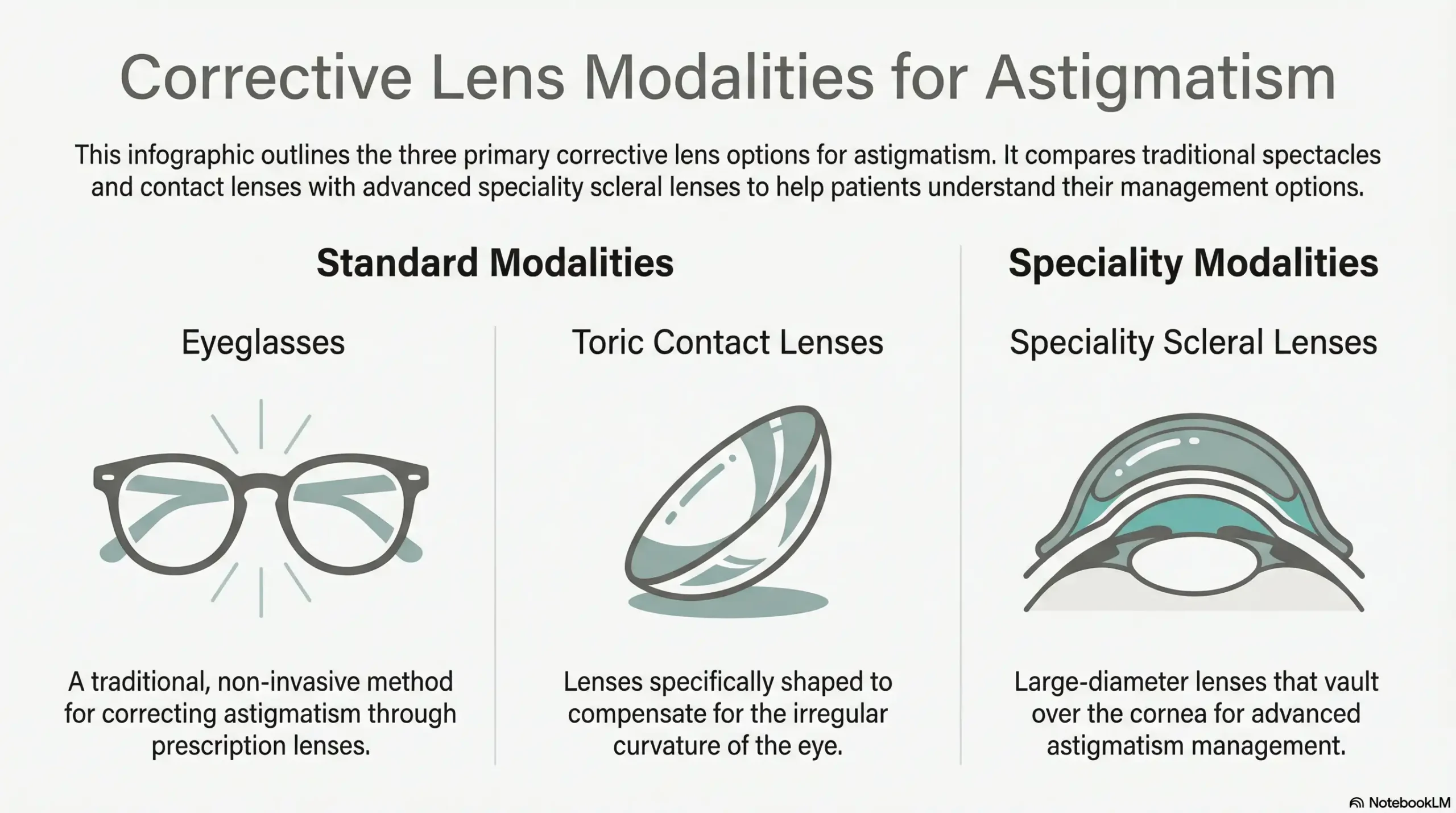
Once your astigmatism prescription is accurate and fully understood, the next step is choosing the right correction. You have three primary options, and the best choice depends on your lifestyle, comfort preferences, and the specific nature of your astigmatism.
Eyeglasses remain the simplest and most reliable correction for most astigmatism patients. The cylindrical lens component is ground directly into your lenses with the precise Axis orientation your prescription specifies. Quality materials and a proper professional fitting are non-negotiable — a lens that is even slightly off-axis can undermine the entire correction.
Toric contact lenses are specially designed soft contacts for astigmatism. Unlike standard spherical contacts that can rotate freely on your eye, toric lenses are weighted and designed to maintain a specific orientation to match your Axis. This makes the fitting process more involved than a standard contact lens fitting — and significantly more important to get right.
Specialty contact lenses — including rigid gas-permeable (RGP) lenses and scleral lenses — are particularly effective for patients with higher degrees of astigmatism or irregular astigmatism. These lenses vault over the irregular corneal surface, effectively replacing it with a perfectly smooth refracting surface.
Why Toric Contact Lenses Require a Specialty Fitting
If you have ever tried toric contacts purchased online or from a provider who did not take the time to assess the fit properly, you may know the uncomfortable result — lenses that rotate out of alignment, vision that fluctuates throughout the day, and that gritty, sandpaper-like sensation that makes you want to remove them within hours.
A proper toric contact lens fitting at Frame & Focus Eye Care involves assessing not just your prescription, but the curvature of your cornea, your tear film quality, and how the lens actually behaves on your specific eye during wear. This is the difference between contacts that feel like a second set of eyes and contacts that feel like a foreign object.
Eyeglasses for Astigmatism — Quality and Fit Matter
The frame and lens quality you choose for astigmatism correction matters more than many patients realize. Cheap online frames that slide down your nose shift your lenses out of optical alignment — effectively changing your Axis orientation with every slip. For a prescription that depends on precise directional placement, that is not a minor inconvenience. It is a direct cause of the headaches and blurry vision you were trying to fix.
At Frame & Focus Eye Care, our eyewear is professionally fitted and built to maintain that fit. And for patients who want a high-quality, stylish option at an accessible price point, our $99 Frame Special includes a frame from our fashionable in-house collection plus standard polycarbonate lenses with anti-reflective coating — everything you need for clear, comfortable vision without compromise.
Frame & Focus Eye Care offers comprehensive eye exams and specialty contact lens fittings for patients throughout Richmond, Pecan Grove, Sugar Land, Rosenberg, and Fulshear. Same-day appointments are available for urgent needs. Call (832) 930-7797 to schedule your visit today.
| Correction Type | Best For | Fitting Complexity | Frame & Focus Service |
|---|---|---|---|
| Eyeglasses | All astigmatism types; simplest option | Standard | Comprehensive Eye Exam + Frame Fitting |
| Toric Contact Lenses | Mild to moderate astigmatism; active lifestyles | Moderate — requires specialty fitting | Specialty Contact Lens Fitting |
| Specialty Lenses (RGP/Scleral) | Higher or irregular astigmatism | Advanced — requires a comprehensive assessment | Specialty Contact Lens Fitting |
When to See an Eye Doctor About Astigmatism in Richmond, TX
Many people walk around with undiagnosed astigmatism for years — not because their symptoms are absent, but because the symptoms are so gradual they become normalized. If you or someone in your family is experiencing any of the following, a comprehensive eye exam is the essential next step.
Persistent headaches — especially after reading, screen time, or close work — are one of the most overlooked signs of uncorrected astigmatism. Blurry or distorted vision at any distance, difficulty seeing clearly at night, frequent squinting to bring things into focus, and eye fatigue or strain that does not improve with rest are all common indicators.
A simple vision screening — the kind offered at schools or DMV offices — is not sufficient to detect or accurately measure astigmatism. Only a comprehensive eye exam, performed by a licensed optometrist using clinical-grade diagnostic equipment, can accurately measure your CYL and Axis values and assess the full health of your eyes.
At Frame & Focus Eye Care, our comprehensive exams go well beyond a letter chart. We use advanced imaging technology — including retinal photography that captures detailed images of the back of your eye — to ensure that your astigmatism assessment is part of a complete picture of your ocular health. Early detection is not just about seeing more clearly today. It is about protecting your vision for the long term.
🔗 Local Resources & Citations
The following authoritative, non-commercial resources can help Richmond, TX residents learn more about astigmatism, understand their patient rights, and verify the credentials of their eye care provider.
1. Texas Optometry Board — Verify Your Eye Doctor’s License
The Texas Optometry Board is the official state licensing authority for all optometrists practicing in Texas. Use their free online license verification tool to confirm that your Richmond eye care provider is fully credentialed and in good standing before your appointment.
2. National Eye Institute (NIH) — Astigmatism Facts
The National Eye Institute explains that astigmatism happens when your cornea or lens has a different shape than normal, causing light to bend differently as it enters your eye. This official NIH resource provides clinically accurate, jargon-free information on astigmatism causes, symptoms, and treatment options directly from federal health researchers.
3. University of Houston College of Optometry — Eye Care Center
The University of Houston College of Optometry is one of only two optometry schools in Texas, and operates the UH Health Eye Care Center — a valuable educational resource for Houston-area patients seeking background on optometric standards, vision research, and the advanced clinical training Texas optometrists receive.
4. Federal Trade Commission — Your Prescription Rights as a Patient
Under federal law, any time your prescriber measures your prescription for eyeglasses or contact lenses, they must give you a copy of your prescription — whether you ask for it or not — at no extra charge. This FTC consumer guide clearly explains your legal right to receive, keep, and use your astigmatism prescription anywhere you choose.
Why Richmond Families Trust Frame & Focus Eye Care for Astigmatism Care
When it comes to something as personal and important as your vision, who you trust matters as much as what they find.
Dr. Sarah Zaver has spent over a decade caring for patients across the Richmond, TX area and surrounding communities — building a reputation not just for clinical precision, but for the kind of patient experience that keeps families coming back year after year. She is consistently described by patients as patient, thorough, personable, and genuinely passionate about her work. Her approach — and the approach of every team member at Frame & Focus — is rooted in one simple commitment: every patient leaves confident that their vision and ocular health were truly prioritized.
That commitment shows up in the details. It shows up in the time taken to explain exactly what your CYL and Axis numbers mean. It shows up in the thorough contact lens fitting that prevents the sandpaper discomfort of ill-fitting toric lenses. It shows up in the warm, unhurried atmosphere that patients describe as feeling like family.
Patient Vasny captured it perfectly: “From calling to make an appointment to picking up my lenses and everything in between, every touch point is met with kindness and warmth.”
With a 4.9-star Google rating across 315 reviews, Frame & Focus Eye Care has earned the trust of families throughout Richmond, Pecan Grove, Sugar Land, Rosenberg, and Fulshear — and we are proud to continue building that trust, one clear prescription at a time.
Your vision deserves more than guesswork. Schedule your comprehensive eye exam with Dr. Sarah Zaver at Frame & Focus Eye Care — proudly serving Richmond, TX and the surrounding communities.
📍 18310 W Airport Blvd #900, Richmond, TX 77407 📞 (832) 930-7797 🗓️ Book online or call today. Same-day appointments available.
Frequently Asked Questions
-
CYL stands for cylinder. It measures the lens power needed to correct astigmatism. A higher number indicates an irregular, football-shaped cornea requiring stronger correction for clear vision.