

Neurolens vs. Prism: Expert Guide to Headaches & Strain Relief
If you are looking for an effective alternative to prism glasses for headaches and eye strain, Neurolens offers a dynamic, contoured solution that traditional fixed prisms cannot match. While standard prism lenses correct misalignment at a single distance, Neurolens technology adjusts in real-time to provide relief across all viewing distances, from your smartphone to the horizon.
The Hidden Cause of Chronic Discomfort: Trigeminal Dysphoria
For countless hours each day, your eyes work together as a synchronized team. But what happens when that team is just slightly out of sync? This subtle, often unnoticeable misalignment forces your visual system to constantly overcompensate, straining the eye muscles. This continuous, low-level effort is what we call Trigeminal Dysphoria.
This strain affects the trigeminal nerve, the largest sensory nerve in the head, which is connected to the eyes and sends signals throughout the head, face, and neck. When the nerve is aggravated by visual misalignment, the result is chronic symptoms that traditional prescriptions often fail to address:
-
Persistent headaches, especially after screen time
-
Tension, pain, or stiffness in the neck and shoulders
-
Intense digital eye strain and fatigue
When patients seek relief from these symptoms, they often hear about two potential solutions: traditional prism lenses and the advanced contoured prism technology of Neurolens. While both involve a prism, the way they work to achieve comfort is fundamentally different.
Traditional Prism Lenses: The Fixed Correction
Traditional prism lenses are a well-established tool in optometry, primarily used to shift the path of light entering the eye. This shifting action can help the two eyes align images more easily.
What Traditional Prism Does Well
A traditional prism is typically prescribed to help correct significant eye muscle imbalances or conditions that result in diplopia (double vision). If your eyes have a large, measurable misalignment that is constant across all viewing distances, a traditional prism prescription can provide relief.
The Limitation of the Fixed Prism
However, a traditional prism provides a fixed, static correction. It is designed to correct misalignment at one specific point or distance.
In our modern world, your visual demands are constantly changing: you look from your computer screen (near) to your colleague across the room (mid-distance) and back to the clock on the wall (distance). A fixed prism correction, while helpful for large, singular issues, may not be optimized for the dynamic, real-world strain of shifting focus multiple times per minute. For many patients with chronic digital eye strain, this fixed approach falls short.
Neurolens: The Dynamic, Contoured Solution
Neurolens represents a major technological leap in treating the underlying cause of Trigeminal Dysphoria. Instead of offering a single, fixed correction, Neurolens uses a contoured prism that dynamically changes power across the lens.
The Power of Dynamic Correction
The core difference is that Neurolens is designed to offer the exact amount of prism correction needed for every distance, seamlessly adjusting as your eyes shift focus from far away to up close.
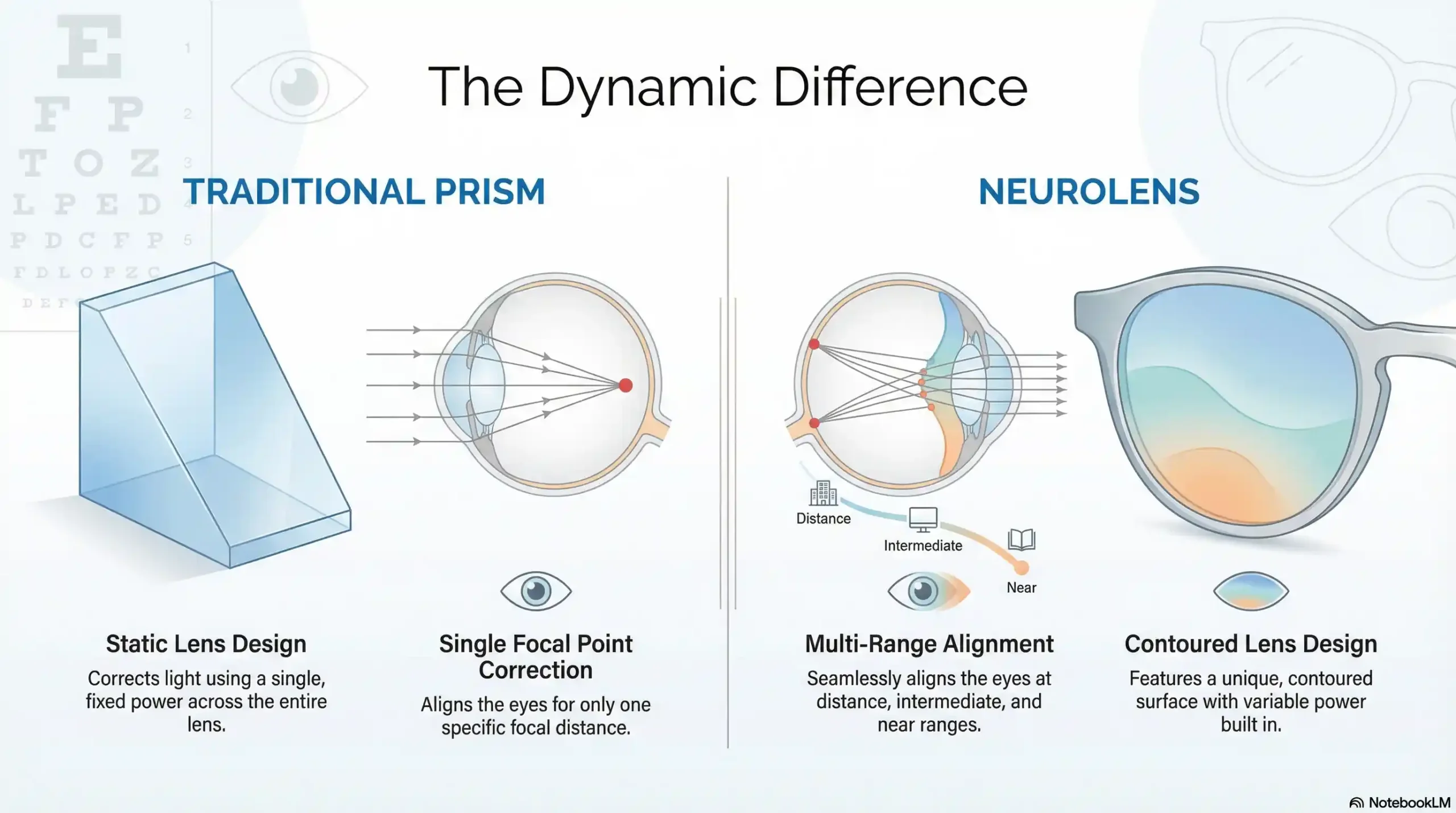
This dynamic approach ensures your visual system is consistently supported, minimizing muscle strain regardless of where you are looking.
Schedule a Neurolens nMD Consultation in Richmond
Precision Measurement: The nMD Device
The accuracy of Neurolens is made possible by the Neurolens nMD measurement device. This is not a standard eye exam. The nMD device objectively measures subtle eye misalignment at both distance and near, capturing over 10,000 data points in minutes.
The resulting data provides a hyper-accurate, customized prism prescription that is unique to you, ensuring the contoured lens provides the precise correction necessary to finally relax your eyes, relieve the trigeminal nerve, and alleviate chronic pain.
Key Differences: Neurolens vs. Traditional Prism
|
Feature |
Traditional Prism |
Neurolens Contoured Prism |
|---|---|---|
|
Correction Type |
Fixed (Static) |
Contoured (Dynamic) |
|
Distances Covered |
Primarily one set distance (e.g., distance or reading) |
All distances (distance, mid-distance, near) |
|
Measurement |
Subjective testing during a standard eye exam |
Objective measurement using the advanced nMD device |
|
Primary Use |
Large, constant muscle imbalances and double vision (diplopia) |
Chronic visual strain, headaches, neck pain, and digital fatigue |
Conclusion: Finding Custom Relief at Frame & Focus
At Frame & Focus Eye Care in Richmond, TX, our goal is to move beyond standard prescriptions to find the real solution for your discomfort. If you suffer from persistent headaches, neck pain, or debilitating digital eye strain, a comprehensive eye exam with Dr. Zaver is the first step.
We leverage the cutting-edge technology of the Neurolens nMD device because we believe in providing customized, objective care that addresses the root cause of your symptoms.
If you’re ready to see clearly and live without the burden of chronic visual discomfort, we warmly invite you to schedule your appointment to determine if Neurolens is the right solution for you.
FAQs
-
Traditional prism offers fixed correction for one distance. Neurolens provides contoured, dynamic correction that changes power across the lens for comfortable vision at all distances.
Please note: None of the above should be considered medical advice. If you have any concerns about your vision, please contact us immediately or consult your primary care provider.