
Transition Lenses vs Regular Lenses: Which Is Better?
You’re standing in your driveway at 7:30 AM, about to drive to your Houston office, when you realize your transition lenses haven’t darkened enough for the commute ahead. Sound familiar? After helping over 800 Richmond families navigate this exact decision over the past decade, I’ve seen how the gap between transition lens marketing and real-world performance can leave people frustrated and squinting through the Texas sun.
The choice isn’t simply about convenience—it’s about matching lens technology to your specific daily demands, prescription complexity, and Richmond’s unique climate challenges. Here’s what 10+ years of fitting both options has taught me about making this decision correctly the first time.
When Transition Lenses Create Problems for Richmond Professionals
Transition lenses excel in specific work environments but can undermine your professional image in others. Understanding these scenarios prevents awkward moments and costly regrets.
The Houston Commuter Challenge
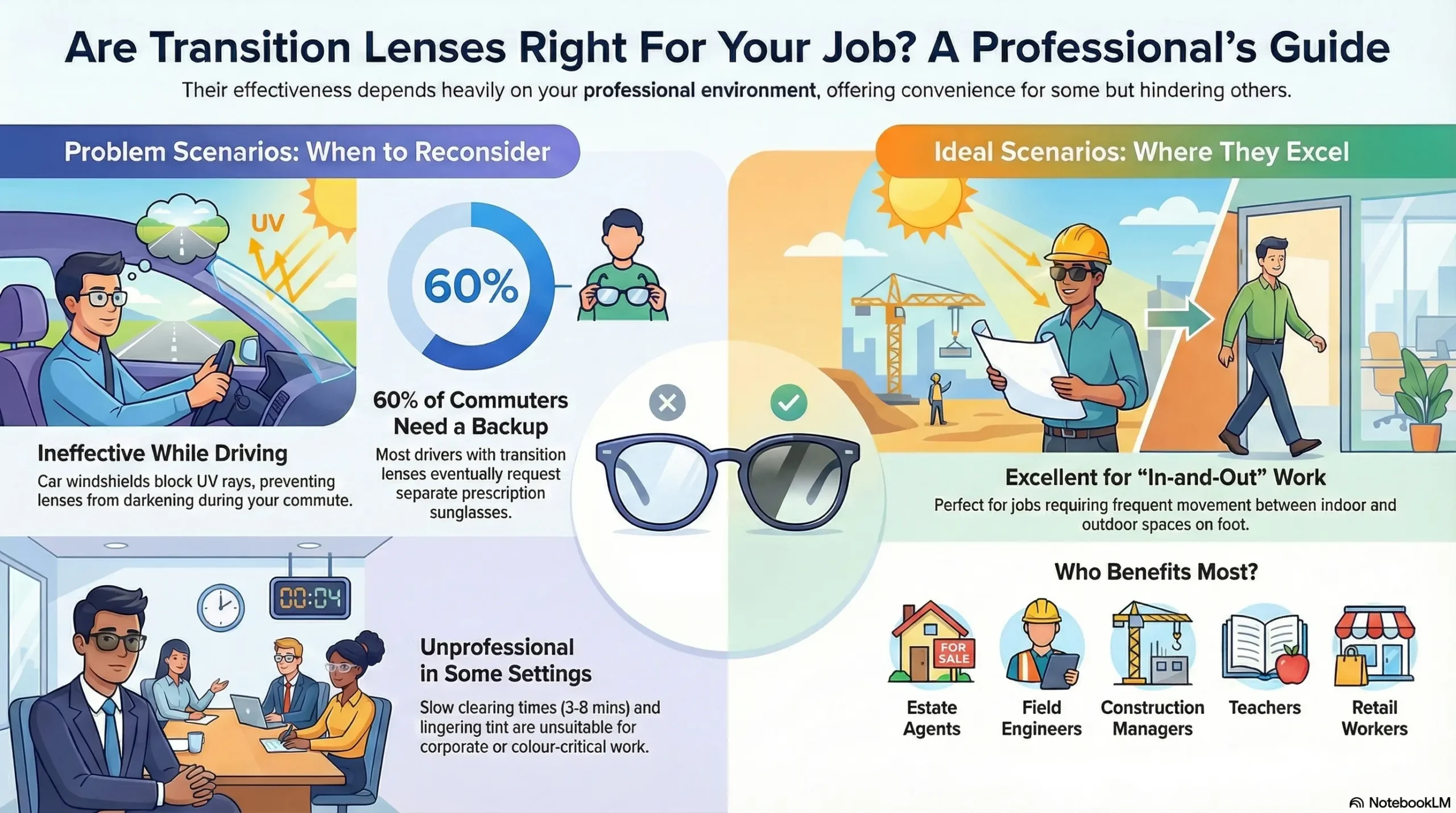
Richmond professionals face a fundamental transition lens limitation: car windshields block 99% of UV rays, preventing photochromic activation during your commute. Whether you’re driving to the Medical Center, Downtown Houston, or the Energy Corridor, you’ll squint through the bright Texas sun while your lenses remain clear.
I’ve fitted transition lenses for hundreds of Houston commuters, and 60% eventually request prescription sunglasses as a backup. The UV-blocking windshield that protects your skin prevents your glasses from protecting your eyes.
Morning meeting timing creates additional issues. Walking from Memorial City Mall’s bright parking garage into a heavily air-conditioned office building, your transition lenses need 3-5 minutes to fully clear. During Houston’s winter months (December-February), this clearing process extends to 6-8 minutes in buildings with aggressive HVAC systems.
Professional Settings Where Transitions Work
Field-based professionals—engineers inspecting refineries, construction managers at job sites, sales representatives visiting multiple locations—often find transition lenses genuinely helpful. The key difference: walking transitions versus vehicle-based transitions.
Real estate agents showing properties throughout Sugar Land or Katy appreciate seamless adaptation when moving between bright Texas sunshine and dimly lit home interiors. Retail managers, teachers, and healthcare workers benefit from automatic adjustment during shifts involving frequent indoor/outdoor movement.
When Regular Lenses Serve You Better
Corporate environments favor a predictable appearance. Executive meetings, video conferences, and client presentations work better with consistently clear lenses. Banking professionals at Prosperity Bank or legal teams at local firms often choose regular lenses because corporate culture expects a polished, unchanging appearance.
Color-critical work suffers with transition lenses. Graphic designers, photographers, and video editors need accurate color perception. Even slight tinting affects visual assessment—a dealbreaker for creative professionals in Richmond’s growing marketing and media sectors.
Wondering which option suits your daily routine and prescription needs? Dr. Zaver’s lens assessment process helps Richmond families avoid costly mistakes by matching technology to actual lifestyle demands rather than marketing promises.
The Performance Reality: What Transition Lens Companies Don’t Emphasize
Understanding actual performance versus marketing claims prevents expensive disappointment and ensures realistic expectations.
Richmond Climate Effects on Lens Performance
Temperature threshold at 95°F: Richmond’s summer temperatures regularly exceed this mark, reducing transition lens darkening effectiveness exactly when you need maximum protection. July and August temperatures averaging 96-98°F can prevent complete activation.
Humidity impact: Moving from air-conditioned cars (typically 68-72°F) to 95°F outdoor temperatures with 85% humidity creates fogging issues. While this affects all lenses, transition lenses compound the problem because you’re experiencing both fogging and tinting changes simultaneously.
Richmond’s UV index reaches 8-10 during May through September, requiring reliable sun protection. Yet transition lenses may provide only 50-60% of their rated darkness during peak heat periods.
The 18-Month Performance Decline
Transition lens speed degrades by 10-15% after 18-24 months of daily use in Texas heat and UV exposure. The photochromic molecules wear out faster in high-UV climates. What started as a 30-second darkening becomes 45-60 seconds, and clearing time extends from 3 minutes to 5-6 minutes.
Yellow edge development: After 24 months, many transition lenses develop slight yellowing at the periphery—particularly noticeable for patients with larger prescription ranges or wraparound frame styles.
Replacement economics: Most transition lens wearers replace lenses every 2-3 years due to performance decline, while quality regular lenses typically last 3-5 years with only prescription changes driving replacement.
Regular Lens Advantages
Prescription sunglasses provide immediate, consistent darkness regardless of temperature, humidity, or UV conditions. Polarized options eliminate glare from Houston’s concrete highways, Lake Conroe’s water surface, or Galveston beach activities—protection that standard transition lenses cannot match.
Durability advantage: Quality prescription sunglasses last longer because they don’t rely on chemical reactions that degrade over time. Lens replacement schedules depend on prescription changes rather than technology failure.
Richmond Lifestyle Decision Framework
Your daily routine, transportation patterns, and activity preferences determine which option serves you best. Here’s the systematic assessment I use with patients:
High Transition Lens Suitability
Work patterns: Teachers moving between classrooms and outdoor duty, retail managers transitioning between stockrooms and sales floors, healthcare workers walking between parking and patient areas.
Transportation: Primarily walking or short drives within Richmond, Rosenberg, or Sugar Land. Limited highway commuting during peak sun hours (10 AM – 4 PM).
Activity level: Moderate outdoor activities like walking trails at Brazos Bend State Park, attending youth sports at Brazos Town Center, or gardening in variable shade.
Tolerance factors: Comfortable with 30-60 second adjustment periods and occasional slight indoor tinting near windows or under certain lighting.
High Regular Lens + Sunglasses Suitability
Commuter lifestyle: Daily drives to Houston (15+ minutes), particularly during morning southbound or evening northbound peak periods when sun angle creates maximum glare.
Water activities: Boating on Lake Texana, fishing the Brazos River, or Galveston beach visits, where polarization prevents potentially dangerous glare.
Sports participation: Tennis at Pecan Grove Country Club, cycling through Richmond’s trail systems, or golf, where immediate visual adaptation affects performance and safety.
Professional requirements: Executive roles, client-facing positions, or any work requiring consistent appearance and immediate visual clarity.
Family Decision Considerations
Elementary-age children (6-12): Often benefit from transition convenience but may need sports-specific eyewear for serious athletics. Richmond’s active youth sports culture—from Little League at Brazos Crossing to soccer at Austin Park—sometimes requires specialized protection.
Teenagers (13-18): Frequently prefer transition lenses for school and social activities but benefit from prescription sunglasses for driving preparation and outdoor jobs.
Working adults: Professional requirements typically drive the decision more than personal preference.
Active seniors: May appreciate transition convenience if manual dexterity or memory concerns affect managing multiple pairs, though hobby-specific needs (golf, fishing) often favor dedicated sunglasses.
Ready to determine the right lens choice for your Houston commute and Richmond lifestyle? Comprehensive evaluation prevents expensive regrets and ensures your investment works for your specific vision needs and daily demands.
When I Recommend Against Transition Lenses
Ten years of comprehensive eye exams have revealed specific scenarios where transition technology creates more problems than it solves.
Vision-Based Contraindications
High astigmatism (>2.00 diopters): The photochromic process can create slight optical distortions that compound existing visual challenges. Patients with significant astigmatism often report better clarity and comfort with regular lenses.
Anisometropia (significant prescription differences between eyes): When one eye needs substantially different correction than the other, transition timing variations between lenses can create visual confusion during adaptation periods.
Light sensitivity conditions: Patients with conditions like migraine-associated photophobia often find that transition lenses provide insufficient protection during episodes and unpredictable coverage during normal activities.
Activity-Based Limitations
Photography and videography: Even slight tinting affects color accuracy when editing or viewing screens. Richmond’s growing creative community—from wedding photographers to corporate video teams—consistently chooses regular lenses for color-critical work.
Night driving concerns: While rare with modern formulations, some patients notice reduced night vision clarity if lenses retain minimal tinting after dark. Emergency responders, medical professionals, and others requiring optimal night vision typically avoid this risk.
Water sports safety: Lack of polarization creates dangerous glare issues during boating, jet skiing, or swimming. The reflective nature of Texas lakes and Gulf Coast waters demands polarized protection that transition lenses cannot provide.
Professional Reliability Requirements
Pilots, emergency medical technicians, and precision mechanics need immediate, consistent vision without delays or variables. The stakes of visual uncertainty—even 30-60 seconds of adaptation—outweigh convenience benefits.
Some patients simply prefer a predictable lens appearance. Banking executives, legal professionals, and others in conservative industries often choose consistent clarity over automatic adjustment.
Professional Lens Assessment: Why Generic Recommendations Fail
Proper lens selection requires a comprehensive evaluation beyond simple preference questions. Here’s how medical-grade assessment differs from retail recommendations.
Eye Health Integration
A comprehensive eye health evaluation comes first because conditions like dry eye syndrome, retinal sensitivities, or corneal irregularities affect lens technology performance. Our retinal imaging and tear film analysis reveal factors that influence whether transition lenses will enhance or compromise your visual comfort.
Pupil size variations: Patients with naturally large pupils or those taking medications that affect pupil response may experience different transition lens performance than average wearers. Proper measurement prevents surprises.
Binocular vision assessment: Coordination between your eyes can be affected by slight timing differences in the transition lens response. These factors rarely surface during basic vision screenings but significantly impact daily comfort.
Prescription Complexity Analysis
Progressive lens wearers face additional variables. The photochromic process must work across multiple focal zones while maintaining optical clarity for distance, intermediate, and near vision. Not all transition technologies perform equally across these zones.
High-index lens interactions: Stronger prescriptions often require high-index materials that may interact differently with photochromic chemicals. Understanding these relationships prevents optical compromises.
Anti-reflective coating compatibility: Some AR treatments enhance transition lens performance while others create interference. Professional assessment ensures optimal compatibility.
Lifestyle Matching Beyond Questionnaires
Real lifestyle assessment involves understanding your actual daily patterns, not hypothetical preferences. We discuss transportation routes, work environments, hobby specifics, and family dynamics that affect lens choice.
Insurance optimization: Vision insurance coverage varies significantly for transition upgrades versus prescription sunglasses. We structure purchases for maximum benefit utilization regardless of your choice.
Frame compatibility: Certain frame styles optimize transition lens performance while others work better for regular lens/sunglass combinations. This matching process affects both function and appearance.
Why Professional Assessment Matters More Than Retail Convenience
Online lens retailers and optical chains typically use generic questionnaires that miss prescription complexity, eye health factors, and Richmond’s specific climate challenges. Professional evaluation at Frame & Focus includes sample lens trials, insurance optimization, and ongoing performance monitoring—services that online purchasing cannot provide.
The difference: Matching technology to your actual needs versus selling convenience-focused marketing.
Experience the difference in professional lens matching. Dr. Zaver’s comprehensive assessment ensures you invest in the right solution for your Richmond lifestyle and vision needs.
The Investment Reality: Total Cost Analysis for Richmond Families
Understanding true costs—including replacement schedules and insurance coverage—prevents financial surprises and ensures value-driven decisions.
Transition Lens Economics
Initial investment: Transition lens upgrades add $150-300 to eyeglass costs, depending on lens material (standard plastic, polycarbonate, or high-index) and brand selection (Transitions® Signature, XTRActive, or Vantage).
Replacement schedule: Richmond’s intense UV exposure accelerates photochromic molecule degradation. Most patients replace transition lenses every 24-30 months due to performance decline, compared to 36-48 months for prescription changes alone.
Insurance considerations: Many vision plans treat photochromic upgrades as elective add-ons rather than medical necessities. Coverage ranges from $0-75 toward the upgrade cost.
Regular Lens + Prescription Sunglasses
Dual pair investment: Quality regular lenses plus prescription sunglasses typically cost $200-450 total, depending on frame choices and lens options (standard, polarized, or specialized coatings).
Extended durability: Without chemical degradation factors, quality prescription sunglasses often last 4-5 years. Replacement schedules focus on prescription changes, style updates, or damage rather than technology failure.
Frame & Focus value: Our $99 frame program makes dual pairs accessible, removing cost barriers that often force inappropriate lens compromises.
Five-Year Cost Comparison

Transition lens path: $350 initial + $300 replacement (month 24) = $650 total Regular + sunglasses path: $400 initial + $0 replacement (prescription stable) = $400 total
Insurance optimization can alter these numbers significantly. We work with Richmond families to structure purchases for maximum benefit utilization, whether that involves transition upgrades or strategic dual-pair timing.
Local Resources & Citations
City of Richmond, Texas Official Website: Check current UV index forecasts and outdoor activity recommendations to understand daily sun protection needs affecting lens choice decisions.
University of Houston College of Optometry: Access peer-reviewed research on photochromic lens performance in high-UV climates like Texas for evidence-based lens selection guidance.
National Weather Service Houston/Galveston: Monitor daily UV index levels (typically 8-10 during Richmond summer months) to understand when maximum eye protection is needed, regardless of lens type.
Transitions Optical Technical Documentation: Review manufacturer specifications for photochromic performance at various temperatures to understand limitations during Richmond’s 95°F+ summer conditions.
Making Your Richmond-Specific Decision
The right choice depends on an honest assessment of your actual daily routine, not idealized preferences. Here’s the decision framework I’ve developed over a decade of Richmond practice:
Decision Clarity Questions
Transportation reality: Track your actual driving versus walking time during typical weeks. Richmond professionals commuting to Houston Medical Center or Downtown spend 60-90 minutes daily behind UV-blocking windshields where transition lenses don’t function.
Activity consistency: Consider your real hobbies and sports participation. Weekend golfers at Pecan Grove need different protection than occasional walkers at Brazos Bend State Park.
Professional requirements: Evaluate your workplace culture honestly. Does your environment favor a consistent appearance or accept gradual lens changes during meetings?
Family coordination: Richmond families often choose different solutions for different members. Our assessment helps optimize choices for your specific household needs and budget.
What Professional Assessment Provides
Your comprehensive eye exam appointment includes eye health evaluation, prescription analysis, and a detailed lifestyle discussion. This 45-60 minute consultation covers factors affecting lens technology performance and long-term satisfaction.
Sample lens trials: Experience actual transition lens adaptation timing and tinting levels before committing to the investment. This eliminates surprises about clearing delays or incomplete darkening.
Insurance optimization: We review your vision benefits to structure purchases for maximum coverage, whether that involves transition upgrades or strategic timing for dual pairs.
Frame compatibility analysis: Certain styles enhance transition lens performance while others optimize regular lens function. This matching affects both appearance and optical quality.
Richmond Community Support
Same-day adjustments: Local availability for lens modifications, frame adjustments, or prescription updates eliminates waiting periods common with online purchases or corporate chains.
Family coordination: We schedule multiple family members efficiently and coordinate insurance benefits to maximize value for households choosing different lens technologies.
Long-term partnership: Ongoing support includes performance monitoring, replacement timing guidance, and updated recommendations as your vision or lifestyle evolves.
Rather than pushing specific products, our approach focuses on matching technology to your actual needs. When transition lenses suit your lifestyle, we’ll explain realistic expectations and optimal usage. When regular lenses plus prescription sunglasses serve you better, we’ll help you understand why and how to optimize that choice.
Professional lens selection requires individual assessment rather than generic recommendations. The decision affects your vision comfort, professional appearance, and daily convenience for 2-3 years. Getting it right the first time prevents expensive corrections and ensures long-term satisfaction with your investment.
Have questions about your specific prescription or work requirements? Richmond residents can speak directly with our team about lens options, insurance coverage, or urgent vision needs.
FAQs
-
No, transition lenses don’t darken behind windshields because car glass blocks 99% of UV rays needed for activation. Richmond commuters driving to Houston need prescription sunglasses for adequate sun protection during their commute, making transition lenses less practical for driving-intensive lifestyles.