Vision Therapy
If you struggle with persistent headaches, double vision, or “brain fog” after screen use despite having 20/20 vision, your eyes and brain may not be communicating correctly. Our personalized vision therapy in Richmond, TX, uses neuroplasticity to retrain your visual system, providing a non-invasive, drug-free solution for Binocular Vision Dysfunction (BVD) and tracking issues.
[Schedule Your Functional Vision Evaluation in Richmond]
Key Takeaways
-
VT is Not Just for Kids: While commonly associated with children, adults can significantly benefit from Vision Therapy to resolve long-standing visual discomfort and poor performance.
-
Target the Root Cause: VT is a non-invasive, drug-free treatment that trains the visual system to work efficiently, solving underlying issues that cause headaches, double vision, and eye strain.
-
Skills for Daily Life: Therapy improves vital skills like tracking moving objects, judging depth perception (for mobility), and maintaining clear focus when shifting distances (for driving or computer work).
-
Personalized & Supervised: Treatment plans are custom-tailored to your unique needs and conducted under the expert supervision of an eye doctor in scheduled, typically weekly, in-office appointments.
-
Safe Alternative: Vision Therapy is a safe, painless, and highly effective alternative to conventional surgical solutions for many common binocular (two-eye) vision issues.
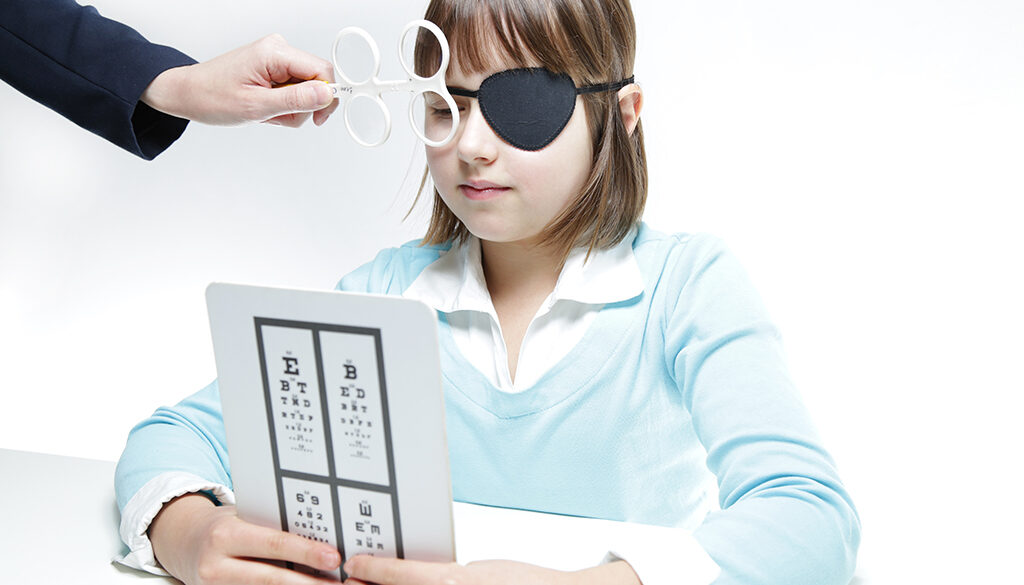
Vision therapy is a treatment plan designed to develop and enhance a patient’s visual skills and abilities, ultimately making their day-to-day life easier. You may also hear Vision Therapy referred to as VT. Although most commonly associated with children, whose visual skills are still naturally developing, adults can also benefit from vision therapy.
Key Visual Skills Improved Through Functional Vision Therapy
Skills that can be developed and improved through vision therapy
Vision therapy is an effective way of developing and improving the following visual skills, all of which are important for day-to-day life.
- Tracking: this refers to the ability to follow a moving object smoothly and accurately with both eyes, such as moving traffic or a ball coming towards you.
- Depth Perception: this is the ability to judge relative distances of objects and move accurately in a 3D space – for example, being able to walk down a flight of stairs.
- Peripheral vision: This refers to the edges of your vision and your ability to assess what’s happening in your peripheral vision while paying attention to something directly in front of you.
- Acuity at different distances: this is the stationary see clearly enough to identify and understand objects at both near and far distances.
- Fixation: enabling patients to quickly and accurately look at, identify, and understand stationery objects one after the other, for example, reading word to word.
- Binocular vision: the ability for both eyes to work together in perfect synchronization.
- Shifting focus: patients with this skill can look quickly at different distances without momentary blur.
- Visualization: a valuable visual skill that enables patients to form and retain images in their heads.
The Science of Change: Why Your Brain is the Key to Clearer Vision
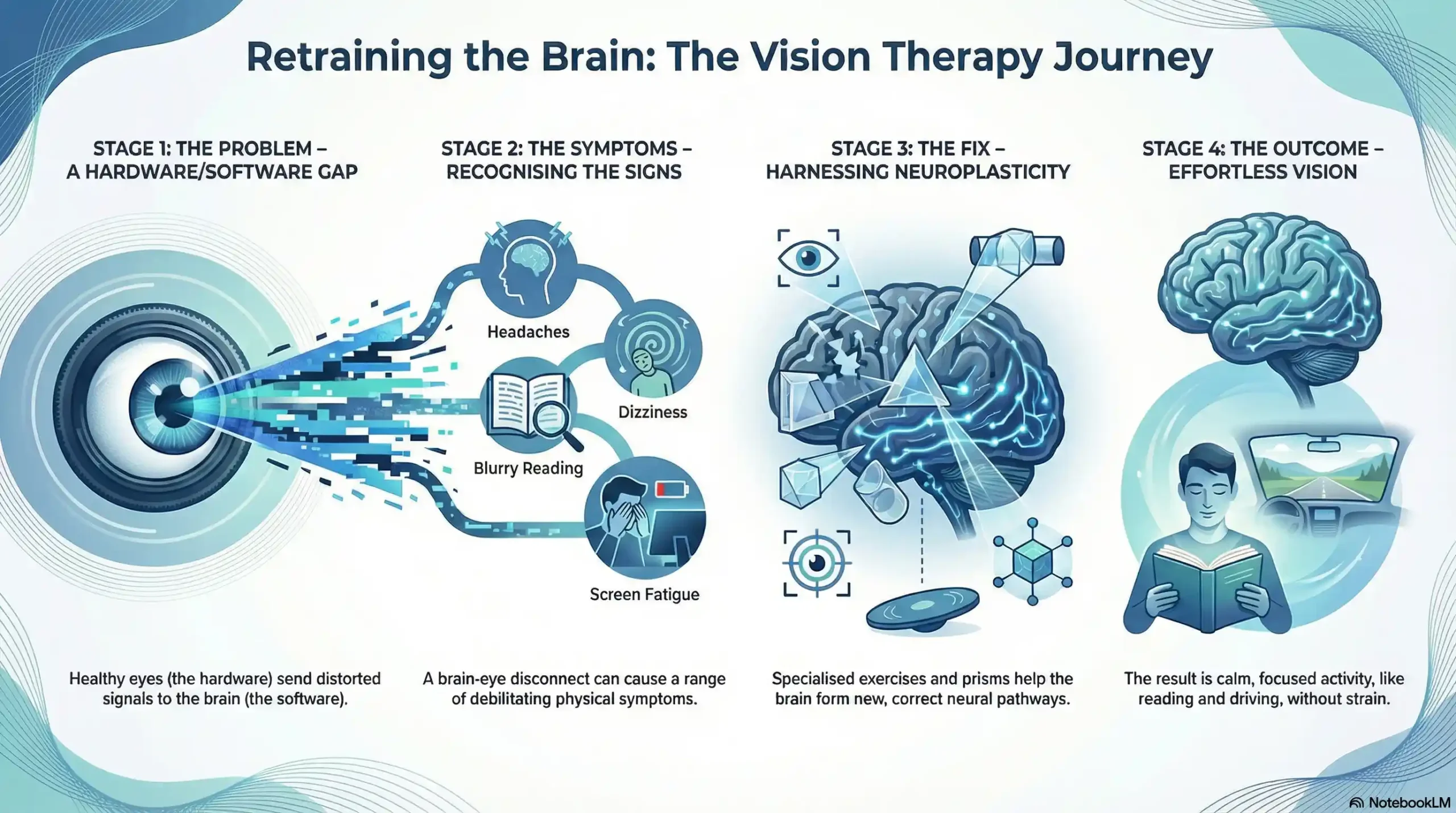
Many people think vision happens only in the eyes. In reality, your eyes are just the cameras—your brain is the processor. This is why some patients have “20/20” vision on a wall chart but still struggle with headaches or reading; the “software” (the brain) isn’t communicating correctly with the “hardware” (the eyes).
At Frame & Focus Eye Care, our therapy programs leverage neuroplasticity. This is the brain’s remarkable ability to reorganize itself by forming new neural connections. Through repetitive, targeted exercises, we “rewire” how your brain processes visual information.
-
For Kids: We capitalize on a developing system to build strong foundations during pediatric eye exams.
-
For Adults: We prove that “you can teach an old dog new tricks.” Even decades-old visual habits can be corrected by retraining the neural pathways.
What to expect from a vision therapy appointment?
Vision therapy is generally conducted as an in-office treatment, under the hour-long supervision of your eye doctor. Each vision therapy treatment plan is personalized, tailored to the specific individual needs of each patient. Most patients can expect to schedule hour appointments once or twice a week. You may also be given specific exercises to complete at home, which will support the progress that you are making during your in-office appointments. The components of Vision Therapy Treatment are non-invasive and drug-free, making VT suitable for the vast majority of patients, regardless of their age, health, and history. For many people, vision therapy is a safe alternative to conventional eye surgeries.
Various techniques can be involved in vision therapy. These include, but aren’t limited to:
- Prisms
- Patches
- Occluders
- Therapeutic lenses
- Exercises
- The use of tools designed specifically for use in vision therapy exercises
By attending regular activity therapy appointments, patients can see an improvement in their vision, visual comfort, and experience an overall improvement with the ease with which they use their eyes for daily activities.
The Hidden Culprit: Understanding Binocular Vision Dysfunction (BVD)
Have you ever felt dizzy in a grocery store aisle or experienced “shadowing” around text? You might be suffering from Binocular Vision Dysfunction (BVD). This occurs when your two eyes are slightly misaligned, forcing your brain to work overtime to fuse two different images into one.
This constant “micro-correction” leads to common complaints for the Solution-Seeker:
-
Persistent Headaches & Migraines: Often felt right above the eyebrows.
-
Anxiety in Crowds: Too much visual movement overwhelms the misaligned system.
-
Neck and Shoulder Tension: Caused by tilting your head subconsciously to “fix” the misalignment.
Our diagnostic process goes beyond the standard eye chart to identify these tiny misalignments. By combining Vision Therapy with advanced tools like Neurolens, we can often provide relief where traditional glasses have failed.
Survival Guide for the 8-Hour Screen Day
In today’s digital world, our eyes were never designed to stare at a glowing rectangle 10 inches from our faces for hours on end. This has led to an epidemic of Computer Vision Syndrome (CVS).
While “blue light blockers” are a popular trend, they are often a Band-Aid for a deeper problem: Focusing Stamina. At our Richmond, TX office, we help professionals build the visual endurance needed for high-demand careers.
How Vision Therapy solves Digital Eye Strain:
-
Improving Flexibility: Training your eyes to shift focus from the screen to the boardroom wall effortlessly.
-
Reducing “Nearpoint Stress”: Relaxing the overactive focusing muscles that cause that “heavy eye” feeling by 3 PM.
-
Blinking Habits: Retraining the neurological trigger to blink, which is a key component of our dry eye treatment.
Your Roadmap to Success: The Frame & Focus Process
We believe in “straight talk.” Vision therapy isn’t a “quick fix”—it’s a physical therapy program for your sight. Here is how we get you from frustrated to clear and confident:
-
The Functional Vision Evaluation: This is a deep dive. Dr. Zaver uses state-of-the-art technology to map how your eyes track, team, and focus.
-
The Custom Plan: No “cookie-cutter” exercises. Your program is built specifically for your goals (e.g., “I want to read for an hour without a headache”).
-
In-Office Coaching: Weekly 1-on-1 sessions with a specialist to ensure every exercise is performed with the correct “brain-body” connection.
-
The Home Integration: Short, 15-minute daily “boosts” at home to lock in the progress we make in the clinic.
Further Resources and Citations
For more in-depth, authoritative information on Vision Therapy, its applications, and its effectiveness, please consult the following trusted organizations:
-
American Academy of Optometry (AAO)
-
Resource Focus: The AAO provides research-backed information and clinical guidance on various optometric specialties, including the use of Vision Therapy for binocular vision disorders.
-
-
College of Optometrists in Vision Development (COVD)
-
Resource Focus: COVD is a board-certifying organization dedicated to developmental and behavioral optometry. It is a leading source for information on how visual skills relate to learning and daily performance.
-
According to the College of Optometrists in Vision Development (COVD), supervised in-office therapy combined with home reinforcement shows significantly higher success rates than “at-home only” programs. If you’re ready to start, book your consultation here.
FAQs
-
VT is a personalized, non-invasive treatment plan using lenses, prisms, patches, and specific exercises to retrain the brain and eyes for improved coordination.