Amblyopia
Amblyopia, commonly known as a lazy eye, is a developmental brain-vision connection issue that affects depth perception and visual acuity. While early pediatric diagnosis is vital for a complete recovery, modern breakthroughs in neuroplasticity mean that adult lazy eye treatment is now highly effective through vision therapy and VR-based dichoptic training.
Schedule a Comprehensive Functional Vision Exam
Key Takeaways
-
Amblyopia is a Brain Problem, not a “Lazy” Eye: It’s a developmental issue where the brain actively ignores input from the weaker eye, not an inherent problem with the eye muscle itself.
-
The Power of Early Intervention: Treatment for amblyopia is most effective when started in early childhood, significantly increasing the chance of a complete visual recovery.
-
Don’t Rely on Obvious Symptoms: Many children with unequal vision don’t show visible signs. The only reliable way to identify and treat the condition is through comprehensive, regular eye examinations.
-
Schedule Critical Eye Checks: Ensure your child has a professional eye exam before they are 3 months old, between 6 and 12 months, and at ages 3 and 5.
-
Modern Treatment is Multi-Faceted: Treatment goes beyond patching and may include corrective glasses, Atropine drops to blur the stronger eye, and vision exercises/games to stimulate the affected eye.
-
Amblyopia Will Not Resolve on Its Own: If left untreated into preteen or adult years, treatment becomes longer, more complex, and often less successful.
Amblyopia, also known as a “lazy eye”, is described as a reduced vision in one eye compared to the other. Some rare forms of amblyopia involve both eyes. Amblyopia is the most common cause of partial or total blindness in one eye in children.
The term lazy eye is misleading because the eye is not actually lazy. In fact, it is a developmental problem in the nerve connecting the eye to the brain, affecting the brain’s ability to use both eyes together. It is not a problem in the eye itself, but in the brain, which actively ignores the visual input from the misaligned eye, leading to amblyopia in that eye.
In addition to poor visual acuity, people with amblyopia are more prone to having difficulties with depth perception, eye movements related to reading, and visual decision-making while driving.
Refractive Amblyopia: The “Silent” Vision Thief
Does your child have a “straight” eye but still struggle with vision? They may have Refractive Amblyopia. This is the “silent” version of the condition because, unlike a crossed eye (strabismus), there is no visible sign that anything is wrong. It happens when one eye has a significantly different prescription than the other.
The brain, unable to fuse these two blurry and clear images, simply “turns off” the weaker eye.
-
The Danger: Because the eyes look normal, these children often pass basic school vision screenings.
-
The Solution: Only a Comprehensive Pediatric Eye Exam can catch this. We use state-of-the-art technology to detect these “hidden” barriers before they impact your child’s academic success.
What Are The Causes of Amblyopia?
Amblyopia develops in childhood due to:
- Significant differences in the prescription (refractive) status between the two eyes due to nearsightedness, farsightedness, or astigmatism;
- Constantly misaligned eyes or crossed eyes (strabismus);
- An obstruction of vision in early childhood,d i..,e. cataract, ptosis (droopy eyelid)
It is important to note that, because amblyopia is typically a problem of infant vision development, symptoms of the condition can be difficult to detect. Symptoms may include noticeably favoring one eye over the other, an eye turn (either upward-downward, outward, or inward), or a tendency to bump into objects on one side.
The best way to identify children who are at risk for or already have amblyopia is by performing comprehensive eye examinations.
How Is Amblyopia Treated?
Amblyopia can be treated at any age, although the earlier the problem is found and treated, the more successful the outcomes tend to be.
Many children who have anisometropia or unequal vision do not know they have an eye problem because the stronger eye and the brain compensate for that shortage. Over time, the weaker eye gets progressively worse, and amblyopia develops.
The “Critical Period” Myth: Can Adults Be Treated?
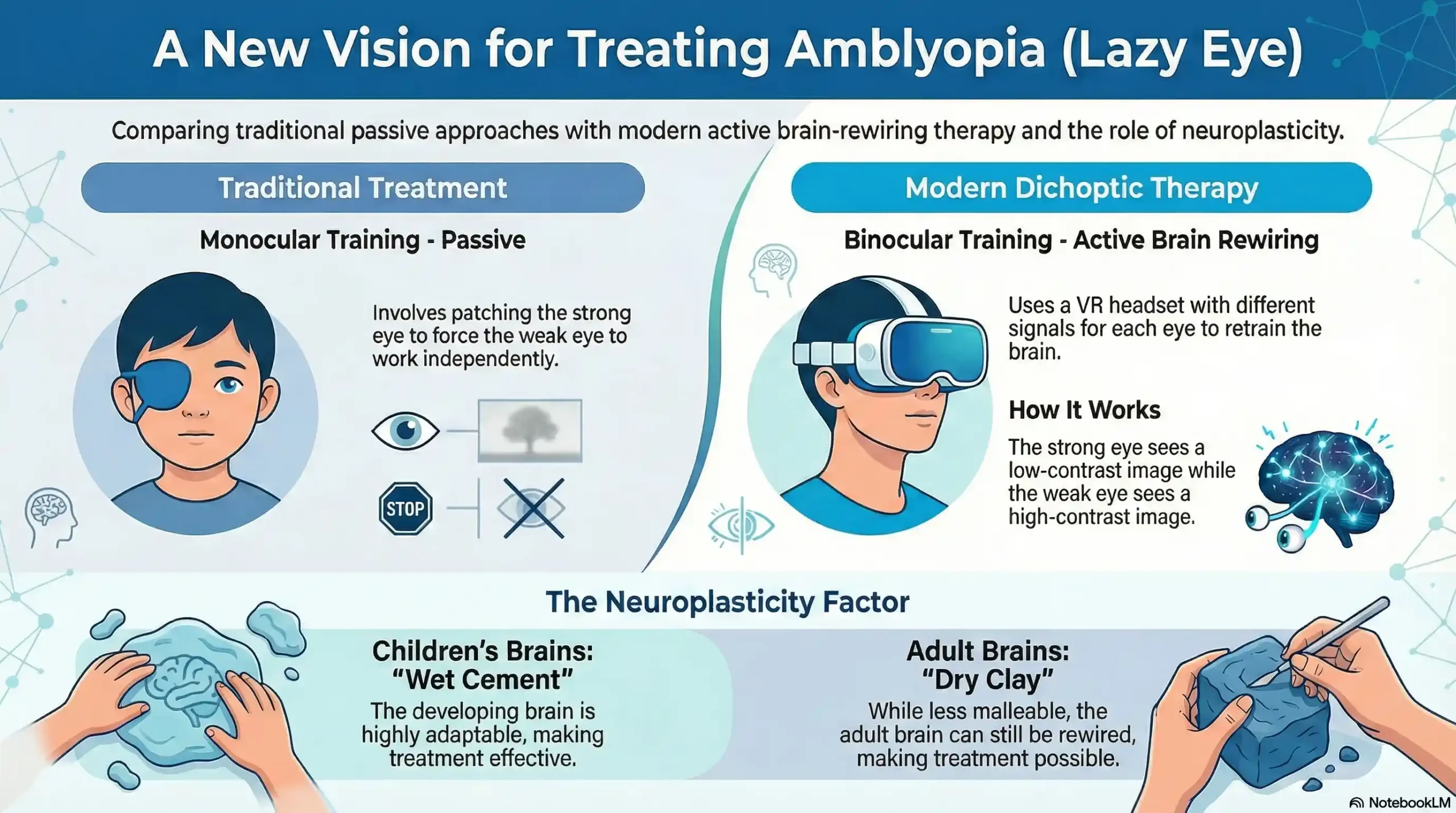
For decades, the medical world believed that if you didn’t fix a “lazy eye” by age seven, the window was closed forever. We now know that’s simply not true. Thanks to a biological phenomenon called neuroplasticity, your brain remains capable of “rewiring” itself and forming new visual connections well into adulthood.
At Frame & Focus Eye Care, Dr. Sarah Zaver utilizes advanced protocols that go beyond “old school” patching. While a child’s brain is more like wet cement—easily molded—an adult’s brain is like dry clay; it takes more effort to reshape, but with modern Vision Therapy and binocular training, significant gains are possible. Recent clinical evidence from 2024-2025 shows that adults can achieve high success rates in improving visual acuity and depth perception when following a structured, specialist-led program.
Treatment may include
Glasses
To correct nearsightedness, farsightedness, or astigmatism. Glasses may also correct an eye turn. Sometimes, glasses solve the amblyopia, and no further treatment is required.
Cataract surgery
If a cataract is the cause of amblyopia, it can be removed surgically under either local or general anesthesia.
Correcting droopy eyelids
In some cases, amblyopia is caused by an eyelid that is blocking the vision to the weaker eye; in such cases, the usual treatment is surgery to lift the eyelid. Once the vision is corrected and any underlying medical issues are treated, there are several other ways to help improve vision and get the lazy eye to work.
Using an eye patch
For the better-seeing, an eye patch may be required for several hours each day or all day long and may continue for weeks or months. A child should be encouraged to do close-up activities while wearing the patch, such as schoolwork, reading, or coloring. (Patches can be made colorful and fun to help the child accept them)
Atropine eye drops
Used to blur vision in the unaffected eye. Atropine is usually less awkward for the child, compared with a patch, and can be just as effective. Thus, children who cannot tolerate wearing a patch may be prescribed eye drops instead.
Vision exercises
This involves different exercises and games to improve vision development in the child’s affected eye, which may be done in combination with other treatments.
Surgery
It is sometimes performed to improve the appearance of an eye turn, resulting in better alignment of the eyes. This may or may not improve vision.
The “Neurolens” Connection: Relieving Chronic Strain
Many patients with Amblyopia suffer from chronic headaches, neck pain, and digital eye strain without realizing the cause is actually their eyes. This is often due to Trigeminal Dysphoria—a condition where the brain and eyes struggle to stay aligned, putting massive pressure on the trigeminal nerve.
As a specialized provider of Neurolens in Richmond, Dr. Zaver uses proprietary “contoured prism” technology to fix this misalignment. Unlike standard glasses, Neurolenses are custom-designed to bring your eyes into perfect harmony at all distances—reading, computer work, and driving.
The Digital Frontier: VR and Gaming as Medicine
The most exciting breakthrough in eye care is the shift from “covering the good eye” to “training both eyes together.” This is known as Dichoptic Therapy. Instead of a bulky eye patch, we now use immersive Virtual Reality (VR) and specialized video games.
How it works: Through a VR headset, the “strong” eye is shown lower-contrast images, while the “weak” eye is stimulated with high-contrast, high-action visuals. This forces the brain to stop ignoring the signals from the amblyopic eye and start using both eyes as a team.
-
Engagement: Kids (and adults!) are much more likely to stick with a treatment that feels like a game.
-
Effectiveness: This binocular approach is a core part of our pediatric eye care and myopia management philosophy, aiming for faster results than traditional patching alone.
When should children be checked for amblyopia?
Amblyopia often starts before there are any obvious signs that something is wrong. This is why babies and young children should have their eyes regularly checked. According to research, children should have eye examinations at the following times:
- Before the child is 3 months old
- Between 6 months and 1 year of age
- At 3 years of age
- At 5 years of age
External Resources and Citations
For further information on Amblyopia and pediatric vision health, we recommend the following external resources:
-
American Academy of Ophthalmology (AAO): A trusted source providing detailed clinical information on amblyopia causes, symptoms, and treatment guidelines for patients and practitioners.
-
Citation: Amblyopia (Lazy Eye) – AAO
-
-
National Eye Institute (NEI): Part of the National Institutes of Health (NIH), the NEI offers research-backed, public-facing health information on eye disorders and clinical trials.
-
Citation: Facts About Amblyopia – NEI
-
If there are any concerns that the child may be suffering from or developing a “lazy eye,” have him/her examined right away. Children with a family history of amblyopia are at a higher risk of developing it themselves.
Early diagnosis and treatment increase the chance of a complete recovery. Amblyopia will not go away on its own. If not diagnosed until the preteen, teen, or adult years, treatment will take longer and is often less effective. The sooner the treatment begins, the better.
FAQs
-
Amblyopia is reduced vision in one eye caused by a brain-eye connection developmental issue. It’s called “lazy eye” because the brain actively ignores the weaker eye’s input.