Pediatric Eye Exams
A pediatric eye exam does more than check for 20/20 vision; it identifies functional issues like Prism Correction needs, binocular vision dysfunction, and tracking errors that school screenings often miss. Whether your child is struggling with reading, showing signs of ADHD-linked vision issues, or needs a routine checkup, our Richmond specialists use the 2025 Myopia Management Protocol to protect their long-term sight.
Is your child struggling with reading or focus? [Schedule a Binocular Vision Assessment Today]
Key Takeaways for Parents
-
Schedule Early and Often: A child’s initial eye screening should happen between 6 and 12 months of age, followed by routine comprehensive exams every two years until age 18.
-
Vision is Tied to Success: Good eyesight is fundamentally critical for school performance, affecting activities like reading, using computers, and even participation in sports.
-
Look Beyond the Squint: Besides obvious signs (like squinting or blurry complaints), watch for subtle red flags such as a short attention span, quickly losing interest in focused games, or tilting the head to see better.
-
The earlier, the Better: Timely detection and treatment of issues like lazy eye (amblyopia) or misaligned eyes (strabismus) in the preschool years ensures the highest chance of successful, lifelong vision correction.

-
Myopia is Common: Nearsightedness (myopia) is the most frequent refractive error in school-age children and can be effectively managed with eyeglasses and specialized treatments.
Regular eye exams are important for children since their eyes can change significantly in as little as a year as the muscles and tissue develop. Good eyesight is critical for a child’s life and achievements since success in school is closely tied to eye health. School demands intense visual involvement, including reading, writing, using computers, and blackboard/smartboard work. Even physical activities and sports require strong vision. If their eyes aren’t up to the task, a child may feel tired, have trouble concentrating, have problems in school, or have difficulty playing their favorite games, which may affect their overall quality of life.
When to Perform a Pediatric Eye Exam?
According to research, a child should have an initial screening between 6 and 12 months of age. After that, routine eye health and vision screenings throughout childhood should be performed in order to help detect any abnormalities as their eyes develop. Then, unless otherwise recommended, every two years thereafter until the age of 18.
For a newborn, an optometrist should examine the baby’s eyes and perform a test called the “red reflex test,” which is a basic indicator that the eyes are normal. In a case where the baby is premature or at high risk for medical problems for other reasons, has signs of abnormalities, or has a family history of serious vision disorders in childhood, the optometrist should perform a comprehensive exam.
A second eye health examination should be done for infants between six months and their first birthday. This examination includes tests of pupil responses to evaluate whether the pupil opens and closes properly in the presence or absence of light, a fixate and follow test to determine whether the baby can fixate on an object such as a light and follow it as it moves, and a preferential looking test which uses cards that are blank on one side with stripes on the other side to attract the gaze of an infant to the stripes and thus vision capabilities can be assessed. Infants should be able to perform this task well by the time they are 3 months old.
For a Preschooler, between the ages of 3 and 3½, a child’s visual acuity and eye alignment should be assessed. If the child is diagnosed with misaligned eyes (strabismus), “lazy eye” (amblyopia), refractive errors (astigmatism, myopia, hyperopia), or any other focusing problems, it’s important to begin treatment as soon as possible to ensure successful vision correction and lifelong benefits.
At school age or upon entering school, the child’s eyes should be screened for visual acuity and alignment. In this age group, nearsightedness (myopia) is the most common refractive error and can be corrected with eyeglasses.
The 2025 Myopia Management Protocol: Beyond Standard Glasses
At Frame & Focus Eye Care, we often tell parents, “Standard glasses are a tool to see, but Myopia Management is a health treatment.” In 2025, simply increasing the strength of your child’s prescription every year is no longer the clinical standard.
Dr. Sarah Zaver utilizes state-of-the-art technology to monitor Axial Length—the physical growth of the eye. By slowing this growth, we significantly reduce the long-term risk of retinal detachment and glaucoma.
-
Ortho-K (Orthokeratology): “Magic” overnight lenses that reshape the cornea while your child sleeps, providing clear vision all day without glasses.
-
Low-Dose Atropine Drops: A simple nightly drop proven to signal the eye to slow its elongation.
-
MiSight® Lenses: The first FDA-approved daily soft contact lenses designed specifically to slow myopia progression in children.
Digital Eye Strain & The “Outdoor Light” Factor
In an era of 1-to-1 school laptop programs, digital eye strain is the most common complaint from Richmond parents. Children rarely say “my vision is blurry”; instead, they show it through frequent blinking, rubbing their eyes, or becoming irritable during homework.
To protect your child’s developing eyes, we recommend the 20-20-20-2 Rule:
-
20-20-20: Every 20 minutes, look 20 feet away for 20 seconds.
-
The “+2”: Ensure your child gets 2 hours of natural outdoor light daily. Research from the National Eye Institute suggests sunlight triggers dopamine release in the retina, which helps prevent the eye from becoming excessively nearsighted.
If your child is complaining of headaches or neck pain after screen use, they may benefit from a Neurolens consultation to correct eye misalignment.
Is it a Learning Issue or a Vision Issue? (The ADHD Link)
Many children are diagnosed with learning disabilities when the root cause is actually a functional vision problem. Traditional school screenings only test Visual Acuity (20/20 sight). They rarely test how the eyes work together as a team.
Signs of a “Tracking” or “Teaming” issue:
-
Losing place while reading: The eyes aren’t “jumping” smoothly from line to line.
-
Reversing letters: Often mistaken for dyslexia, this can be a spatial awareness vision issue.
-
Convergence Insufficiency: Struggling to keep eyes “turned in” for close-up work, leading to double vision.
At Frame & Focus, our comprehensive pediatric eye exams include a binocular vision assessment to ensure your child’s “visual engine” is running smoothly so they can focus on learning, not just seeing.
Resources & Citations
For more comprehensive information on pediatric eye health and recommended screening guidelines, please refer to the following authoritative sources:
-
American Academy of Ophthalmology (AAO): Information on when children should have eye exams and common childhood vision problems.
-
American Optometric Association (AOA): Recommended frequency for pediatric eye exams and detailed information on vision milestones by age.
Preparation Guide: Your Child’s First “Tear-Free” Visit
We know that “eye drops” and “big machines” can be scary. Our Richmond office is a “No-Stress Zone” designed for the Richmond Family Guardian. Here is how to prepare:
-
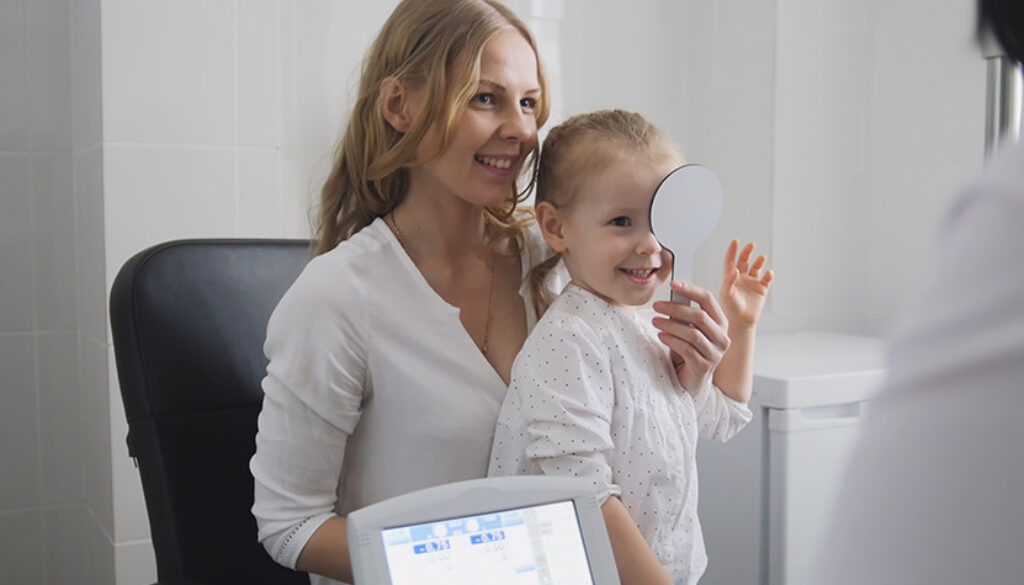
Use Friendly Language: Tell them the doctor is going to “take pictures of their eyes” or “play a matching game.”
-
No Wrong Answers: Explain they can’t “fail” the test; we are just checking how they see the world.
-
The “Magic Drops”: If dilation is needed, we use a gentle approach. Dilation is vital because it allows Dr. Zaver to see the internal health of the eye.
-
Schedule Around Naps: A well-rested child is a happy patient!
Ready to protect your child’s vision? Schedule a Pediatric Eye Exam at our Richmond Office Today
FAQs
-
A child’s initial comprehensive eye screening is recommended between 6 and 12 months of age. Routine exams should then occur every two years until they turn 18.