How to Choose Comfortable Daily Contact Lenses
When it comes to contact lenses, comfort is not a luxury — it is a clinical requirement. Daily contact lenses in Richmond, TX are most comfortable when matched to your eye’s specific material needs, oxygen requirements, and water content tolerance — and professionally fitted by a licensed optometrist. No single brand fits every eye. A contact lens exam is the only reliable way to find your perfect match.
Millions of Americans wear contact lenses every day — and millions of those same people quietly put up with discomfort they have been told is just “part of wearing contacts.” Dryness that worsens by afternoon. A gritty, sandpaper sensation that makes you reach for your glasses before dinner. Eyes that look red and feel exhausted even after a full night of sleep.
Here is the truth that Frame & Focus Eye Care wants every patient in Richmond, TX to know: that discomfort is not normal, and it is not inevitable.
The right contact lens — properly selected for your eye’s unique biology and professionally fitted by an experienced optometrist — should feel like almost nothing at all. Achieving that level of comfort is not luck. It is the direct result of understanding the science behind lens design and working with a provider who takes the time to get it right.
This guide will walk you through everything you need to know about choosing comfortable daily contact lenses, including the features that matter most, who benefits from daily disposables, what contact lenses cannot do for UV protection, and when a specialty fitting is the smarter path forward. Serving Richmond, Pecan Grove, Sugar Land, Rosenberg, and Fulshear, the team at Frame & Focus Eye Care is here to make sure your eyes get the care they truly deserve.
The Key Comfort Factors Every Contact Lens Wearer Should Know
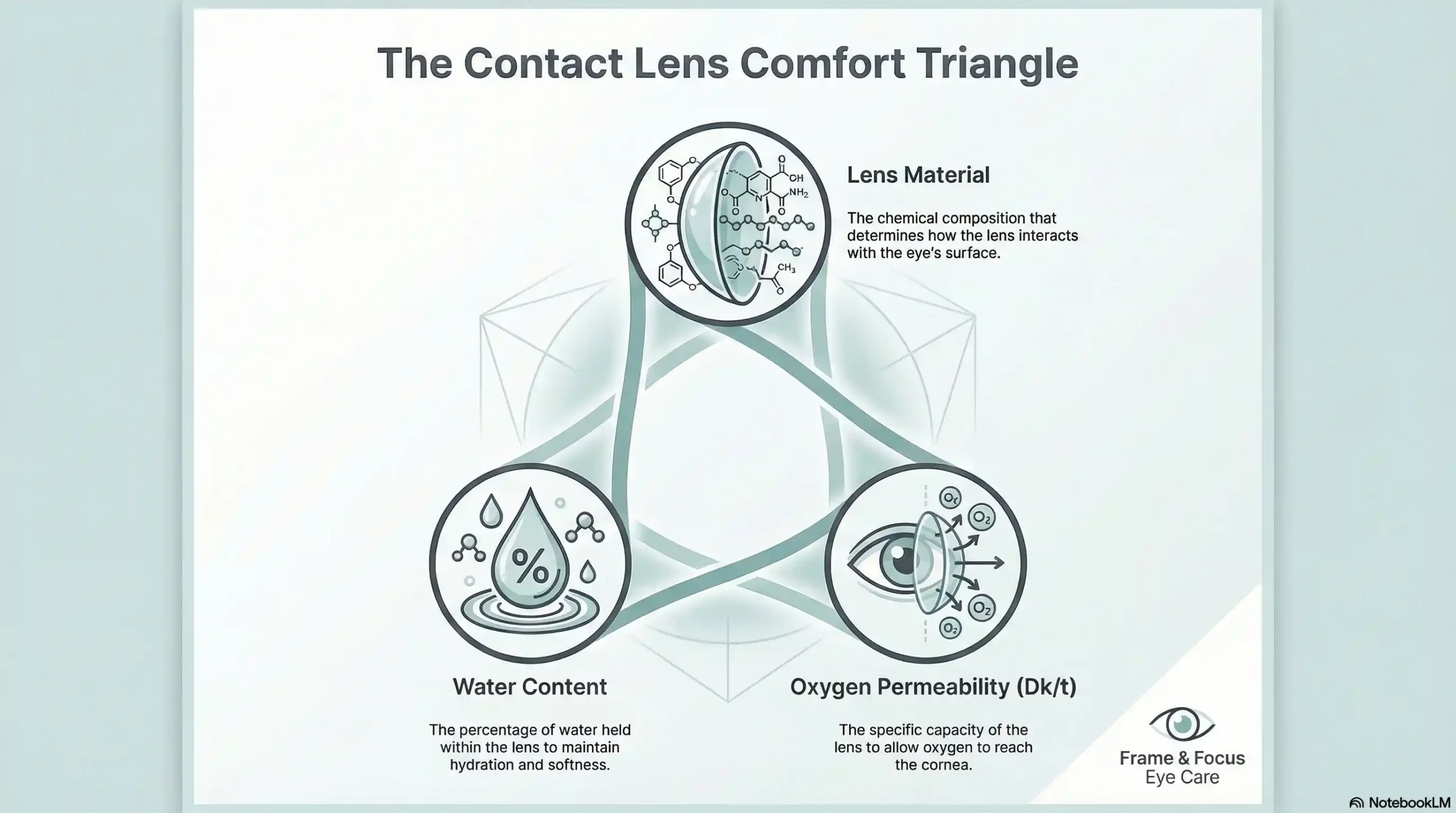
Not all contact lenses are created equal. Walk into any optical office and you will find dozens of options — and without the right guidance, choosing between them feels overwhelming. The good news is that contact lens comfort comes down to three core factors. Once you understand these, you will never look at a lens the same way again.
1. Lens Material — The Foundation of All-Day Comfort
The material a contact lens is made from is arguably the single most important factor in how it feels on your eye from morning to night.
For decades, the standard material was conventional hydrogel — a soft, water-containing plastic that revolutionized contact lens wear when it was introduced. Hydrogel lenses are soft and initially comfortable, but they have a significant limitation: they rely almost entirely on their water content to transmit oxygen to your cornea. As the day progresses and the lens begins to dry out, oxygen delivery drops and discomfort often follows.
The game-changer was the development of silicone hydrogel, now the gold standard in modern daily contact lens design. Silicone hydrogel lenses transmit oxygen directly through the lens material itself — not just through water. This means your cornea receives a consistent, healthy supply of oxygen throughout the entire day, regardless of how dry your environment is or how many hours you have been wearing your lenses.
The practical result? Less redness. Less end-of-day fatigue. Eyes that feel genuinely comfortable at 7 PM, not just 7 AM.
For most patients seeking all-day comfort, silicone hydrogel daily lenses represent the strongest starting point — but material alone does not tell the whole story.
2. Water Content — Finding Your Eye’s Sweet Spot
Here is one of the most common misconceptions in contact lens care: higher water content always means more comfort. It sounds logical — more water, more moisture, happier eyes. But the reality is more nuanced, and understanding it can make a significant difference for patients who have struggled with dryness.
Contact lenses are categorized by their water content percentage:
- Low water content lenses (below 50%) retain moisture more effectively in dry environments and are often surprisingly comfortable for patients with mild to moderate dry eye.
- Mid-water content lenses (50–60%) offer a balanced profile suitable for a wide range of patients.
- High water content lenses (above 60%) feel very comfortable initially but can act like a sponge — drawing moisture from your own tear film to maintain hydration as the day progresses, which can paradoxically worsen dryness symptoms.
This interaction between lens water content and your natural tear film stability is precisely why a professional fitting matters. An experienced optometrist evaluates your tear film and dry eye profile before recommending a lens — ensuring the water content works with your eyes, not against them.
3. Oxygen Permeability (Dk/t) — Why Your Eyes Need to Breathe
Your cornea is unique among body tissues — it has no blood vessels and relies entirely on direct oxygen absorption from the air and tear film to stay healthy. When a contact lens sits on your eye, it creates a barrier. How much oxygen passes through that barrier is measured by a value called Dk/t — the lens’s oxygen permeability rating.
Low Dk/t values mean less oxygen reaches your cornea. Over time, this oxygen deprivation can trigger a cascade of uncomfortable and potentially serious responses: redness as blood vessels attempt to compensate, increased irritation, blurred vision, and in chronic cases, a condition called corneal neovascularization, where new blood vessels grow into the cornea in an attempt to supply oxygen.
Modern silicone hydrogel daily lenses offer dramatically higher Dk/t values than their conventional hydrogel predecessors — in many cases five to six times higher. This means your cornea breathes freely, your eyes stay whiter, and your comfort is sustained across a full wearing day.
An added benefit of daily disposable lenses in particular is their deposit resistance. Because you discard the lens at the end of each day, protein and lipid deposits from your tear film never have the opportunity to accumulate on the lens surface — a major contributor to the irritation and blurry vision that plagues patients who wear the same lens for two to four weeks.
| Comfort Factor | What It Measures | Ideal Profile for Comfort |
|---|---|---|
| Lens Material | Oxygen transmission method | Silicone hydrogel preferred |
| Water Content | Moisture retention percentage | Matched to individual tear film |
| Oxygen Permeability (Dk/t) | Oxygen flow through lens | Higher Dk/t = healthier cornea |
| Deposit Resistance | Surface buildup over time | Daily disposables = zero buildup |
| Lens Thickness | Edge and center profile | Thinner edge = less lid awareness |
Why Daily Disposable Contacts Are Often the Most Comfortable Choice
With all three comfort factors in mind, a clear pattern emerges: daily disposable contact lenses consistently deliver the highest comfort potential for the widest range of patients. Here is why.
Every morning, you open a fresh, sterile lens. There are no protein deposits from yesterday. No residue from last week’s solution. No gradual degradation of the lens surface that accumulates over a monthly wearing cycle. You start every single day at peak lens performance — and at the end of the day, you simply discard the lens and start fresh tomorrow.
This daily renewal cycle offers specific advantages that matter deeply to patient comfort:
- Dry eye sufferers benefit enormously because deposit-free lenses interact more cleanly with a compromised tear film, reducing the inflammation cycle that worsens dry eye over time.
- Allergy patients find that daily lenses dramatically reduce the accumulation of airborne allergens — pollen, dust, pet dander — on the lens surface throughout the day.
- Part-time wearers who use contacts occasionally for sports, social events, or travel avoid the degradation issues that affect monthly lenses when they sit in solution between infrequent uses.
- Children and teenagers managing myopia benefit from the hygiene simplicity of dailies — no cleaning routines, no solution handling, reduced risk of lens-related infections.
- Sensitive eyes respond well to the consistently fresh surface of a daily lens, minimizing the cumulative irritation that builds on reusable lenses.
That said, daily disposables are not a universal answer. They are the right answer for the right patient — and identifying whether you are that patient requires a professional evaluation, not a guess.
📞 Not sure if daily lenses are right for you? The team at Frame & Focus Eye Care in Richmond, TX is ready to help you find your perfect fit. Call (832) 930-7797) or book online — same-day appointments available.
The Truth About UV Protection in Contact Lenses
This is one of the most important — and most misunderstood — topics in contact lens care. It falls firmly into the category of information your eye health depends on getting right.
Many modern contact lenses are marketed as offering UV protection, and some genuinely do provide a meaningful degree of UV-blocking capability. However, there is a critical limitation that every contact lens wearer must understand.
What UV-Blocking Contacts Can and Cannot Do
The FDA classifies UV-blocking contact lenses into two categories:
- Class I UV-blocking lenses block more than 90% of UV-A radiation and more than 99% of UV-B radiation — the stronger classification.
- Class II UV-blocking lenses block more than 70% of UV-A and more than 95% of UV-B radiation.
These numbers sound reassuring. But here is the essential clinical reality: a contact lens only covers your cornea. It is a small disc sitting on the central surface of your eye. The lens provides zero protection to your eyelids, your conjunctiva (the white of your eye and inner eyelid lining), your iris, or the delicate skin surrounding your eye socket — all of which are vulnerable to UV damage that can contribute to conditions including cataracts, macular degeneration, pterygium, and even eyelid cancers.
When to Wear Both — Contacts AND UV-Protective Eyewear
The American Optometric Association is clear on this point, and so is the team at Frame & Focus Eye Care: UV-blocking contact lenses are a supplementary layer of protection, never a replacement for UV-protective eyewear.
For any outdoor activity — a walk through Pecan Grove Park, a weekend on the water near Sugar Land, yard work in Fulshear, a morning run through your Richmond neighborhood — the complete protection strategy is:
- UV-blocking contact lenses on your cornea
- Wraparound UV-protective sunglasses covering your full eye and surrounding tissue
- A wide-brimmed hat for additional coverage in high-exposure environments
This is not an upsell. It is the honest, medically grounded guidance that Frame & Focus Eye Care’s “Straight Talk” philosophy demands — because your long-term eye health is always the priority.
Who Should Consider Daily Contact Lenses?
Understanding the features of daily lenses is valuable. But the more important question is: are daily contact lenses the right choice for your specific eyes and lifestyle?
You May Be an Ideal Candidate If…
Daily disposable lenses tend to deliver outstanding results for patients who:
- Experience mild to moderate dry eye and have struggled with end-of-day discomfort on monthly lenses
- Suffer from seasonal or environmental allergies that cause lens surface buildup and irritation
- Lead an active lifestyle — sports, fitness, outdoor activities — where hygiene simplicity and fresh daily lenses are a practical advantage
- Wear contacts part-time rather than every day, making a daily disposable more hygienic and cost-effective than maintaining a monthly lens between uses
- Are children or teenagers in a myopia management program where hygiene compliance and ease of use are important factors?
- Have sensitive eyes that react poorly to contact lens solutions or lens care products
- Are making their first transition into contact lens wear and want the simplest, most forgiving introduction to lens use
When a Specialty Contact Lens Fitting May Be the Better Answer
For some patients, a standard daily disposable lens — however well-designed — simply cannot deliver adequate comfort or vision correction. This is not a failure; it is a clinical reality, and it is exactly why specialty contact lens fitting exists.
Patients who may require a specialty fitting include those with:
- Keratoconus or other corneal irregularities that prevent a standard lens from sitting properly on the eye
- Severe dry eye disease that makes soft lens wear chronically uncomfortable regardless of lens brand
- High astigmatism requiring precisely engineered toric lens designs
- Presbyopia (age-related near vision loss) requires multifocal contact lens solutions
- Post-surgical corneas following LASIK, corneal transplants, or other procedures
For these patients, options such as scleral lenses, rigid gas permeable lenses, toric daily lenses, or multifocal designs may deliver the comfort and clarity that standard lenses cannot. The key message is simple: not every eye fits a standard lens, and that is perfectly okay. What matters is finding the right solution for your eye — and that requires a specialist who takes the time to truly evaluate your individual needs.
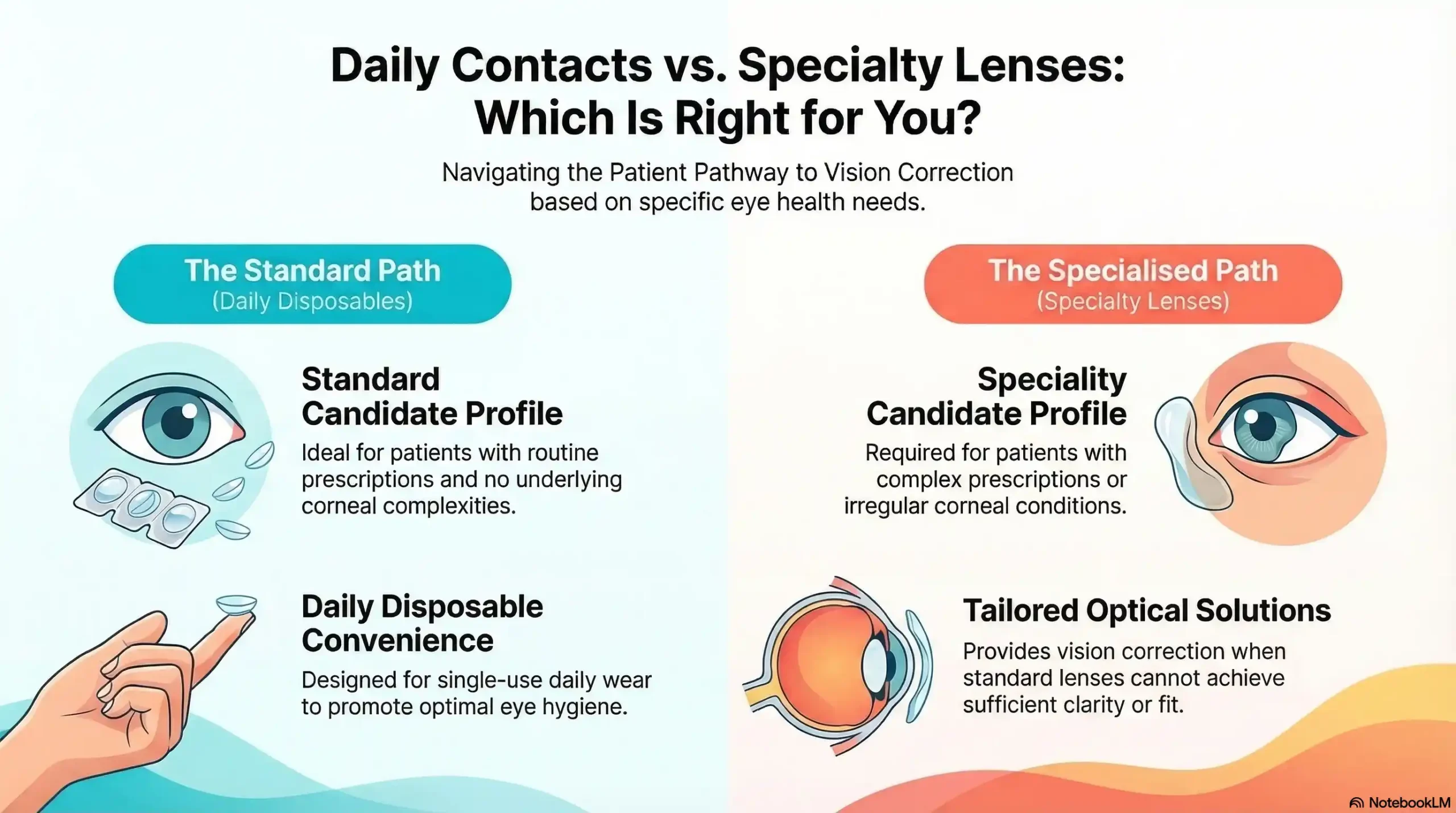
| Patient Profile | Recommended Lens Path |
|---|---|
| Mild dry eye, allergies, active lifestyle | Daily disposable silicone hydrogel |
| Part-time wearer, first-time lens user | Daily disposable — hygiene simplicity |
| Children in myopia management | Daily disposable — easy compliance |
| High astigmatism | Toric daily or specialty lens |
| Keratoconus / corneal irregularity | Scleral or RGP specialty lens |
| Severe dry eye disease | Specialty fitting evaluation required |
| Presbyopia / multifocal needs | Multifocal contact lens evaluation |
| Post-surgical cornea | Specialty fitting evaluation required |
📞 Frame & Focus Eye Care offers specialty contact lens fittings for patients across Richmond, Sugar Land, Pecan Grove, Rosenberg, and Fulshear. Call (832) 930-7797 to schedule your fitting today — our team is ready to find the solution that works for your unique eyes.
How to Get the Best Contact Lens Fit — The Role of a Professional Exam
Everything covered in this guide — materials, water content, oxygen permeability, UV protection, candidate profiles — points to a single, non-negotiable conclusion: the only reliable way to find a comfortable contact lens is through a professional contact lens exam.
What Happens During a Contact Lens Exam at Frame & Focus Eye Care?
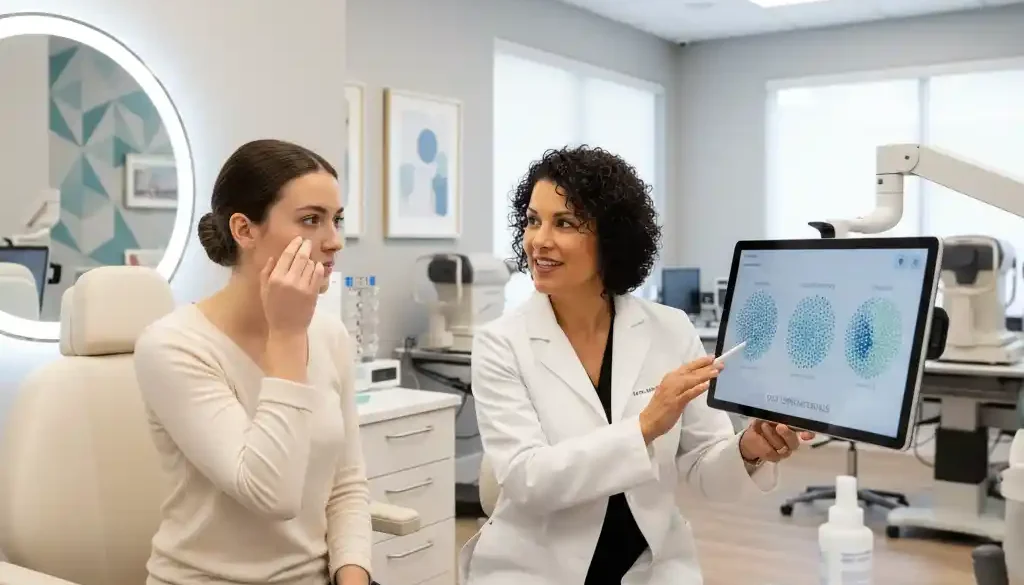
Many patients assume a contact lens prescription is simply an extension of their regular glasses prescription. It is not. A contact lens exam is a distinct clinical evaluation that goes significantly further, and at Frame & Focus Eye Care, it reflects Dr. Sarah Zaver’s commitment to thorough, patient-centered care.
During your contact lens exam, you can expect:
- Comprehensive refraction — determining your precise vision correction needs, which differ from a glasses prescription due to the lens sitting directly on your eye
- Corneal measurements — evaluating the curvature and diameter of your cornea to ensure the lens base curve and diameter create a stable, comfortable fit
- Tear film evaluation — assessing the quality and quantity of your natural tears, which directly informs water content and material recommendations
- Trial lens assessment — fitting you with a trial lens so you and Dr. Zaver can evaluate real-world comfort, vision clarity, and lens movement before any final prescription is issued
- Patient education — because at Frame & Focus Eye Care, you will always leave understanding exactly what was found, what was recommended, and why
This is the “Straight Talk” approach in practice. No jargon. No guesswork. Just clear, honest, expert guidance tailored to your eyes and your life.
Questions to Ask Your Eye Doctor Before Choosing a Lens
A great contact lens fitting is a conversation, not a transaction. Come prepared with questions like:
- Does my tear film quality affect which lens material is best for me?
- Given my prescription, are there specific lens designs that will give me sharper vision?
- How does my lifestyle — screen time, outdoor activities, travel — affect which lens I should choose?
- Will my vision insurance cover daily disposables, or is there a more cost-effective option for my wearing frequency?
- Is the $99 Frame Special a good option for me to have a quality backup pair of glasses alongside my contact lenses?
The right eye doctor welcomes every one of these questions — because an informed patient makes better decisions, experiences better outcomes, and builds a longer, more trusting relationship with their provider.
📞 Ready to experience contact lenses that actually feel comfortable? Schedule your contact lens exam at Frame & Focus Eye Care in Richmond, TX. Visit us at 18310 W Airport Blvd #900, Richmond, TX 77407, call (832) 930-7797, or book online today. Same-day appointments available.
🏛️ Local Resources & Citations
1. U.S. Food & Drug Administration (FDA) — Contact Lens Safety
Why it helps: The FDA’s official contact lens safety page explains the real risks of improper lens wear, UV classification standards (Class I and Class II), and why a valid prescription is legally required — giving patients in Richmond, TX the federal regulatory context behind the guidance Dr. Zaver provides at Frame & Focus Eye Care.
2. Texas Optometry Board — License Verification
Why it helps: Richmond-area patients can use this official Texas state agency portal to verify that their eye care provider holds a valid, active optometry license — reinforcing the credibility and trustworthiness of Frame & Focus Eye Care as a fully licensed practice in the state of Texas.
3. Fort Bend Independent School District (FBISD) — Student Health Services
Why it helps: As the school district serving Richmond, Sugar Land, and Pecan Grove families, FBISD’s student health guidelines highlight vision screening requirements for school-age children — making it a directly relevant resource for parents exploring myopia management or daily contact lenses for their kids at Frame & Focus Eye Care.
4. National Eye Institute (NEI) — Facts About Contact Lenses
Why it helps: Part of the U.S. National Institutes of Health (.gov), the NEI provides clinically vetted, federally backed patient education on contact lens care, dry eye, and UV eye damage — lending powerful third-party authority to the health guidance covered in this article and throughout Frame & Focus Eye Care’s patient communications.
Proudly Serving Richmond, Fort Bend County, and the Surrounding Communities
Frame & Focus Eye Care is proud to be a trusted vision care partner for families and individuals across Richmond, Pecan Grove, Sugar Land, Rosenberg, and Fulshear. Our practice was built on a simple but powerful belief: every patient in Fort Bend County deserves eye care that combines clinical excellence with genuine human warmth.
Whether you are coming in for your first contact lens fitting, searching for relief from chronic lens discomfort, or exploring specialty options for a complex prescription, our team is here — with the expertise, technology, and care to get it right.
Dr. Sarah Zaver and the entire Frame & Focus team look forward to earning your trust and becoming your family’s eye care home for years to come.
We look forward to “seeing” you soon.
Frequently Asked Questions
-
The best daily contacts for dry eyes feature water gradient technology or silicone hydrogel. Top-rated options include Alcon Dailies Total 1 and Acuvue Oasys 1-Day for maximum moisture retention.