Why Optical Illusions Fool Your Eyes — And What They Reveal About Your Vision Health
Why do optical illusions fool your eyes? Optical illusions fool your eyes because vision is not a perfect recording — it is an interpretation. Your brain processes visual signals at lightning speed, filling in gaps and making assumptions based on past experience. When those shortcuts are triggered by carefully designed patterns, your perception diverges from reality. At Frame & Focus Eye Care in Richmond, TX, we help patients understand what their visual system is — and isn’t — telling them.
You stare at the image and the lines start to move. You look at two identical squares and swear one is darker than the other. You glance away from a spinning pattern and watch a still wall ripple like water. Nothing is wrong with you. In fact, your brain is doing exactly what it was built to do — and doing it remarkably well.
But here is the part that does not make it onto most viral posts about optical illusions: the same remarkable system that gets fooled by a cleverly designed image is also the system responsible for everything you see, every moment of every day. When it is working well, you barely notice it. When something is off — even slightly — the consequences can range from persistent headaches to undetected eye disease quietly progressing in the background.
At Frame & Focus Eye Care, we believe understanding how your visual system works is the first step toward protecting it. As Richmond, TX’s trusted local eye care provider, Dr. Sarah Zaver and our team are here to make sure your brain and eyes are working in harmony — and to catch it early when they are not.
📅 Curious about what your eyes are really telling you? Schedule a comprehensive eye exam at Frame & Focus Eye Care in Richmond, TX. Call us at (832) 930-7797 — same-day appointments available.
The Science Behind the Trick — How Your Eyes and Brain Work Together
Most people assume that seeing is simple: light enters your eyes, and you see. The reality is far more complex — and far more fascinating.
Your Eyes Don’t See. Your Brain Does.
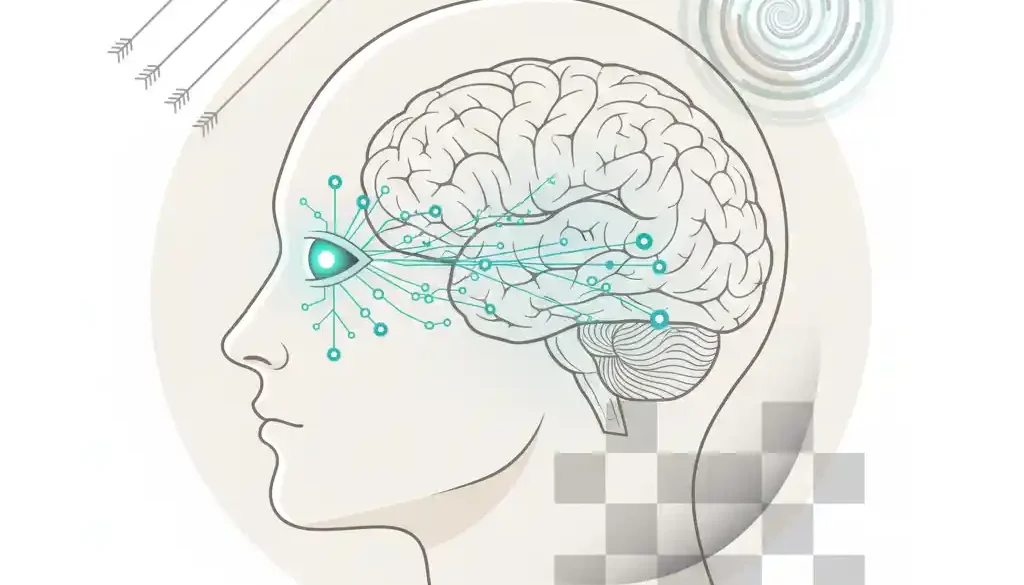
Your eyes are not cameras. They are data collectors. When light enters your eye, it lands on the retina — a thin layer of photosensitive cells lining the back of your eye. Those cells convert light into electrical signals, which travel along the optic nerve to the visual cortex at the back of your brain. Only there, after a remarkable journey, does actual “seeing” happen.
This means that everything you perceive — every color, shape, edge, and shadow — is a construction assembled by your brain, not a direct recording of reality. Your brain is constantly building a visual model of the world based on incomplete information, filling in gaps, making educated guesses, and applying rules it has learned over a lifetime of experience.
This is not a flaw. It is an extraordinary feat of biological engineering that allows you to navigate the world at the speed of thought.
The Split-Second Decisions Your Visual System Makes
Here is where optical illusions come in. Because your brain processes visual information so quickly and automatically, it relies on mental shortcuts — assumptions about depth, contrast, motion, and context that are almost always correct. Almost.
Optical illusions are specifically designed to exploit those shortcuts. They present your visual system with a scenario where the usual rules produce the wrong answer. Your brain is not broken when it falls for an illusion. It is actually working exactly as designed — just being outsmarted by a carefully engineered exception.
Understanding this dynamic tells us something profound: your visual system is powerful, but it is not infallible. And when factors like refractive error, disease, or fatigue enter the equation, those same shortcuts can begin to work against you in ways that are far less obvious than a viral illusion.
The Most Famous Optical Illusions — Decoded
Let us look at three of the most well-known optical illusions and what they reveal about the mechanics of human vision.
The Müller-Lyer Illusion — When Equal Lines Look Different
Two lines of identical length. One has arrows pointing inward at each end; the other has arrows pointing outward. Despite being exactly equal, the line with inward-pointing arrows appears significantly longer to almost every observer.
Why? Your brain interprets the arrow shapes as perspective cues — the same visual signals that tell you whether a corner of a room is coming toward you or receding away. It applies a depth-perception rule automatically, and the result is a length judgment that is confidently, completely wrong.
This is directly relevant to how your visual system handles spatial relationships every day — while driving, reading, or navigating a crowded space. When depth perception is compromised by uncorrected refractive error or binocular vision issues, these kinds of misjudgments stop being optical illusions and start being daily frustrations.
The Checker Shadow Illusion — When Your Brain Overrides Reality
Two squares on a checkerboard — one in direct light, one in shadow. They appear to be dramatically different shades. In reality, they are the exact same color.
Your visual cortex automatically compensates for lighting conditions, adjusting perceived color and brightness based on surrounding context. It is a remarkable ability that allows you to recognize a white shirt as white whether you are indoors under fluorescent lights or outside in full sun. But in this illusion, that compensation leads you directly away from the truth.
This mechanism is deeply connected to contrast sensitivity — the ability to distinguish subtle differences in shading and detail. Contrast sensitivity is one of the key metrics we evaluate during a comprehensive eye exam at Frame & Focus Eye Care. It is also one of the first things affected by conditions like early cataracts, glaucoma, and macular changes — long before vision blur becomes obvious.
This is precisely why our exams go beyond the standard letter chart. As Dr. Zaver’s patients consistently note, we take the time to examine the full picture of your eye health — literally snapping photographs of the backs of your eyes to catch what the surface cannot show.
The Motion Aftereffect — When Still Images Appear to Move
Stare at a spinning spiral for thirty seconds, then look away at a flat wall. The wall appears to move. Nothing is actually moving. What you are experiencing is neural adaptation — your motion-detecting neurons have been firing so intensively in one direction that when they stop, the opposing neurons briefly dominate, creating the perception of reverse motion.
This illusion matters clinically because the same underlying mechanism — neural fatigue and adaptation — is at work when patients report visual disturbances, persistent after-images, or the sense that things are moving when they should not be. These are symptoms that deserve professional evaluation, not dismissal.
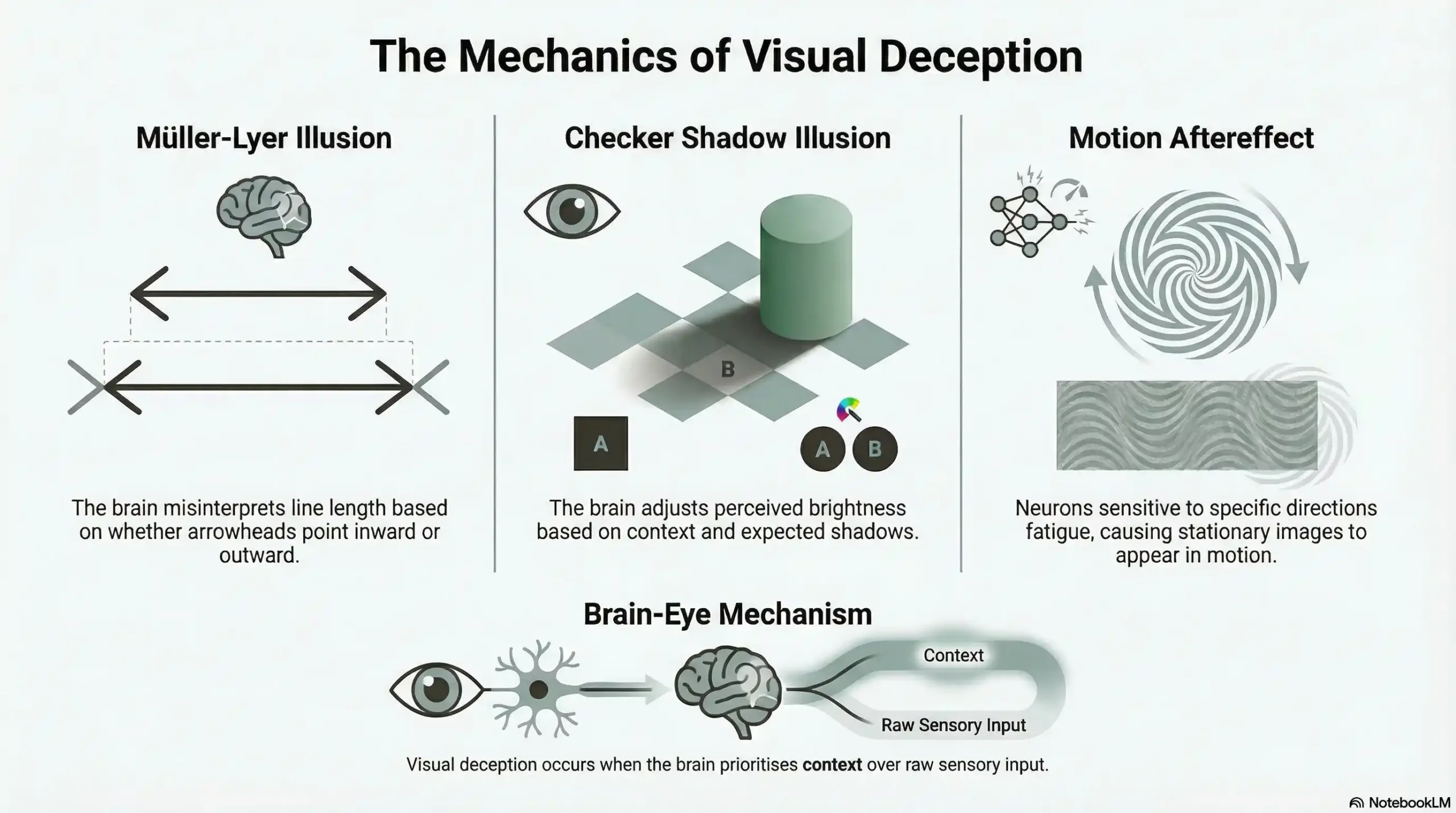
| Illusion Name | Brain Mechanism Exploited | Real-World Vision Connection |
|---|---|---|
| Müller-Lyer | Perspective & depth cue processing | Spatial judgment, depth perception assessment |
| Checker Shadow | Contrast & brightness compensation | Contrast sensitivity, early cataract/glaucoma detection |
| Motion Aftereffect | Neural adaptation & fatigue | Visual disturbances, eye strain evaluation |
What Optical Illusions Reveal About Your Personal Vision Health
Not Everyone Sees Illusions the Same Way — And That Is Medically Significant
Here is something that surprises most people: optical illusions do not affect everyone equally. Research consistently shows that perception of illusions varies significantly based on age, the presence of refractive errors like myopia or astigmatism, and the status of a person’s binocular vision — the ability of both eyes to work together as a coordinated team.
Children with undetected vision problems often process visual information differently from their peers — not because they are less intelligent, but because their visual system is working with compromised or mismatched input. A child who struggles to perceive depth accurately or whose eyes do not align properly may interact with optical illusions — and the world — in ways that signal an underlying condition.
This variability is not a curiosity. It is a clinical signal. And it is one of many reasons why routine eye exams, beginning as early as six months of age, are a cornerstone of the care we provide at Frame & Focus Eye Care.
When Visual “Tricks” Stop Being Tricks
The brain-eye miscommunications that make optical illusions entertaining become far less entertaining when they start happening in everyday life. Persistent blurry vision, double vision, halos around lights, frequent headaches, and difficulty with reading or near work are all symptoms that share a common root with the illusion phenomena we have been exploring: a visual system that is not processing information as cleanly and accurately as it should be.
Conditions like astigmatism blur and distort the visual signal before it even reaches the brain. Binocular vision disorders mean the two eyes are sending the brain subtly different pictures, forcing it to work overtime to reconcile the conflict. These are not rare conditions — they are remarkably common, often underdiagnosed, and profoundly treatable when caught early.
The Myopia Connection — What Richmond Parents Need to Know
Myopia — nearsightedness — is one of the most rapidly growing vision conditions in children worldwide, and it has a direct connection to the spatial perception mechanisms we have been discussing. A myopic eye distorts distance information, creating a version of the depth-perception errors we see in the Müller-Lyer illusion — except it happens all day, every day, in the real world.
Children with undetected myopia are frequently misidentified as struggling readers or inattentive students, when in reality their visual system is working against them in the classroom. They cannot see the board clearly. They struggle to shift focus between near and far. And because they have never known anything different, they often do not report a problem — they simply underperform.
Dr. Sarah Zaver’s Myopia Management program is designed specifically for Richmond families facing this challenge. Through evidence-based interventions, we work to slow the progression of myopia in children, protecting their long-term vision and unlocking their full potential — in the classroom and beyond.
👨👩👧 Is your child struggling in school or complaining of headaches? It could be a vision issue, not a learning one. Book a pediatric eye exam today at Frame & Focus Eye Care. Visit us at 18310 W Airport Blvd #900, Richmond, TX 77407 or call (832) 930-7797.
The Brain-Eye System Under Stress — Modern Life’s Hidden Vision Threats
Digital Screens and Visual Overload
The average American spends more than seven hours per day looking at screens. Every one of those hours asks your visual system to perform the same rapid-fire processing that optical illusions exploit — but in sustained, repetitive cycles that the human eye was never designed to handle at this volume.
Digital Eye Strain, also called Computer Vision Syndrome, is the result. Symptoms include blurred vision, dry and irritated eyes, headaches, neck and shoulder pain, and difficulty focusing — all driven by the same neural fatigue mechanisms behind the Motion Aftereffect illusion. The difference is that there is no looking away from a screen-dominated life.
At Frame & Focus Eye Care, we address Digital Eye Strain as part of our comprehensive exam process, identifying the specific factors driving your symptoms and providing targeted solutions — from specialized lens coatings to customized contact lens recommendations — that make your screen time significantly more comfortable and sustainable.
Dry Eye — When Your Visual Data Feed Gets Corrupted
Your tear film is not just about comfort. It is the first optical surface light encounters when it enters your eye, and its quality directly determines the clarity of the visual signal your retina receives. When the tear film is unstable — as it is in Dry Eye Disease — the visual input becomes inconsistent and degraded.
Think of it this way: if an optical illusion works by feeding your brain misleading visual data, dry eye works by feeding your brain inconsistent visual data. Your brain struggles to build a stable, reliable picture of the world, and the result is fluctuating blur, visual fatigue, and a persistent sense that your eyes are simply not performing the way they should.
Dry Eye Disease is one of the most underdiagnosed and undertreated conditions in optometry. At Frame & Focus Eye Care, we offer targeted dry eye treatments that go beyond artificial tears to address the root causes of your symptoms — because you deserve eyes that feel as good as they see.
Why Annual Exams Are Your Visual System’s Calibration Check
Think of a comprehensive eye exam the way a mechanic thinks of a full diagnostic on your vehicle. Your car might start every morning and feel fine on the highway, but that does not mean everything under the hood is performing optimally. There may be early-stage issues developing that will only become obvious — and costly — once they have progressed.
Your visual system works the same way. Many of the most serious eye conditions, including glaucoma, diabetic retinopathy, and macular degeneration, develop silently. There are no optical illusions that announce their arrival. There is no dramatic moment when you suddenly cannot see. There is only gradual, preventable deterioration — unless a thorough professional examination catches it first.
At Frame & Focus Eye Care, our comprehensive exams include advanced retinal photography, binocular vision assessment, contrast sensitivity testing, and a full evaluation of your ocular health — not just your prescription. We see the whole picture, so you never have to wonder what might be developing in the background.
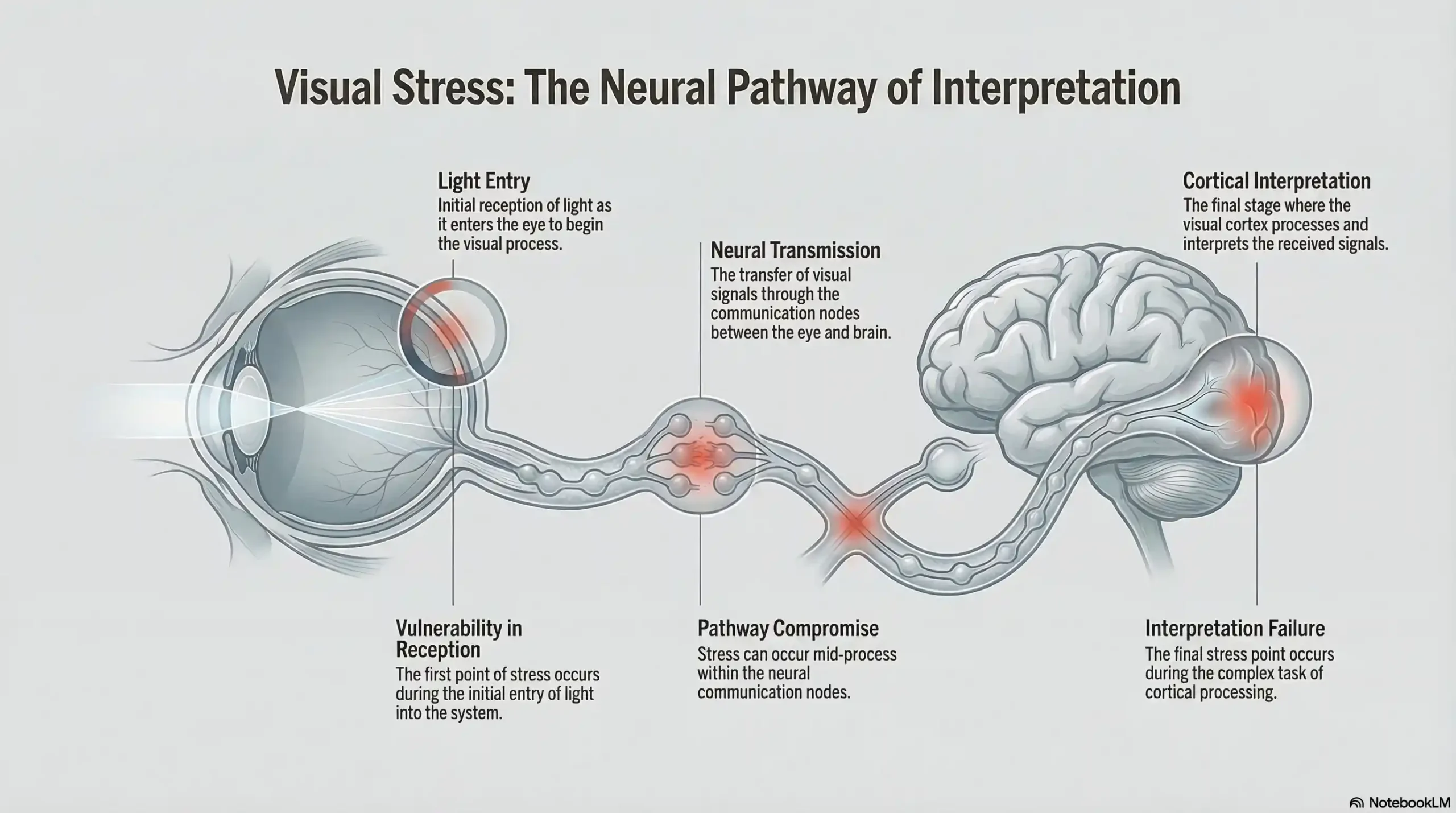
| Communication Stage | What Can Go Wrong | How Frame & Focus Checks It |
|---|---|---|
| Light enters the cornea & lens | Refractive error — myopia, astigmatism, hyperopia | Comprehensive refraction test |
| Retina converts light to signals | Retinal disease, macular degeneration, diabetic changes | Retinal photography & dilation |
| Optic nerve transmits signals | Glaucoma, optic nerve pressure elevation | Optic nerve assessment & imaging |
| Visual cortex interprets the image | Processing disorders, binocular vision dysfunction, eye strain | Binocular vision & convergence evaluation |
🔗 Local Resources & Citations
1. National Eye Institute (NEI) — Optical Illusions (nei.nih.gov — Federal .gov) The NIH’s National Eye Institute explains directly how optical illusions teach us the way our eyes and brain work together to see — reference this page to show patients the science behind visual perception is backed by the same federal body that funds eye disease research nationwide.
2. Fort Bend County Health & Human Services (fortbendcountytx.gov — Local .gov) Fort Bend County’s Clinical Health Services Division ensures that county residents have access to available and affordable care in specific public health clinical areas — Richmond-area residents can check here for local public health programs and indigent vision care assistance options available in the community.
3. University of Houston College of Optometry (UHCO) (opt.uh.edu — Texas Public University .edu) The University of Houston is a national leader in vision science, receiving more National Eye Institute research funding than any other institution in Texas — the closest accredited optometry research institution to Richmond, making it the authoritative local academic source for vision science and myopia research cited in this article.
4. Texas DSHS — Vision & Hearing Screening Program (dshs.texas.gov — Texas State .gov) The Texas Department of State Health Services Vision, Hearing & Spinal Screening Program is designed to detect vision and hearing disorders in children aged 4–18 years and refer them for appropriate follow-up with their doctor — Richmond parents can verify their child’s school-mandated vision screening requirements and understand when a referral to a licensed optometrist like Dr. Zaver is required by Texas law.
Frame & Focus Eye Care — Richmond’s Vision Authority
Dr. Sarah Zaver — A Decade of Seeing the Full Picture
There is a reason patients drive from Sugar Land, Pecan Grove, Fulshear, and Rosenberg to see Dr. Sarah Zaver in Richmond. It is not just her more than ten years of clinical experience serving the greater Houston area — though that foundation of expertise is the bedrock of everything we do. It is the way she practices.
Dr. Zaver is described by her patients as patient, thorough, personable, and genuinely passionate about her work. She takes the time to explain exactly what she is finding, what it means for your health, and what your options are — in plain language, without the jargon that leaves so many patients walking out of a medical office more confused than when they walked in. That commitment to clarity is not just good communication. It is the Frame & Focus standard of care.
What a Comprehensive Exam at Frame & Focus Actually Includes
A visit to Frame & Focus Eye Care is not a quick prescription check. It is a complete evaluation of your visual system — the kind of thorough, technology-backed assessment that gives you a true picture of your ocular health.
Our exams include advanced retinal photography, refraction testing, binocular vision evaluation, contrast sensitivity assessment, contact lens fitting consultation, and a full review of your ocular health history. Every finding is explained clearly. Every question is welcomed. And every solution — whether that is an updated prescription, a Myopia Management plan for your child, targeted Dry Eye treatment, or a specialty contact lens fitting — is customized to your specific needs and lifestyle.
With a 4.9-star rating across 315 Google reviews, our patients consistently confirm what we work every day to deliver: an experience defined by kindness, warmth, clinical excellence, and the genuine feeling of being cared for by people who take your health personally.
Serving Richmond, Pecan Grove, Sugar Land, Rosenberg & Fulshear
Frame & Focus Eye Care is proud to be the trusted local eye care provider for families across the Richmond area and surrounding communities. We offer comprehensive vision care for the whole family — from a child’s first exam to specialized senior care — with the warmth and continuity of a practice that genuinely knows its patients.
We are conveniently located at 18310 W Airport Blvd #900, Richmond, TX 77407, and we are open Monday through Thursday from 10:00 AM to 6:00 PM and Friday from 10:00 AM to 4:00 PM. Same-day appointments are available for urgent needs, because eye emergencies do not wait — and neither should you.
🔍 Your visual system is more complex — and more remarkable — than any optical illusion makes it look. Do not leave your eye health to guesswork. Schedule your comprehensive eye exam with Dr. Sarah Zaver at Frame & Focus Eye Care today. Visit us at 18310 W Airport Blvd #900, Richmond, TX 77407 or call (832) 930-7797. Same-day appointments available.
Frequently Asked Questions
-
Optical illusions fool your eyes because your brain — not your eyes — does the actual work of seeing. Your visual system processes information at extraordinary speed using mental shortcuts based on experience and pattern recognition. When an illusion is engineered to trigger those shortcuts incorrectly, your perception confidently produces the wrong answer. It is not a flaw — it is your brain working exactly as designed.