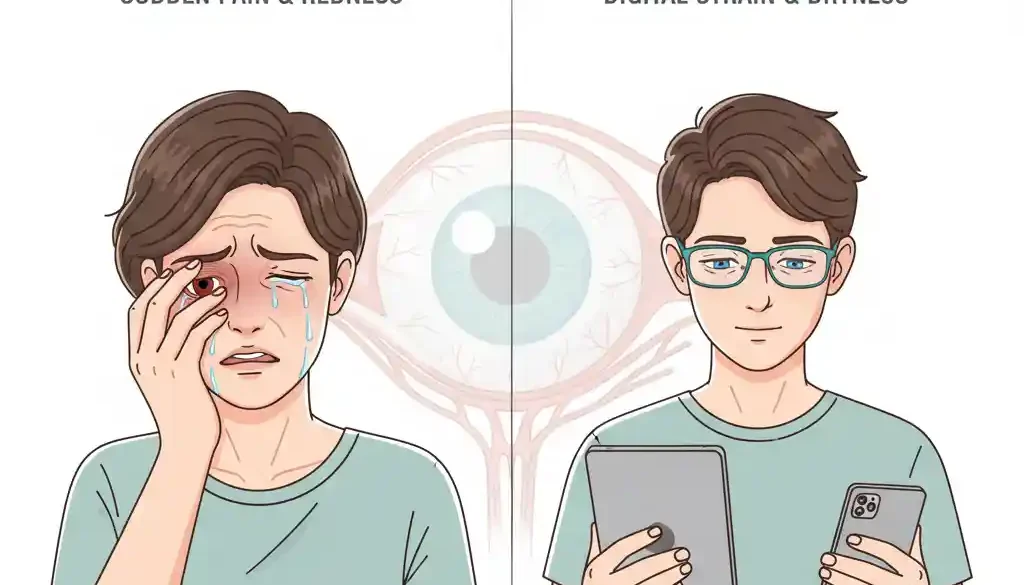
Acute vs. Chronic Eye Conditions: Key Differences & When to Seek Care
Acute eye conditions appear suddenly and require urgent or same-day care — examples include eye injuries, sudden vision loss, and eye infections. Chronic eye conditions develop gradually over time and require ongoing management — examples include dry eye disease, glaucoma, and myopia. Knowing the difference is critical: delaying care for an acute condition can cause permanent vision loss, while unmanaged chronic conditions silently worsen over years. If you are unsure which category your symptoms fall into, contact an eye doctor in Richmond, TX immediately.
Why Every Richmond Resident Needs to Know This Difference
Vision issues have a way of catching us off guard. One morning you wake up with a red, painful eye and have no idea whether to rush to a doctor or simply rinse it out and wait. Another day, you notice you have been squinting at screens more than usual and wonder if it is just tiredness — or something more serious building beneath the surface.
These moments of uncertainty are not just frustrating. In the world of eye health, they can be genuinely dangerous.
At Frame & Focus Eye Care, we believe that an informed patient is a protected patient. Dr. Sarah Zaver and our team have spent over a decade helping Richmond families navigate exactly these questions — cutting through the confusion with straight talk and state-of-the-art diagnostics. This guide is built on that same philosophy: clear, honest, clinically sound information that helps you make the right decision for your vision and your health.
Here is a truth that does not get said enough: the majority of serious vision loss is preventable. The obstacle is not always access to care — it is knowing when care is needed. Understanding the fundamental difference between acute and chronic eye conditions gives you a framework for every eye health decision you will ever make — for yourself and for every member of your family. It is the difference between acting in time and wishing you had.
📞 Not sure what you are experiencing right now? Our team is here to help. Call Frame & Focus Eye Care at (832) 930-7797) or book an appointment online — same-day appointments are available for urgent concerns.
What Are Acute Eye Conditions? (And Why They Cannot Wait)
Defining “Acute” in Plain English
In medicine, the word acute simply means sudden and short in duration. Think of an acute eye condition as a fire alarm — it demands your immediate attention, and ignoring it only allows the damage to spread.
Acute conditions are characterized by a rapid, often dramatic onset of symptoms. They are your body’s urgent signal that something has gone wrong and that waiting is not a safe option. While some acute conditions are minor and resolve quickly with proper treatment, others — left unaddressed — can become vision-threatening emergencies within hours.
Common Acute Eye Conditions to Know
Corneal Abrasion: A scratch on the clear front surface of your eye, often caused by a foreign object, a fingernail, or contact lens mishandling. Symptoms include sharp pain, excessive tearing, and sensitivity to light. While often minor, an untreated corneal abrasion can become infected rapidly.
Eye Infections: Beyond common “pink eye,” bacterial and viral eye infections can escalate quickly. Symptoms like significant discharge, swelling, and intense redness — particularly in only one eye — warrant same-day evaluation.
Sudden Vision Loss or Blurring: Any abrupt change in your vision — whether partial, full, or in one eye only — is a red flag that should never be ignored. This symptom can indicate a range of serious conditions, from a vascular event to retinal detachment.
Flashes of Light and New Floaters: A sudden shower of floaters combined with flashes of light in your peripheral vision is a classic warning sign of retinal detachment — a medical emergency where the retina pulls away from the back of the eye. Early intervention dramatically improves outcomes.
Chemical or Foreign Object Exposure: If a chemical, cleaning product, or foreign body makes contact with your eye, flush immediately with clean water and seek care without delay. Time is critical in preventing lasting corneal damage.
Acute Angle-Closure Glaucoma: This sudden, severe form of glaucoma causes rapid pressure buildup inside the eye. Symptoms include intense eye pain, headache, nausea, blurred vision, and seeing halos around lights. This is a true ocular emergency.
Warning Signs That Demand Same-Day Care
Do not wait for your next scheduled appointment if you experience any of the following:
- Sudden loss of vision in one or both eyes
- Eye pain that is severe or does not resolve
- Significant eye redness accompanied by pain or vision changes
- A visible foreign object embedded in the eye
- Chemical exposure to the eye
- New, sudden onset of floaters and flashes of light
- Double vision that appears without warning
- Eye injury from trauma, impact, or sharp objects
- Eyelid swelling severe enough to close the eye
Frame & Focus Eye Care offers same-day appointments for exactly these moments — because a trusted local eye doctor is almost always the better first call over a crowded emergency room for eye-specific concerns.
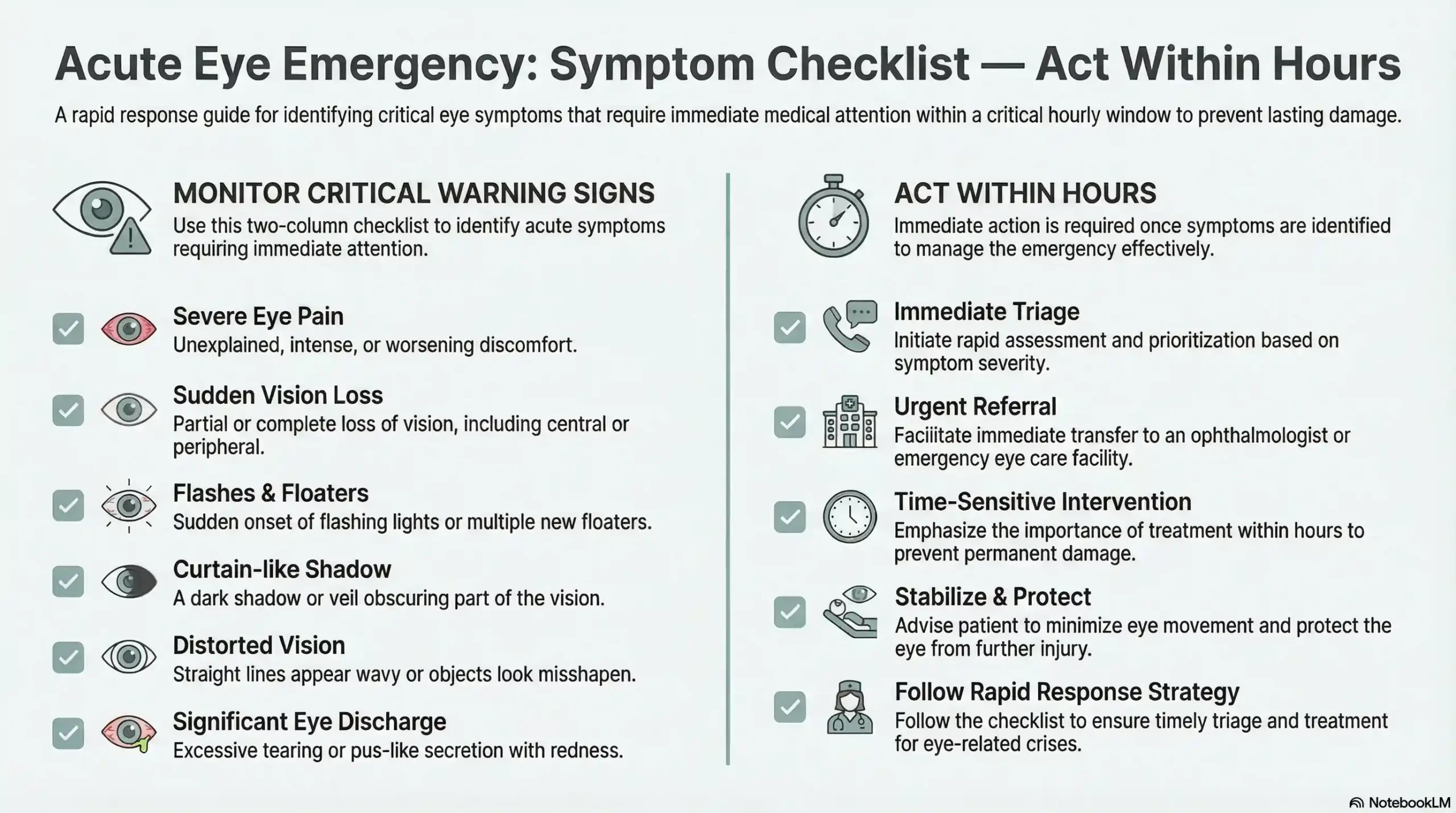
| Acute Eye Emergency Symptom | Action Required |
|---|---|
| Sudden vision loss (one or both eyes) | Seek same-day care immediately |
| Severe or persistent eye pain | Call your eye doctor today |
| New floaters + flashes of light | Same-day evaluation — possible retinal detachment |
| Chemical exposure to the eye | Flush with water, seek care immediately |
| Foreign object embedded in eye | Do not rub — seek care immediately |
| Eye injury from trauma or impact | Same-day emergency eye care |
| Intense redness with pain or vision change | Same-day evaluation |
| Sudden double vision | Call your eye doctor today |
What Are Chronic Eye Conditions? (Long-Term Management, Long-Term Vision)
Defining “Chronic” in Plain English
Where acute conditions arrive like a fire alarm, chronic eye conditions behave more like a slow leak. They develop gradually — often silently — over months or years. By the time symptoms become noticeable, meaningful damage may already have occurred.
This is what makes chronic eye conditions so deceptive and so dangerous. They rarely announce themselves dramatically. Instead, they erode your vision quietly, taking advantage of every year you skip a comprehensive eye exam.
The good news is this: with early detection and consistent management, the majority of chronic eye conditions can be slowed, controlled, and in some cases corrected — protecting your vision for decades to come.
Common Chronic Eye Conditions in the Richmond Area
Dry Eye Disease: Far more than occasional dryness, chronic dry eye is a persistent condition in which the eyes either do not produce enough tears or produce poor-quality tears. Left untreated, it causes increasing discomfort, blurred vision, and surface damage to the eye. It is one of the most common — and most undertreated — conditions we see at our Richmond practice.
Glaucoma: Often called the “silent thief of sight,” glaucoma causes progressive damage to the optic nerve, typically as a result of elevated eye pressure. It produces no pain and no early visual symptoms in most forms — which is exactly why routine eye exams that include pressure checks and retinal imaging are so critical. Glaucoma is the leading cause of irreversible blindness worldwide.
Diabetic Retinopathy: For patients living with diabetes in the Richmond area, the eyes are one of the first organs affected. High blood sugar damages the tiny blood vessels in the retina over time, leading to leakage, swelling, and eventually vision loss. Annual dilated eye exams are a non-negotiable part of diabetes management.
Age-Related Macular Degeneration (AMD): AMD affects the central portion of the retina responsible for sharp, detailed vision. It progresses slowly and is most common in patients over 55. Early-stage AMD produces no symptoms — making regular retinal photography an essential detection tool.
Progressive Myopia in Children: Myopia, or nearsightedness, is increasingly common in school-aged children throughout the Houston area. When left unmanaged, myopia can progress rapidly during childhood, increasing the risk of serious conditions like retinal detachment and glaucoma later in life. Myopia Management at Frame & Focus addresses this progression proactively.
Chronic Digital Eye Strain: With screen use at an all-time high, chronic eye strain has become one of the defining eye health challenges of our era. Persistent symptoms — including headaches, blurred vision, neck pain, and dry eyes — signal that your visual system is under sustained stress that requires professional evaluation.
Why Chronic Conditions Are So Often Missed
The most dangerous characteristic of chronic eye conditions is their silence. Many patients with early-stage glaucoma, macular degeneration, or diabetic retinopathy feel completely fine — right up until they cannot.
This is precisely why Dr. Zaver’s approach to comprehensive eye exams goes far beyond the standard reading chart. Our examinations include retinal photography — literally imaging the back of your eyes — to detect changes that are invisible to the naked eye and that no symptom checklist can catch. This technology is your earliest and most reliable warning system against chronic disease progression.
Acute vs. Chronic Eye Conditions — Side-by-Side Comparison
Understanding how these two categories differ across every dimension helps you build a mental framework for every eye health decision going forward.
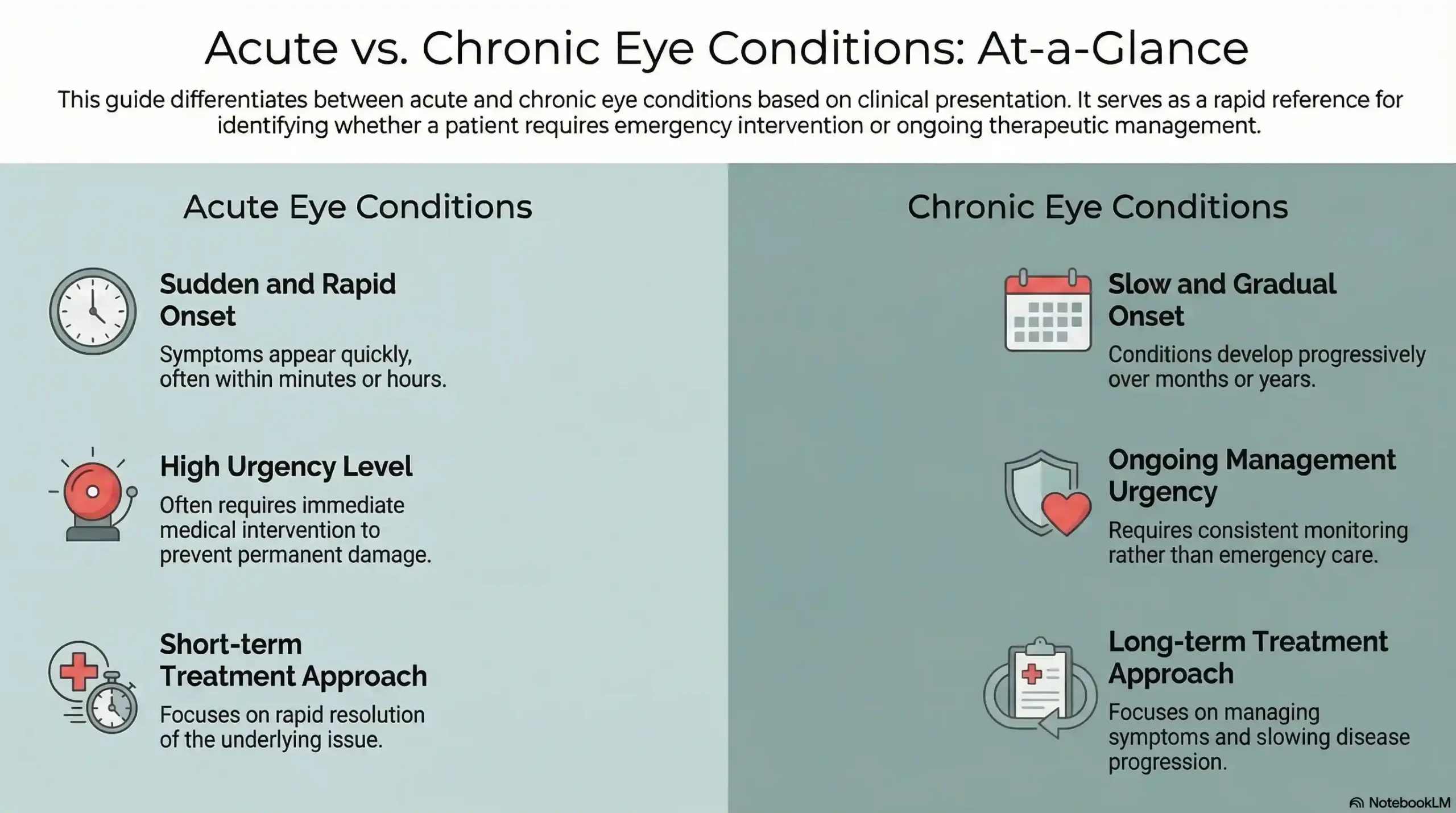
| Feature | Acute Eye Conditions | Chronic Eye Conditions |
|---|---|---|
| Onset | Sudden — hours or less | Gradual — weeks, months, or years |
| Duration | Short-term if treated promptly | Long-term, requires ongoing management |
| Symptoms | Dramatic, often painful or alarming | Subtle or absent in early stages |
| Urgency Level | High — same-day care often required | Moderate — prompt scheduling recommended |
| Examples | Corneal abrasion, eye infection, retinal detachment warning signs, chemical exposure | Dry eye disease, glaucoma, diabetic retinopathy, AMD, myopia |
| Primary Risk of Delay | Rapid, potentially irreversible damage | Silent progression leading to permanent loss |
| Treatment Approach | Immediate intervention and resolution | Ongoing monitoring, management, and lifestyle support |
| Detection Method | Symptom-driven — you will know something is wrong | Exam-driven — only reliably caught through regular comprehensive exams |
When to Seek Care — The Richmond Patient’s Decision Guide
Go to Your Eye Doctor TODAY If…
The following symptoms should be treated as urgent. Contact Frame & Focus Eye Care for a same-day appointment or proceed to an emergency eye care provider:
- Any sudden, unexplained change in your vision
- Eye pain that is severe, worsening, or does not resolve within a few hours
- A significant eye injury, impact, or chemical exposure
- New floaters combined with flashes of light
- Visible foreign object in the eye
- Intense redness with pain, discharge, or vision disturbance
- Sudden onset of double vision or loss of peripheral vision
Schedule a Comprehensive Exam Soon If…
The following symptoms are less immediately alarming but should not be left unaddressed. Schedule your appointment within the coming days or weeks:
- Gradual blurring of vision, particularly at distance or near
- Persistent headaches — especially after screen use or reading
- Eyes that feel consistently dry, gritty, or fatigued by the end of the day
- Your child is squinting, sitting too close to the screen, or struggling in school
- It has been more than a year since your last comprehensive eye exam
- You have diabetes, high blood pressure, or a family history of glaucoma or macular degeneration
- You are experiencing increased glare or difficulty seeing at night
Make Annual Exams Your Foundation
If there is one takeaway from this guide, let it be this: annual comprehensive eye exams are not optional maintenance — they are your most powerful tool against both acute and chronic eye disease.
Many of the most sight-threatening conditions give you no warning at all. The only way to catch them early is to be examined regularly by a trusted professional using the right technology. For families in Richmond and the surrounding communities, that means establishing consistent care with a provider who knows your history, understands your risk factors, and is equipped to see what you cannot.
📞 Richmond’s trusted eye care team is ready for you — same-day appointments available for emergencies. Call (832) 930-7797 or visit us at 18310 W Airport Blvd #900, Richmond, TX 77407.
How Frame & Focus Eye Care Treats Both Acute & Chronic Conditions
Emergency Eye Care — We Are Here When It Is Urgent
Eye emergencies are frightening. The last thing you need in that moment is to navigate a crowded ER waiting room staffed by professionals who are not eye care specialists. Frame & Focus Eye Care offers same-day emergency appointments precisely for these moments — providing immediate, expert, compassionate care in a familiar and welcoming environment.
Whether it is a scratched cornea, a suspected eye infection, sudden vision changes, or an exposure injury, our team is equipped to diagnose and treat your emergency with the clinical precision and personal care that our Richmond community deserves.
Chronic Condition Management — Your Long-Term Vision Partner
Managing a chronic eye condition is not a single appointment — it is a relationship. Our suite of services is specifically designed to address the most common and impactful chronic conditions affecting patients in Richmond, Sugar Land, Rosenberg, Fulshear, and Pecan Grove:
Dry Eye Treatment: We go beyond artificial tears to identify and address the root cause of your dry eye — delivering real, lasting relief.
Myopia Management: For children whose nearsightedness is progressing, early intervention changes the trajectory of their eye health for life.
Specialty Contact Lens Fittings: For patients whose standard lenses are uncomfortable or ineffective, our specialty fitting process identifies the precise lens design that works for your unique corneal shape and lifestyle.
Comprehensive Eye Exams with Retinal Photography: Our annual exams are the cornerstone of chronic disease prevention. By imaging the back of your eye, we establish a baseline and track changes over time — catching what cannot be seen, before it becomes what cannot be fixed.
The Frame & Focus Difference
Dr. Sarah Zaver brings over a decade of experience to every exam — and brings something equally important: the patience to answer every question, the thoroughness to leave nothing unchecked, and the communication style to explain everything in words that actually make sense to you. No optometry jargon. No rushed appointments. No one-size-fits-all solutions.
Our team has earned a 4.9-star Google rating across 315 reviews. Patients describe their experience at Frame & Focus as feeling “like family” — and that is not an accident. It is the standard we hold ourselves to every single day.
We proudly serve Richmond, Pecan Grove, Sugar Land, Rosenberg, and Fulshear — and we are honored to be the eye care partner that this community trusts with its most precious sense.
🔗 Local Resources & Citations
1. Fort Bend County Health & Human Services — Indigent Eye Care Assistance The official Fort Bend County (.gov) resource listing local eye care assistance programs — including the University Eye Institute’s Eye Care Assistance Program — for Richmond-area residents who need help covering the cost of eye care.
2. Texas Department of State Health Services — Vision Screening Requirements Texas’s official (.gov) state health authority outlines mandatory vision screening requirements for all school-age children, including what a failed screening means and when a professional eye exam by a licensed optometrist is legally required.
3. University of Houston College of Optometry — UH Health Eye Care Texas’s only public optometry school (.edu), located in Houston, provides clinical context and research-backed standards for eye disease management — including dry eye, glaucoma, diabetic retinopathy, and specialty contact lens care — that inform best practices used by local optometrists.
4. Fort Bend ISD — Health Screening Program The official Fort Bend ISD school health page confirms mandatory vision screenings conducted annually for district students, and explains when parents will receive a referral requiring a professional comprehensive eye exam from a licensed eye doctor.
See Clearly. Act Early. Trust Frame & Focus Eye Care.
The difference between an acute and a chronic eye condition is not just a medical distinction — it is a framework for protecting everything you see. Acute conditions demand urgency. Chronic conditions demand consistency. And both demand a trusted local eye doctor who treats your vision as the irreplaceable asset it is.
At Frame & Focus Eye Care, we have built our entire practice around being exactly that provider — for individuals, for families, and for the entire Richmond community. From same-day emergency care to long-term chronic disease management, we are here at every stage of your eye health journey with the expertise, technology, and genuine human care you deserve.
Your vision is not something to leave to chance, delay, or compromise. Whether you are experiencing symptoms right now or simply overdue for your annual exam, the most important step you can take is the next one.
📞 Don’t leave your vision to chance. Whether it’s an emergency or a long-overdue exam, Frame & Focus Eye Care is ready for you. Call (832) 930-7797 or book your appointment online today. Visit us at 18310 W Airport Blvd #900, Richmond, TX 77407 — proudly serving Richmond, Sugar Land, Rosenberg, Fulshear, and Pecan Grove.
We look forward to seeing you — clearly.
Frequently Asked Questions
-
An acute eye condition appears suddenly and requires prompt or same-day care — examples include eye injuries, sudden vision loss, and eye infections. A chronic eye condition develops gradually over time and requires ongoing management — examples include dry eye disease, glaucoma, and macular degeneration. The key difference is urgency: acute conditions demand immediate action, while chronic conditions demand consistent, long-term care. Both types can lead to permanent vision loss if left unaddressed. The most reliable way to catch chronic conditions early is through annual comprehensive eye exams with an experienced local optometrist like Dr. Sarah Zaver at Frame & Focus Eye Care in Richmond, TX.