Glaucoma Eye Drops at Night: Should You Take Them Before Bed?
Should You Take Glaucoma Eye Drops at Night?
Yes — for most glaucoma patients, nighttime is the optimal time to use eye drops, particularly prostaglandin analogs, the most commonly prescribed class. Eye pressure naturally peaks during nighttime and early morning hours. Taking drops at bedtime aligns the medication’s peak effectiveness with your eye’s most vulnerable window. However, timing depends on your specific medication. Beta-blockers, for example, are typically taken in the morning. Always follow your eye doctor’s personalized instructions for your treatment plan.
Every night, millions of glaucoma patients across the country perform a small but critically important ritual — reaching for their eye drops before bed. But surprisingly few of them know why nighttime dosing matters, or what happens when the timing is off.
If you or a loved one has been prescribed glaucoma eye drops in Richmond, TX, this is the straight-talking, no-jargon guide you have been looking for. At Frame & Focus Eye Care, we believe informed patients make better decisions for their health. So let’s break this down clearly, the way it should have been explained from day one.
Why Timing Matters With Glaucoma Eye Drops
To understand why timing matters, you first need to understand what glaucoma actually does — in plain language.
Your eye continuously produces a clear fluid called aqueous humor. This fluid nourishes your eye and then drains out through a tiny drainage channel. When that drainage system doesn’t work efficiently, fluid builds up. Pressure inside the eye rises. That pressure — called intraocular pressure, or IOP — begins to silently compress and damage your optic nerve, the cable that transmits everything you see to your brain.
The damage is irreversible. And for most people, there are no warning signs until significant vision has already been lost. That is why glaucoma is called the “silent thief of sight.”
Here is the critical piece most patients are never told: your eye pressure is not constant throughout the day. IOP follows a natural rhythm, and for many people, it peaks during nighttime and early morning hours — typically between midnight and early morning — when you are lying flat and your body’s fluid dynamics shift.
This is precisely why the timing of your glaucoma drops is not a minor detail. It is a clinically significant decision. Taking your drops at the right time means the medication reaches its peak effectiveness exactly when your eye pressure is at its most dangerous. Miss that window consistently, and your drops may never be working as hard as they should.
For Richmond, TX patients managing glaucoma, understanding this cycle is the first step toward truly protecting your vision long-term.
💬 Not sure if your glaucoma drops are working effectively? The team at Frame & Focus Eye Care offers comprehensive eye exams with state-of-the-art diagnostics designed to catch changes early. Same-day appointments available. Call (832) 930-7797) or book online today.
The Most Common Glaucoma Eye Drops and When to Take Them
Not all glaucoma drops are the same — and not all of them belong at bedtime. Understanding your specific medication class is essential.
Prostaglandin Analogs — The Nighttime Standard
Prostaglandin analogs are the most widely prescribed first-line glaucoma treatment, and they are almost universally recommended at bedtime. Common examples include latanoprost (Xalatan), bimatoprost (Lumigan), travoprost (Travatan Z), and tafluprost (Zioptan).
These medications work by increasing the outflow of aqueous humor through an alternative drainage pathway, effectively reducing eye pressure by improving the eye’s drainage efficiency.
There are two compelling reasons these drops belong at night. First, their IOP-lowering effect is most pronounced during the nocturnal pressure peak, meaning bedtime dosing puts the medication’s peak performance precisely where it is needed most. Second, one of the most common side effects of prostaglandin analogs is temporary eye redness and irritation. Taking them at bedtime means most of that redness resolves overnight while you sleep — so you wake up looking and feeling normal.
Beta-Blocker Eye Drops — Typically a Morning Medication
Beta-blockers work differently. Rather than improving drainage, they reduce the production of aqueous humor in the first place. Common examples include timolol (Timoptic), betaxolol (Betoptic), and levobunolol (Betagan).
For most patients, beta-blockers are recommended in the morning. First, some research suggests they are slightly less effective at lowering IOP during nighttime hours. Second — and importantly — beta-blocker eye drops can be absorbed systemically, meaning a small amount enters your bloodstream. In patients with certain heart or lung conditions, this can affect heart rate and breathing. If you have been prescribed a beta-blocker and have any history of asthma, COPD, or heart conditions, this is a conversation worth having explicitly with Dr. Zaver or your prescribing provider.
Other Drop Classes — Personalized Timing is Essential
Several other glaucoma medication classes are commonly prescribed, each with their own timing considerations.
Alpha agonists such as brimonidine (Alphagan) are typically dosed two to three times daily. They both reduce fluid production and improve drainage, making them versatile additions to a treatment plan.
Carbonic anhydrase inhibitors (CAIs) in eye drop form, such as dorzolamide (Trusopt) and brinzolamide (Azopt), also reduce fluid production and are typically dosed two to three times daily.
Rho kinase (ROCK) inhibitors, such as netarsudil (Rhopressa), are a newer class typically dosed once daily at bedtime — similar to prostaglandins — as they work to improve fluid drainage through the eye’s primary drainage pathway.
The takeaway: your drop timing should be personalized to your specific medication, your lifestyle, and your IOP pattern. This is exactly why a thorough, one-on-one conversation with your eye care provider is irreplaceable.
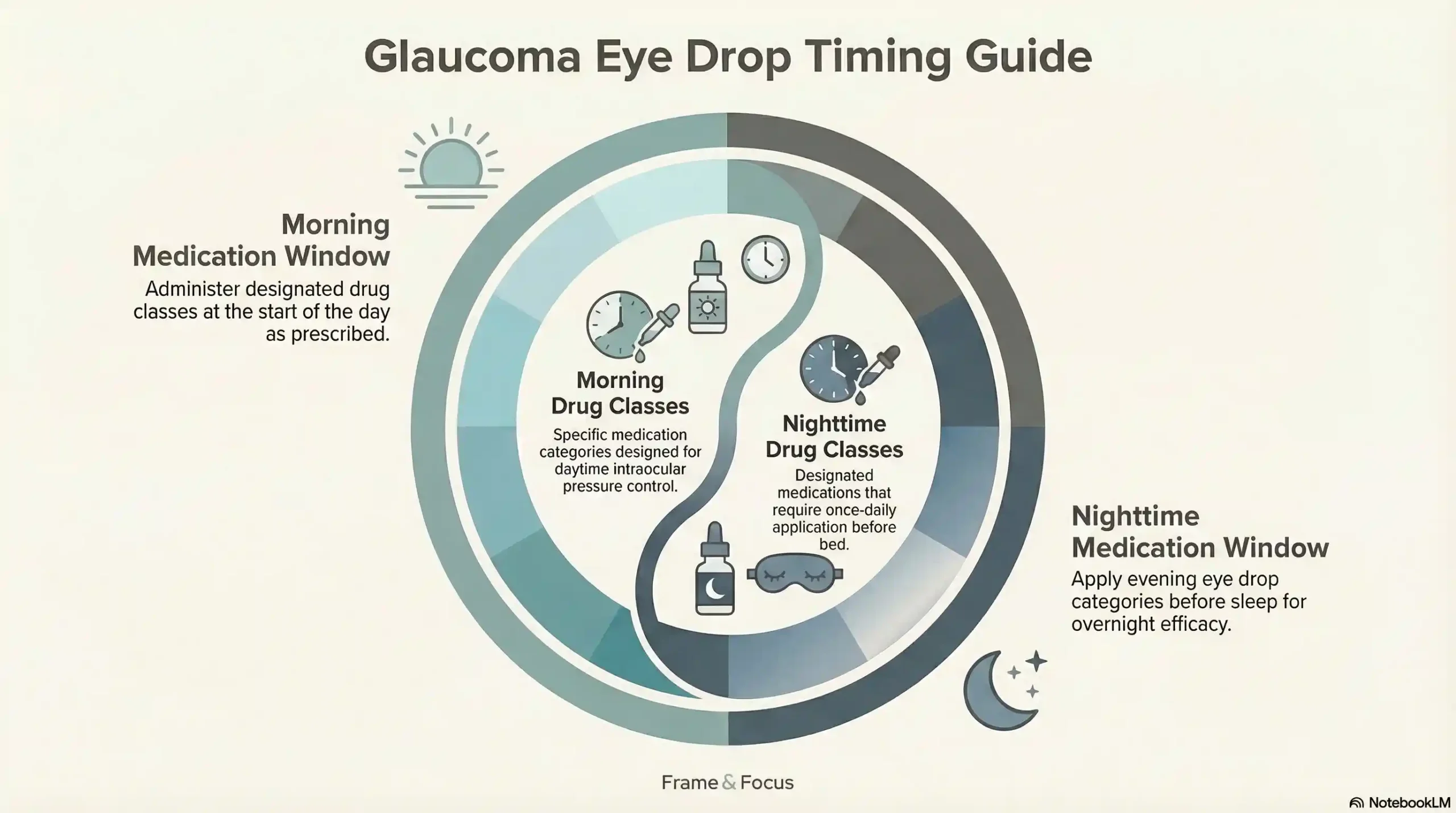
| Drop Class | Common Examples | Typical Timing | Primary Mechanism |
|---|---|---|---|
| Prostaglandin Analogs | Latanoprost, Bimatoprost, Travoprost | Bedtime ✅ | Increases fluid drainage (uveoscleral) |
| Beta-Blockers | Timolol, Betaxolol, Levobunolol | Morning | Reduces fluid production |
| Alpha Agonists | Brimonidine | 2–3x Daily | Reduces production + increases drainage |
| CAIs (Topical) | Dorzolamide, Brinzolamide | 2–3x Daily | Reduces fluid production |
| ROCK Inhibitors | Netarsudil | Bedtime ✅ | Increases drainage (trabecular) |
Always follow the specific instructions provided by your eye care provider. This table is for educational reference only.
What Happens If You Take Glaucoma Drops at the Wrong Time?
Life gets busy. Routines get disrupted. It happens to everyone — and it does not make you a bad patient.
But understanding the consequences of consistently incorrect timing helps explain why building a reliable routine is worth the effort.
When prostaglandin analogs are taken in the morning instead of at night, the medication’s peak IOP-lowering effect occurs during daytime hours — when your eye pressure is naturally lower anyway. Meanwhile, the nocturnal pressure spike goes largely unaddressed. Over weeks and months, this means your optic nerve is exposed to higher pressure during its most vulnerable hours, night after night.
The damage from consistently elevated IOP is cumulative and, critically, irreversible. You cannot restore vision that has already been lost to glaucoma. You can only protect what remains.
What if you miss a dose entirely? Do not double up. If you miss your bedtime drops and remember in the morning, skip that dose and resume your normal schedule the following night. Taking a double dose does not correct the missed protection — it simply increases your risk of side effects without proportional benefit.
If you are frequently forgetting doses, that is a clinical conversation worth having. There are strategies, combination drops, and reminder tools that can help. The Frame & Focus team approaches exactly these kinds of practical challenges with the same patience and clarity they bring to every appointment.
Tips for Taking Glaucoma Eye Drops Correctly
Knowing when to take your drops is only part of the equation. How you take them matters just as much.
Build a Consistent Nighttime Routine
The single most effective strategy for glaucoma drop adherence is habit stacking — anchoring your drops to something you already do every single night without thinking. The most natural anchor is brushing your teeth. Place your drops next to your toothbrush. When the toothbrush comes out, so do the drops. This simple behavioral trick dramatically reduces missed doses over time.
Consistency is more important than perfection. A slightly imperfect routine maintained every night is far more protective than a perfect routine followed sporadically.
Proper Drop Application Technique
Incorrect application means a significant portion of your medication never reaches the right place. Follow these steps every time:
- Wash your hands thoroughly before touching your eyes or the bottle.
- Tilt your head back gently or lie down.
- Pull your lower eyelid down to create a small pocket.
- Look upward, away from the dropper tip.
- Squeeze one drop into the pocket — do not let the tip touch your eye or eyelid.
- Close your eye gently. Do not blink rapidly.
- Press the inner corner of your eye with a clean fingertip for 60–90 seconds. This technique — called punctal occlusion — blocks the tear duct and prevents the medication from draining into your bloodstream, reducing systemic side effects.
- If you use more than one type of drop, wait at least 5 minutes between each medication. This prevents the first drop from being washed out by the second.
Storage and Handling
Most glaucoma drops can be stored at room temperature, away from direct light and heat. However, latanoprost (Xalatan) in its original unopened form requires refrigeration — once opened, it can be kept at room temperature for up to six weeks.
Always check the expiration date. Expired drops lose potency and may not adequately control your IOP, leaving your optic nerve unprotected without you realizing it.
💬 Have questions about your glaucoma drop routine? Dr. Sarah Zaver and the Frame & Focus Eye Care team in Richmond, TX are here with clear, practical answers — no confusing jargon. Call (832) 930-7797 or book your appointment online. We serve Richmond, Pecan Grove, Sugar Land, Rosenberg, and Fulshear.
When Should Richmond, TX Residents See an Eye Doctor About Glaucoma?
Glaucoma’s most dangerous characteristic is its silence. In its most common form — open-angle glaucoma — there is no pain, no redness, and no obvious vision disturbance until the disease has already caused substantial, permanent damage to the optic nerve.
By the time most patients notice something is wrong, they have already lost a meaningful portion of their peripheral vision. That loss cannot be recovered. It can only be stopped.
This is why annual comprehensive eye exams are the single most important tool in glaucoma prevention and management — not because something feels wrong, but precisely because it doesn’t.
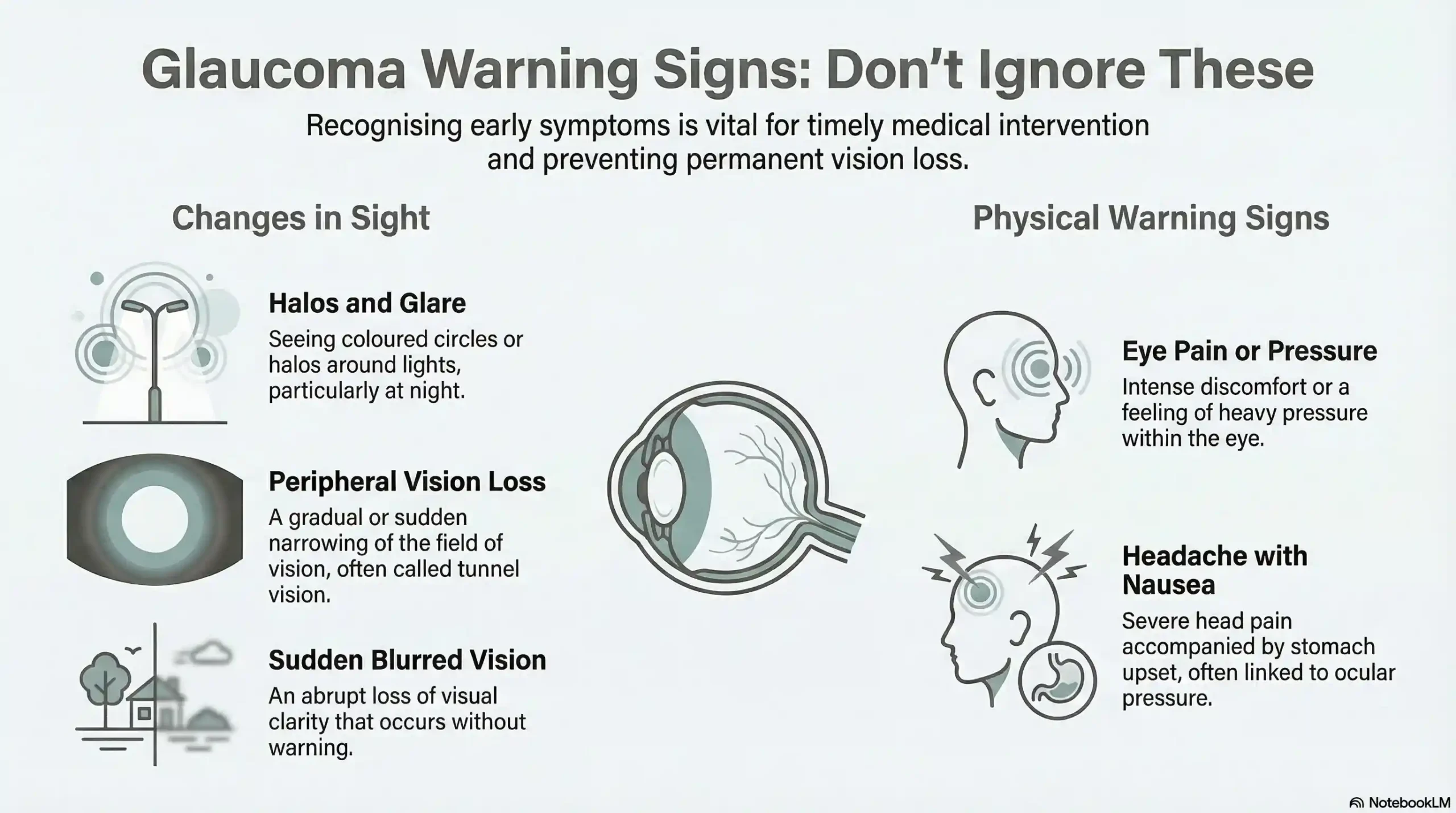
Seek prompt care if you experience any of the following:
- Sudden halos or rainbow-colored rings around lights
- Unexplained loss of peripheral or side vision
- Eye pain, pressure, or a sensation of fullness in the eye
- Sudden blurred or hazy vision
- Headache combined with nausea and vision changes — this combination can signal an acute angle-closure glaucoma attack, which is a medical emergency
At Frame & Focus Eye Care, our comprehensive eye exams go far beyond a standard vision check. Using state-of-the-art retinal photography, we capture detailed images of the back of your eye — including your optic nerve — allowing Dr. Zaver to detect the earliest structural signs of glaucoma before vision loss begins. This proactive approach is what separates genuine eye health management from a simple prescription renewal.
We proudly serve patients throughout Richmond, Pecan Grove, Sugar Land, Rosenberg, Fulshear, and the broader Fort Bend County area, with same-day appointments available for urgent concerns.
| Warning Sign | What It May Indicate | Recommended Action |
|---|---|---|
| Halos around lights | Elevated IOP or corneal swelling | Schedule eye exam promptly |
| Peripheral / tunnel vision loss | Optic nerve damage from glaucoma | Urgent comprehensive eye exam |
| Eye pain or pressure sensation | Possible angle-closure glaucoma | Same-day or emergency eye care |
| Sudden blurred or hazy vision | IOP spike or acute episode | Call for a same-day appointment |
| Headache + nausea + vision changes | Acute angle-closure glaucoma attack | Seek emergency care immediately |
Why Richmond, TX Patients Trust Frame & Focus Eye Care for Glaucoma Management
Managing glaucoma is not a one-time appointment. It is an ongoing relationship between a patient and a provider they genuinely trust — one built on clear communication, thorough monitoring, and personalized care that adapts as your needs evolve.
That is precisely the kind of practice Dr. Sarah Zaver has built at Frame & Focus Eye Care in Richmond, TX 77407.
With over a decade of experience serving the Houston area, Dr. Zaver brings deep clinical expertise to every exam. Patients consistently describe her as patient, thorough, personable, and passionate — a combination that transforms what can be an anxiety-inducing diagnosis into a manageable, well-understood health journey.
Our practice is built on what we call “Straight Talk” — the commitment to explaining your condition, your medication, and your treatment plan in language you can actually use. No intimidating terminology. No rushed appointments. Just clear, honest answers from a provider who genuinely cares about your long-term vision.
Our state-of-the-art diagnostic technology, including retinal photography and comprehensive IOP assessment, ensures that nothing is missed and that your care is always based on the most complete picture of your ocular health possible.
With a 4.9-star Google rating across 315 reviews, our patients speak for themselves:
“From calling to make an appointment to picking up my lenses and everything in between, every touch point is met with kindness and warmth.” — Vasny
“Dr. Zaver is incredibly patient and thorough… every single person you interact with here is so kind and lovely.”
Frame & Focus Eye Care serves Richmond, Pecan Grove, Sugar Land, Rosenberg, Fulshear, and surrounding Fort Bend County communities from our conveniently located office at 18310 W Airport Blvd #900, Richmond, TX 77407.
Your Vision Is Worth Protecting — Start Today
Glaucoma does not announce itself. It does not give warnings. It simply takes — slowly, silently, and permanently. But here is the empowering truth: when detected early and managed correctly, glaucoma is highly controllable. The right drops, taken at the right time, combined with regular monitoring from a trusted local eye care provider, can protect your vision for life.
You do not have to navigate this alone.
The team at Frame & Focus Eye Care is here to make glaucoma management clear, manageable, and genuinely supported — from your very first question to every follow-up appointment along the way.
🏥 Ready to take control of your eye health?
Schedule your comprehensive glaucoma evaluation at Frame & Focus Eye Care today. Our state-of-the-art diagnostics and patient-first approach ensure you leave every appointment informed, confident, and cared for.
📍 18310 W Airport Blvd #900, Richmond, TX 77407 📞 (832) 930-7797 🕐 Mon–Thu: 10:00 AM – 6:00 PM · Fri: 10:00 AM – 4:00 PM
Same-day appointments available. Serving Richmond, Pecan Grove, Sugar Land, Rosenberg, and Fulshear.
Frequently Asked Questions
-
Prostaglandin eye drops are prescribed at night because they work best while you sleep, controlling your eye pressure when it naturally peaks in the early morning
Disclaimer:
This article is for educational purposes only and does not replace professional medical advice, diagnosis, or treatment. Always follow the instructions provided by your eye care professional regarding glaucoma medications and eye drop timing.