Glasses Lenses: Types, Coatings & How to Choose the Right Pair
Eyeglass lenses come in four main designs — single vision, bifocal, progressive, and occupational — and are made from materials including CR-39 plastic, polycarbonate, Trivex, and high-index. The right choice depends on your prescription strength, lifestyle, and visual demands. Key coatings like anti-reflective, UV protection, and blue light filtering significantly improve comfort and long-term eye health. Always work with a licensed optometrist for a professional fitting.
Why Your Lens Choice Matters More Than You Think
Most people spend a lot of time choosing the perfect frame. The shape, the color, the fit — all of it gets careful attention. The lenses, however, often become an afterthought. That is a mistake that costs more than money.
The wrong lenses — whether the wrong material, the wrong design, or the wrong coatings — can cause persistent headaches, uncomfortable eye strain, and blurred vision that no amount of adjustment will fix. Lenses that are not properly fitted to your face and your prescription do not just underperform; they actively work against your visual comfort every single day.
This is one of the most common frustrations patients bring to Frame & Focus Eye Care in Richmond, TX. They arrive having spent real money on glasses ordered online, only to discover that the frames slide, the lenses distort, and their eyes feel worse at the end of the day than they did before. The problem is almost never the frame. It is almost always the lens.
The truth is that selecting the right eyeglass lenses is a clinical decision, not a shopping decision. It requires a current, accurate prescription, a clear understanding of how you use your vision throughout the day, and the guidance of a licensed optometrist who can match every variable to your unique visual demands.
This guide will walk you through everything you need to know — lens designs, materials, coatings, and how to choose — in plain language, without the jargon.
📌 Schedule Your Eye Exam Not sure where to start? Schedule a comprehensive eye exam with Dr. Sarah Zaver at Frame & Focus Eye Care in Richmond, TX — and get lens guidance built around your unique vision needs. Call (832) 930-7797 or book online today. Same-day appointments are available.
The 4 Main Types of Eyeglass Lens Designs
The design of a lens determines which part of your visual field it corrects. Before choosing any material or coating, you first need the right design for your prescription and your lifestyle.
1. Single Vision Lenses
Single vision lenses are the most straightforward option. They correct one field of vision — either distance or near — using a single, uniform prescription across the entire lens surface.
If you are nearsighted and struggle to see road signs clearly while driving, single vision distance lenses are your correction. If you hold your phone at arm’s length to read it comfortably, single vision reading lenses address that need. For children and younger adults whose vision typically involves one primary correction, single vision lenses are the standard and most affordable choice.
They are also the lens used in the Frame & Focus $99 Frame Special, making quality single vision correction genuinely accessible for patients across Richmond, Pecan Grove, Sugar Land, and the surrounding Fort Bend County communities.
2. Bifocal Lenses
Bifocal lenses contain two distinct prescription zones separated by a visible line across the lens. The upper portion corrects distance vision; the lower portion corrects near vision for tasks like reading.
Bifocals were the original solution for presbyopia — the gradual loss of near-focusing ability that typically begins in a patient’s early-to-mid forties. They are functional, durable, and familiar to patients who have worn them for years. Some patients, however, find the visible line distracting or dislike the abrupt visual jump between the two zones. For those patients, progressive lenses offer a more seamless alternative.
3. Progressive Lenses — The Modern Multifocal
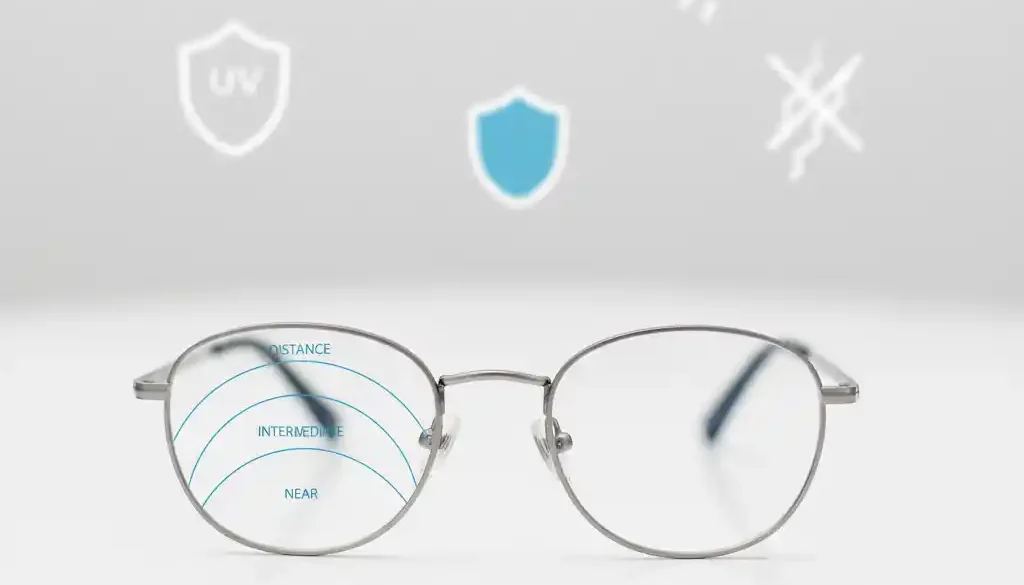
Progressive lenses are the evolution of the bifocal. They provide a smooth, continuous range of correction — distance at the top, intermediate vision in the middle, and near vision at the bottom — with no visible dividing line.
For patients managing presbyopia, progressives deliver the most natural visual experience available in a standard eyeglass lens. You look up to see across a room, look straight ahead to work at a computer, and look down to read a book — all through one seamless lens.
There is an adjustment period. Patients new to progressives typically need one to two weeks to acclimate to the lens corridor and train their eyes to find each zone instinctively. This is completely normal, and the team at Frame & Focus will walk you through exactly what to expect so the transition feels manageable rather than frustrating.
If you are 40 or older and finding yourself holding menus at a distance or removing your glasses to read, it is worth having an honest conversation with Dr. Zaver about whether progressives are the right fit for your lifestyle.
4. Occupational and Office Lenses
Occupational lenses are a specialized category designed for the visual demands of the modern workplace — particularly extended time at computer screens, reading documents, and navigating mid-range distances like a desk to a whiteboard.
Unlike standard progressives, which prioritize distance vision, occupational lenses prioritize the intermediate and near zones. This makes them exceptionally effective at reducing the eye strain, neck tension, and end-of-day fatigue that many remote workers and office professionals experience without ever connecting it to their lenses.
If your current glasses feel fine for driving but leave your eyes exhausted after a full day of screen work, occupational lenses may be the targeted solution you have been missing.
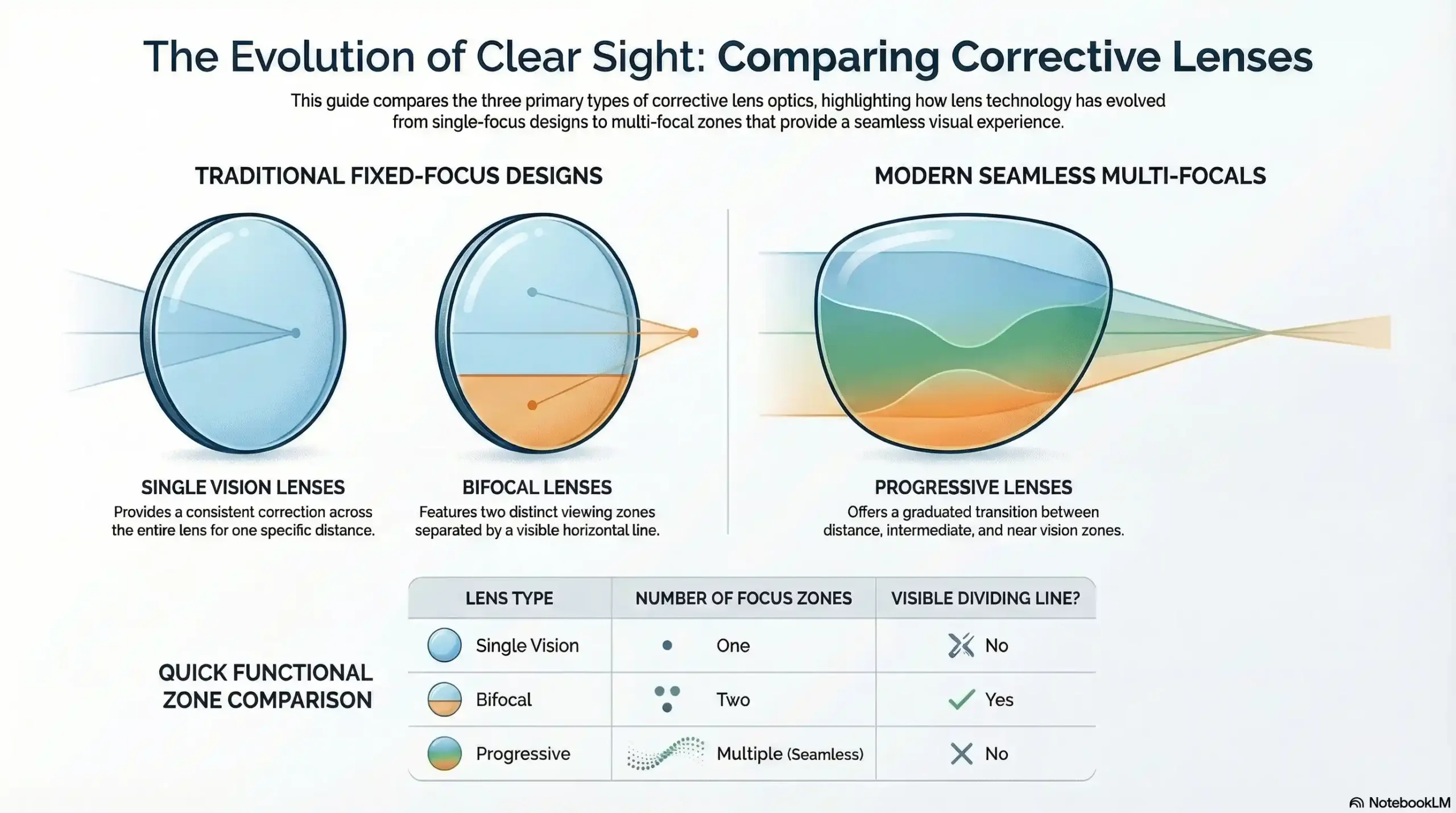
| Lens Design | Vision Zones Corrected | Visible Line | Best For |
|---|---|---|---|
| Single Vision | One zone (distance OR near) | No | Children, younger adults, single-prescription needs |
| Bifocal | Two zones (distance + near) | Yes | Presbyopia patients who prefer defined correction zones |
| Progressive | Three zones (distance + intermediate + near) | No | Adults 40+ wanting seamless, natural multifocal vision |
| Occupational | Intermediate + near emphasis | No | Professionals with heavy screen and desk-work demands |
Lens Materials Explained — What Your Lenses Are Actually Made Of
Lens design tells your lenses what to correct. Lens material determines how well they do it — and how long they last.
CR-39 Plastic — The Classic Standard
CR-39 is the traditional lens plastic that has been the industry standard for decades. It offers good optical clarity, is lightweight relative to glass, and is the most budget-friendly material available.
The limitation of CR-39 becomes apparent at stronger prescriptions. As the prescription increases in power, CR-39 lenses become noticeably thicker and heavier, which affects both comfort and appearance. For patients with mild prescriptions, CR-39 remains a solid, cost-effective choice.
Polycarbonate — The Safety and Value Standard
Polycarbonate is impact-resistant, significantly thinner than CR-39 at equivalent prescriptions, and comes with built-in UV 400 protection. It is the lens material recommended for children, athletes, patients with active lifestyles, and anyone whose daily environment puts their eyewear at risk of impact.
Polycarbonate is also the material included in the Frame & Focus $99 Frame Special — paired with an anti-reflective coating — because it represents genuine quality at an accessible price point. It is not the cheapest material, but it is the responsible standard for everyday wear.
Trivex — The Premium Lightweight Option
Trivex offers the impact resistance of polycarbonate combined with optical clarity that rivals CR-39. For patients who need safety-rated lenses but are particularly sensitive to optical distortion, Trivex is the premium upgrade worth considering.
It is also notably lightweight, making it a comfortable choice for patients who wear their glasses throughout the full day.
High-Index Lenses — For Strong Prescriptions
High-index lenses are engineered to bend light more efficiently than standard materials. The practical result is that a high-index lens delivers the same prescription correction as a thicker standard lens — in a fraction of the thickness and weight.
High-index lenses are available at 1.67 and 1.74 index values. Patients with moderate-to-high myopia, hyperopia, or significant astigmatism will often find that high-index lenses transform the wearability of their glasses, eliminating the “coke bottle” thickness that thicker materials produce at strong prescriptions.
If you have avoided certain frame styles because your prescription makes lenses look thick, high-index is likely the material that changes that conversation entirely.
Lens Coatings — The Upgrades That Actually Make a Difference
A lens without the right coatings is like a quality car without weatherproofing. The core function works, but the daily experience falls significantly short of what it could be. The right coatings are not luxury add-ons — several of them are clinical necessities.
Anti-Reflective (AR) Coating — The Non-Negotiable Upgrade
Anti-reflective coating eliminates the glare that reflects off the front and back surfaces of your lenses. Without it, every overhead light, every oncoming headlight at night, and every bright screen creates visual interference that your eyes are constantly working to compensate for.
The practical benefits of AR coating are immediate and significant: sharper vision in low-light conditions, reduced eye strain during extended screen use, and a cleaner appearance to your lenses — both for you and for anyone making eye contact with you.
AR coating is included as standard in the Frame & Focus $99 Frame Special because, quite simply, sending a patient home without it would be a disservice. It is that important.
UV Protection Coating
Ultraviolet radiation from the sun is directly linked to the development of cataracts and macular degeneration over time. UV protection coating shields the eye from both UVA and UVB rays — the same principle as SPF in sunscreen, applied to your vision.
Patients choosing polycarbonate or high-index lenses often receive UV 400 protection built into the material itself. For patients choosing CR-39 or other standard plastics, UV coating should be considered essential, not optional.
Scratch-Resistant Coating
No lens is completely scratch-proof, but scratch-resistant coating significantly extends the useful life of your lenses by hardening the surface against the minor abrasions of daily wear. For children’s glasses especially, scratch-resistant coating is a practical investment that protects the lens quality — and your prescription clarity — over the full life of the pair.
Blue Light Filtering Coating
Blue light filtering lenses reduce exposure to the high-energy visible light emitted by smartphones, tablets, computer monitors, and LED lighting. Prolonged blue light exposure has been associated with digital eye strain, disrupted sleep cycles, and visual fatigue — a combination that many patients in the Richmond area experience without ever identifying the source.
If your day involves several hours in front of screens — whether for work, study, or personal use — blue light filtering is a coating that delivers noticeable, real-world relief for many patients.
Photochromic Lenses — Transitions® Technology
Photochromic lenses react to UV light by darkening automatically outdoors and returning to clear indoors. For patients who move frequently between indoor and outdoor environments, they eliminate the need to switch between prescription glasses and sunglasses.
One important note: photochromic lenses do not typically darken inside a vehicle, because modern windshields block the UV light that triggers the darkening reaction. Patients who want sun protection while driving will still benefit from prescription sunglasses or a UV coating on standard lenses.
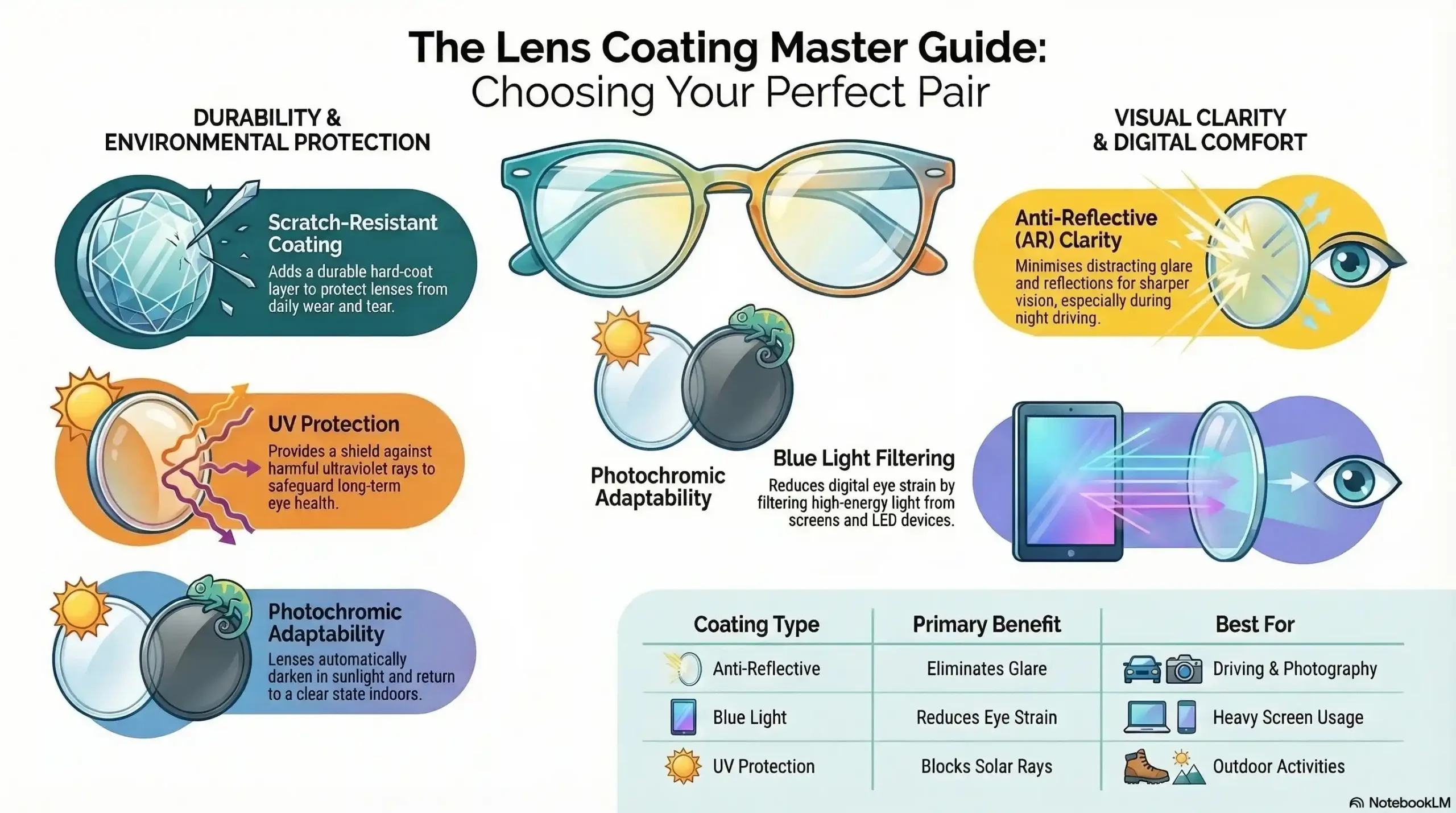
| Coating | Primary Benefit | Best For | Included in $99 Special |
|---|---|---|---|
| Anti-Reflective (AR) | Eliminates glare, sharpens night vision | All patients — daily wear essential | ✅ Yes |
| UV Protection | Shields from UVA/UVB — cataract & AMD prevention | All patients — especially outdoor exposure | Varies by material |
| Scratch-Resistant | Extends lens life | Children, active adults | Recommended add-on |
| Blue Light Filter | Reduces digital eye strain and sleep disruption | Screen-heavy users, remote workers, students | Optional upgrade |
| Photochromic (Transitions®) | Auto-darkens outdoors — eliminates sunglass switching | Patients moving between indoor/outdoor environments | Optional upgrade |
How to Choose the Right Lenses for Your Prescription and Lifestyle
With all of this information in hand, the path to the right lens choice follows five clear steps.
Step 1 — Get a current, comprehensive eye exam. Your prescription is the foundation of every lens decision. An outdated or incomplete prescription makes every subsequent choice less effective. A comprehensive exam at Frame & Focus goes beyond the letter chart — it includes advanced diagnostics to assess the full picture of your ocular health.
Step 2 — Map your visual demands honestly. Do you drive frequently? Work at screens for hours each day? Play sports? Need to read for extended periods? Your lifestyle determines whether single vision, progressive, or occupational lenses will serve you best.
Step 3 — Match your material to your prescription and lifestyle. Mild prescription with a low-impact lifestyle? CR-39 may be sufficient. Strong prescription? High-index saves you from thick, heavy lenses. Active lifestyle or children? Polycarbonate is the responsible standard.
Step 4 — Layer coatings with intention. AR coating is non-negotiable for almost every patient. UV protection is essential for long-term ocular health. Add blue light filtering if screens dominate your day. Add photochromic if you want the convenience of one pair that adapts to your environment.
Step 5 — Work with a licensed optometrist, not an algorithm. Online lens selectors cannot assess your pupillary distance accurately, cannot evaluate the optical center of your lenses relative to your frame, and cannot account for the subtle variables that determine whether your glasses feel effortless or exhausting. Professional fitting is not a premium add-on — it is the baseline standard of quality eyewear.
📌 Find Your Perfect Lenses The team at Frame & Focus Eye Care in Richmond, TX will match every lens recommendation to your prescription, lifestyle, and budget — including options covered by your vision insurance. Call (832) 930-7797 or book your appointment online. Same-day appointments available.
🔗 Local Resources & Citations
1. Texas Department of State Health Services (DSHS) — Vision Screening Program. The official state agency that mandates and certifies vision screening for Texas children ages 4–18 in all public, private, and childcare settings — check here to understand your child’s school vision screening requirements and what a referral for a comprehensive eye exam actually means.
2. Fort Bend County Health & Human Services. The principal county health agency serving Richmond, Pecan Grove, Sugar Land, Rosenberg, and Fulshear — visit here for local public health programs, community wellness resources, and indigent health care assistance options for Fort Bend County residents who need help accessing vision care.
3. University of Houston College of Optometry — UH Health Eye Care. Texas’s only public optometry school, located in Houston and serving the greater area — reference this .edu resource for evidence-based research on lens technology, myopia management, and ocular disease prevention that informs the clinical standards practiced at independent optometrists like Frame & Focus.
4. U.S. Food & Drug Administration — Impact-Resistant Lens Requirements (21 CFR 801.410). The federal regulation that legally requires all prescription eyeglass lenses sold in the United States to pass impact-resistance testing — reference this .gov source to understand exactly why professionally dispensed polycarbonate lenses meet a safety standard that unverified online lenses may not.
The Frame & Focus Difference — Why Richmond Patients Trust Us With Their Lenses
At Frame & Focus Eye Care, lens selection is never a transaction. It is a conversation.
Dr. Sarah Zaver brings over a decade of experience serving the Houston area and Fort Bend County community to every patient interaction. Her approach is characterized by patience, thoroughness, and a commitment to plain-language communication that leaves every patient fully informed — not just handed a prescription and shown the door. Her patients consistently describe exams where every question is answered, every concern is addressed, and every recommendation is explained clearly in words that make sense.
The practice serves patients across Richmond, Pecan Grove, Sugar Land, Rosenberg, and Fulshear with the same standard of care: state-of-the-art diagnostic technology paired with the kind of warm, unhurried attention that makes patients feel like family rather than appointments.
For patients navigating budget considerations, the $99 Frame Special — which includes a frame from the in-house collection, standard polycarbonate lenses, and anti-reflective coating — delivers genuine clinical quality at a price point that removes the barrier between a patient and properly fitted eyewear. The practice also works to maximize vision insurance benefits, ensuring patients receive the best possible lenses within their coverage.
The result is a Google rating of 4.9 stars across 315 patient reviews — not because Frame & Focus is the flashiest option in the market, but because patients leave seeing clearly, feeling heard, and confident that their eye health was the priority from the first phone call to the final fitting.
“From calling to make an appointment to picking up my lenses and everything in between, every touch point is met with kindness and warmth.” — Vasny
📌 Book Your Appointment Today See clearly. Look great. Feel confident.
Visit Frame & Focus Eye Care at 18310 W Airport Blvd #900, Richmond, TX 77407 or call (832) 930-7797 to schedule your appointment. Dr. Sarah Zaver and the entire Frame & Focus team are ready to help you find the lenses that work as hard as you do.
Same-day appointments available. Book online or by phone.
Frequently Asked Questions
-
For prescriptions over +/- 4.00, high-index lenses are the best choice. They bend light efficiently, allowing your lenses to remain significantly thinner and lighter than standard plastic options