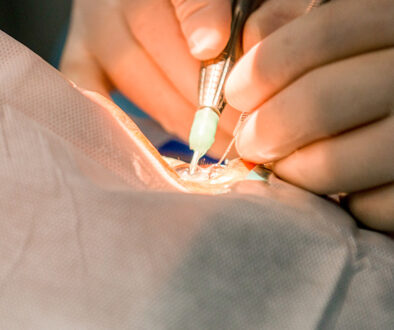
Which Patients are Good Candidates for Premium IOL
To be a good candidate for Premium IOLs in Richmond, Texas, you generally need healthy ocular surfaces and a lifestyle goal of reducing dependence on glasses after cataract surgery. While standard lenses only correct for distance, premium options like Toric or Multifocal IOLs address astigmatism and presbyopia simultaneously, provided you do not have advanced glaucoma or macular degeneration.
Take the 2-Minute IOL Lifestyle Quiz
Understanding Premium IOL Types
Aspheric Lenses
These lenses closely match the natural curve of the eye. Typical lenses were uniformly curved, making it easier to manufacture, but at the same time increasing the chance of causing imperfections in vision. Aspheric lenses help to reduce imperfections and improve clarity, especially at night.
Toric IOLs
These lenses are specifically designed to help correct nearsightedness, farsightedness, and astigmatism.
Accommodating IOLs
Accommodating IOLs can tilt slightly forward when you look at objects that are close to the eye. This helps to improve visibility when you are performing actions like reading a book. While they are not necessarily as sharp as bifocals, patients have a reduced need to use reading glasses while still maintaining excellent distance vision.
Multifocal IOLs
If you require a bifocal or trifocal lens in your glasses, this may be a likely choice for you. Different portions of the lens allow for better vision at different ranges. However, there are some overall sacrifices in vision clarity at a distance.
The “Visual Lifestyle Audit”: Beyond the Reading Chart
Candidacy isn’t just about your eyes; it’s about your days. A premium IOL that works for an avid reader might not be the best choice for someone who drives long distances at night.
-
The Richmond Commuter: If you spend significant time driving on I-69 or the Grand Parkway after sunset, you need a lens that minimizes “dysphotopsia”—the halos and glare often associated with older multifocal designs.
-
The Digital Professional: For those who spend hours on spreadsheets or tablets and suffer from Computer Vision Syndrome, Extended Depth of Focus (EDOF) lenses provide a “stretched” range of vision perfect for intermediate distances.
-
The Active Texan: Golfers and outdoor enthusiasts often prioritize sharp distance and intermediate vision. An Aspheric or Toric IOL can provide the high-definition clarity needed to track a ball across the green.
Solving the “Dry Eye” Barrier to Success
Many patients are surprised to learn that Dry Eye Disease can temporarily disqualify them from a premium IOL. Because premium lenses rely on precise light focusing, an unstable tear film can cause “fuzziness” and inaccurate surgical measurements.
-
The Surface Matters: We utilize state-of-the-art diagnostic technology to screen for dry eye before surgery. If your tear film is unstable, your IOL measurements might lead to a “refractive surprise.”
-
The Frame & Focus Protocol: We offer targeted dry eye treatments to stabilize your eye’s surface 2 to 4 weeks before your final measurements are taken.
History of Premium IOLs
Premium IOLs have been approved by the Food and Drug Administration (FDA) since the 1980s. Before FDA approval, when patients had cataract surgery, they were required to wear very thick eyeglasses or specialized contact lenses to correct their vision. New technologies in the optical world have allowed for a wide variety of available premium IOLs, and figuring out which specific type suits you best will depend on some different factors.
Patient Factors
Physicians are careful to discuss the realities of this procedure with their patients. After recovering from cataract surgery, many patients expect that their vision will be completely restored to their peak performance. However, doctors are careful to warn against this and explain the realities of the surgery and as well as likely expectations of what will result from the surgery. For this reason, surgeons are likely to have some initial concern about the desired outcome for the patient to make sure that their hopes are grounded.
Surgeons will also have an eye toward the patient’s desire not to wear eyeglasses. If the patient does not mind wearing corrective lenses without the need for surgery, this may be the best option. These lenses may also not be an ideal fit for the elderly population. Eyes in the geriatric population are often rapidly deteriorating, requiring a lens replacement more quickly than would be recommended.
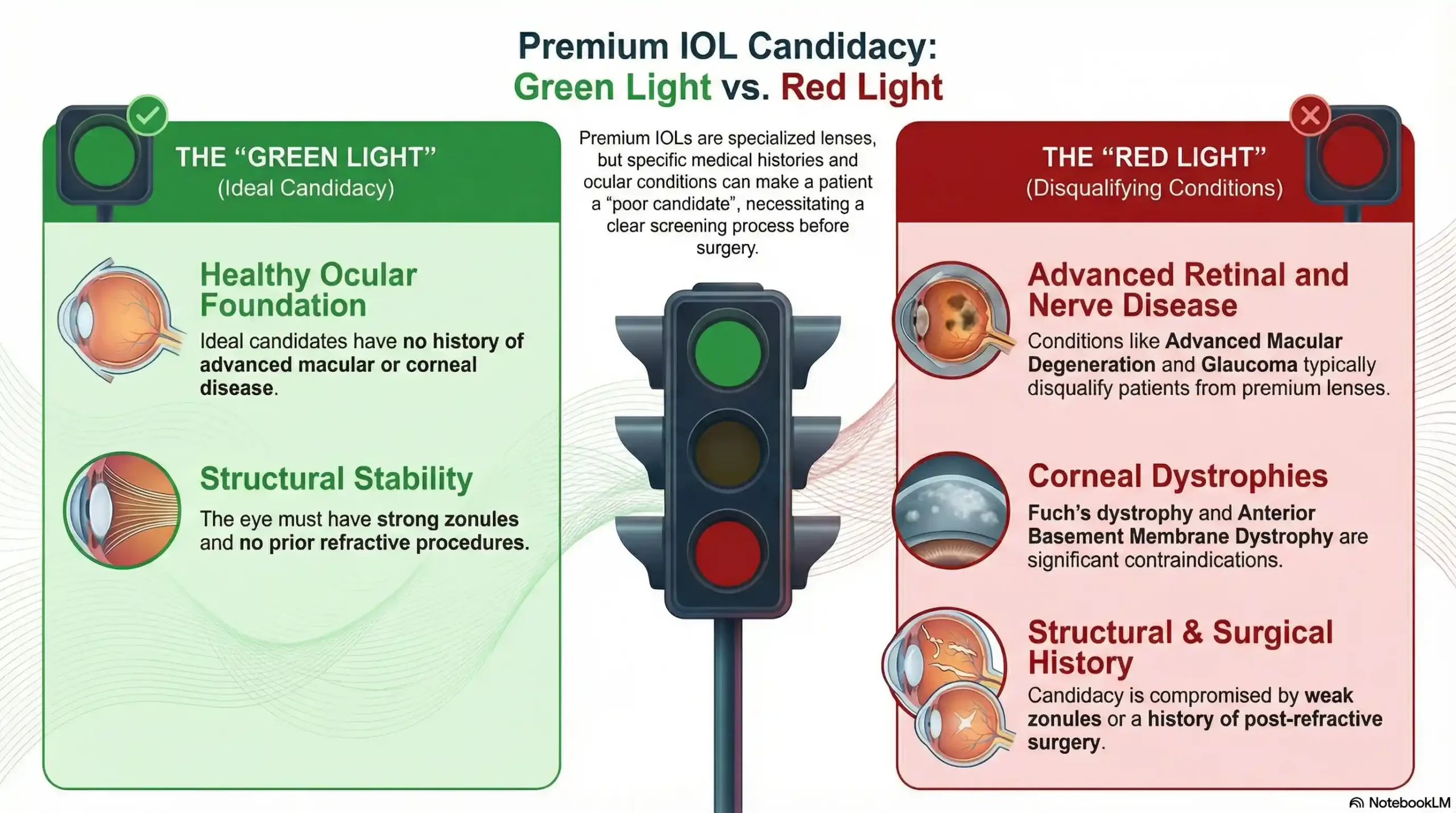
Patients with certain medical histories may also be poor candidates for premium IOL surgery. Some of these conditions include:
- Advanced macular degeneration
- Anterior basement membrane dystrophy
- Fuch’s dystrophy
- Weak zonules
- Glaucoma
- Post-refractive surgery patients
This list is not comprehensive, so it’s important to consult with your physician and bring a detailed medical history for their review.
Finally, patients may also want to consider their careers when weighing the value of this surgery. Patients who are required to read on computer screens for extended periods of time (i.e., print editors, office jobs) may be ideal candidates.
In contrast, individuals who require long-distance acuity, like truck drivers, pilots, or even photographers, may find that some of the issues with these lenses are not suited to their needs. Individuals often complain of “halos” during the night when looking toward a light, glare, or general acuity issues at longer distances.
The “Post-LASIK” Candidate: Can You Still Go Premium?
If you had LASIK or PRK in the 90s or 2000s, you might think you’re stuck with “standard” lenses. While your candidacy is more complex, new technology has opened doors for previous laser surgery patients.
-
The Accuracy Challenge: LASIK permanently changes the shape of your cornea. Dr. Zaver uses specialized formulas designed specifically for post-refractive patients to ensure the new lens matches your eye perfectly.
-
Smart Choices: While traditional multifocals can sometimes struggle with contrast in post-LASIK eyes, newer Light-Adjustable Lenses (LAL) or Enhanced Monofocal lenses offer a safer, high-quality alternative.
Training Your Brain: The “Neuro-Adaptation” Journey
A premium lens is a high-tech tool, and like any new tool, your brain needs time to learn how to use it. This process is called Neuro-Adaptation.
-
The “Learning Curve”: Initially, you may see “ghost images” or halos. This is normal! Your brain is learning to prioritize the clear image over the slightly out-of-focus ones produced by multifocal rings.
-
The Timeline: Most patients see significant improvement within 3 to 6 months. For the vast majority, these visual disturbances fade as the brain “rewires” its processing.
-
Your Recovery: During this time, we provide personalized care to monitor your progress and ensure your eyes are healing exactly as they should.
Resources and Citations
This comprehensive guide is supported by authoritative medical sources and current research to ensure accuracy and reliability for our patients:
Medical Authority Sources
- American Academy of Ophthalmology (AAO) – Premium Intraocular Lenses for Cataract Surgery – Official clinical guidelines and patient education resources on premium IOL technology, including safety profiles and candidacy criteria.
- U.S. Food and Drug Administration (FDA) – Intraocular Lenses (IOLs) – FDA Approved Devices – Comprehensive database of FDA-approved premium IOL devices, including clinical trial data, safety information, and regulatory approval timelines.
Further Consideration
While premium IOLs do have some limitations, they offer an excellent choice for many individuals. However, it is important to meet with your eye care professional to fully discuss all of the available options to find your best fit, as well as to make sure that you understand all of the potential risks and restrictions that this operation poses.
Ready to see the world clearly? Schedule your consultation at our Richmond, TX office today to discover which lens is right for your lifestyle.
FAQs
-
Ideal candidates seek glasses independence, have healthy eyes, no significant ocular disease, and maintain realistic expectations about their post-surgery vision.