
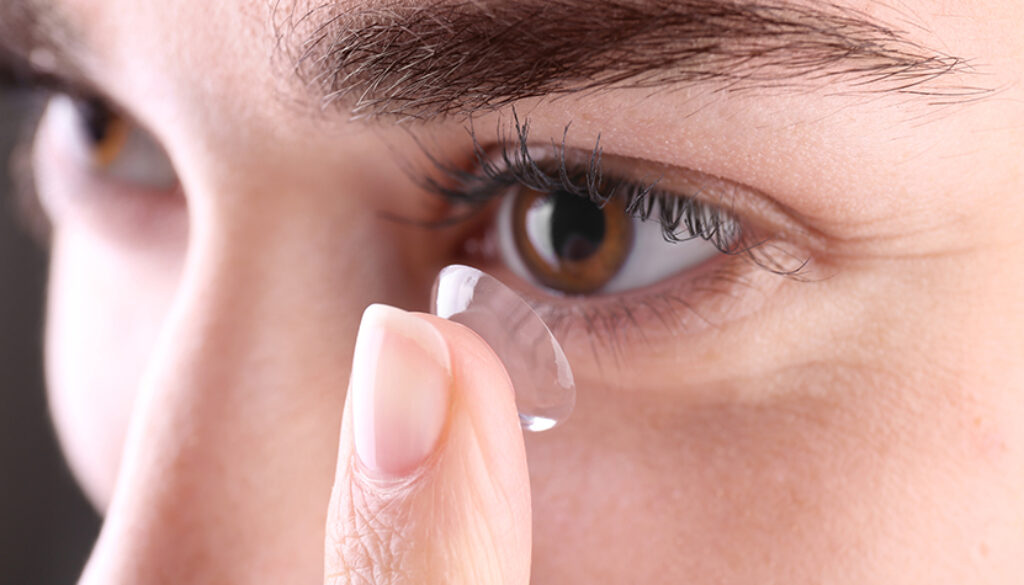
Scleral Lenses
Scleral lenses provide a life-changing solution for patients with severe dry eye, keratoconus, or irregular corneas who find standard contacts unbearable. By vaulting over the cornea and resting on the sclera (the white of the eye), these specialty lenses create a continuous moisture reservoir that ensures sharp vision and all-day comfort.
[Schedule Your Specialty Lens Fitting in Richmond]
Key Takeaways
-
Solve Complex Eye Issues: Scleral lenses are a specialised solution for patients who cannot wear regular contacts due to conditions like severe Dry Eye Syndrome or irregularly shaped corneas.
-
Superior Comfort & Stability: Their large size makes them easy to handle, keeps them highly stable on the eye, and prevents discomfort by resting on the sclera (the white part of the eye), not the sensitive cornea.
-
Built-in Moisture Reservoir: The unique design traps tear film between the lens and the eye, actively keeping the ocular surface moist and healthy.
-
Sharper, Reliable Vision: By vaulting the cornea, scleral lenses correct vision irregularities that cannot be fixed by glasses or standard contacts, resulting in clearer, more reliable vision.
-
Sizing is Key: These lenses come in different sizes (Full, Mini, Semi) based on where they meet the eye; your eye care provider will recommend the precise size for your individual requirements.
What are scleral lenses?
Scleral contact lenses get their name from the fact that, unlike regular contacts, they vault over the entire corneal surface and rest on the white part of the eye, which is called the sclera. This makes them larger than standard contacts, which in turn provides a variety of benefits. Their size makes them easier to handle and more stable when on the eye, which in turn provides the patient with sharper and more reliable vision. They are also less likely to become dislodged and come out.
Scleral contact lenses are also gas permeable, which means that oxygen can pass right through them and reach the surface of the eyes. This is important for comfort, particularly for patients who experience dry eyes.
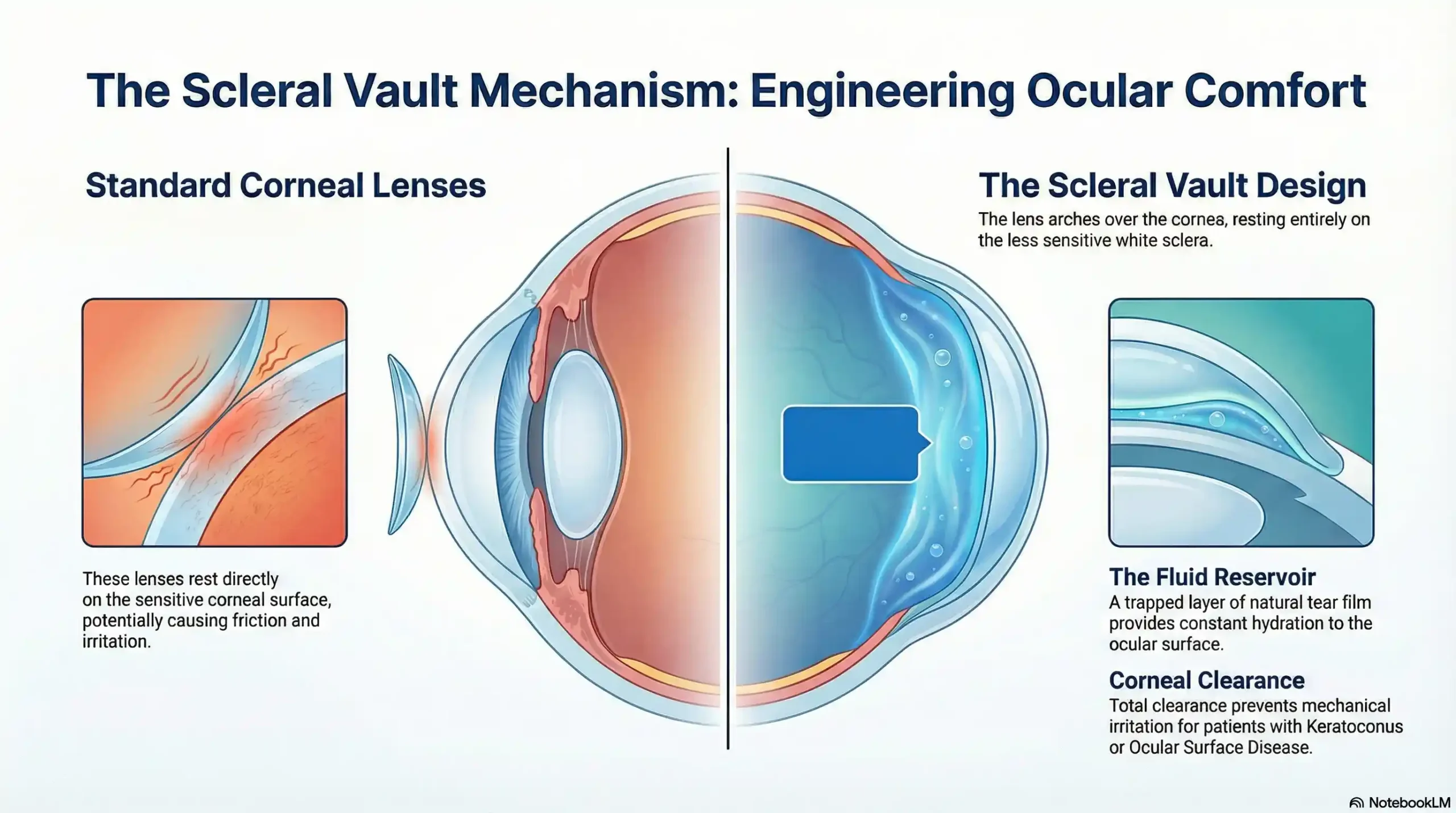
The gap that is created between the back of the contact lens and the front surface of the eye can also trap tear film, acting as a fluid reservoir, which will keep the eyes moist and healthy.
Types of scleral lenses
Within scleral lenses, there are several different sizes to choose from. These are based on where the lenses meet the surface of the eye and are as follows:
Full scleral lenses
The largest type provides the greatest amount of clearance between the cornea and lens and rests on the outer sclera.
Mini scleral lenses
The mid-size variety makes contact with the eye on the anterior sclera.
Semi-scleral lenses
Although larger than conventional lenses, they are not huge, and the edge of the contact lens rests on the junction between the cornea and the sclera.
Your scleral lens provider will be able to make a recommendation as to the correct size for you, which will be based on your individual requirements.
Tired of Blurry Vision? How to Stop Scleral Lens Midday Fogging
If you’ve noticed your vision becoming hazy about four hours into your day, you’re likely experiencing “midday fogging.” This happens when microscopic debris—oils from your tear film or protein buildup—gets trapped in the fluid reservoir behind the lens.
How to get your clarity back:
-
The “Scleral Refresh”: The most effective fix is to remove the lens, rinse it with preservative-free saline, and reinsert it with fresh solution.
-
The “Cocktail” Method: Adding 2–3 drops of a high-viscosity, preservative-free artificial tear to your saline can create a thicker barrier that keeps debris out. This is especially helpful for those with chronic dry eyes.
-
Professional Fit Check: If fogging happens daily, your lens fit may need a minor adjustment. A fit that is too loose allows debris to seep in, while a fit that is too tight can cause unnecessary redness.
The Dr. Zaver Touch: “Midday fogging isn’t just an inconvenience; it’s a signal from your eye. By fine-tuning the peripheral curves of the lens during your specialty contact lens exam, we can often eliminate this issue entirely.”
Who are scleral lenses recommended for?
Although technically anyone can wear and benefit from scleral lenses, they are a particularly good option for patients who have eye conditions or irregularities for which regular contacts are not suitable. This includes patients with:
Dye eye syndrome. Contact lenses float on a fine layer of tear film, which keeps them comfortable and in position. Patients with dry eye syndrome either do not have enough natural tear film, or what they do have drains away too quickly. This can make wearing regular contact lenses difficult and uncomfortable. However, the design of scleral lenses keeps moisture on the surface of the eyes, eliminating some of the effects of dry eyes. This makes scleral lenses a great choice for patients with dry eyes.
Irregular corneas. The cornea is the clear dome that covers the front part of the eye, and many people have a cornea that is slightly or significantly irregular in shape. This causes light to be refracted incorrectly when it enters our eyes, triggering vision problems. Issues arising from irregularly shaped corneas cannot be completely corrected using glasses or conventional contact lenses. Therefore, scleral lenses, which provide sharper and more accurate vision, are recommended.
Scleral Lens Cost: Navigating Insurance and Medical Necessity
At Frame & Focus Eye Care, we believe cost shouldn’t be a barrier to clear vision. Unlike standard contacts, scleral lenses are often classified as “Medically Necessary” by insurance providers.
What does “Medically Necessary” mean? If you have a condition like Keratoconus or severe ocular surface disease where glasses cannot provide functional vision, your insurance may cover a significant portion—or even the total cost—of the lenses.
-
Vision Plans: We work with VSP and EyeMed, which often provide generous specialty lens benefits.
-
Medical Insurance: For complex cases, we can help you navigate claims through medical carriers.
-
The Frame & Focus Backup Plan: While sclerals are specialized, we also offer a $99 Special for frames and lenses to ensure you have a reliable pair of backup glasses at an affordable price.
Precision Matters: Digital 3D Mapping for the Perfect Fit
No two eyes are shaped exactly alike. To provide the most comfortable experience, Dr. Zaver utilizes Digital Ocular Surface Profilometry (3D mapping) to capture thousands of data points across your eye.
Why 3D Mapping is a game-changer for you:
-
Custom Vaulting: We precisely calculate the “vault”—the gap between the lens and your sensitive cornea—to ensure maximum hydration.
-
Eliminates Redness: By mapping the “hills and valleys” of your sclera, we prevent the lens from pressing too hard on specific spots.
-
Faster Results: High-tech mapping reduces the number of trial lenses needed, getting you to clear vision faster than traditional methods used in a routine eye exam.
Mastering Scleral Lens Insertion: The “Face-Down” Rule
The most common hurdle for new wearers is the fear of air bubbles. Following our 90-Degree Rule ensures a perfect seal every time.
-
Prep the Lens: Place the lens on a “tripod” (your thumb, index, and middle finger) or a specialized plunger.
-
Overfill: Fill the bowl to the very brim with preservative-free saline. It should look like a rising “dome” of liquid.
-
Tuck Your Chin: Lean over a flat mirror. Your face must be parallel to the floor (90 degrees) so the liquid doesn’t spill.
-
Steady Contact: Move the lens straight up until you feel the cold liquid touch your eye, then push gently but firmly.
Pro-Tip: If you see a bubble, take it out and try again! Leaving a bubble can irritate. If you ever experience sudden pain or redness that won’t go away, don’t forget we offer emergency eye care for our Richmond neighbors.
Resources & Citations
-
Scleral Lens Academy. The Clinical Application of Scleral Lenses in Irregular Corneas and Ocular Surface Disease.
-
American Academy of Optometry (AAO). Review of Gas Permeable Contact Lenses and Ocular Health.
Ready for a more comfortable contact lens experience? Book your specialty fitting online or call us at (832) 930-7797 today.
FAQs
-
They are ideal for patients with chronic dry eye syndrome or irregularly shaped corneas (like keratoconus) who find traditional contacts uncomfortable or ineffective.