Implantable Contact Lenses
EVO Implantable Contact Lenses (ICLs) provide permanent vision correction for patients with high myopia or thin corneas who are ineligible for LASIK. Unlike laser surgery, these biocompatible lenses are reversible and work with your eye’s natural anatomy to deliver high-definition clarity without inducing dry eye syndrome.
Schedule Your ICL Candidacy Consultation in Richmond
Key Takeaways
Ready to explore permanent vision correction? Here are the most critical takeaways about Implantable Contact Lenses (ICLs):
-
LASIK Alternative: ICLs are an effective, permanent option for vision correction if you are ineligible for laser eye surgery or have specific refractive errors.
-
Minimal Discomfort: The surgical process is extremely fast, involves only a tiny, self-healing corneal incision, and is performed using topical anesthetic drops.
-
Natural Integration: ICLs (Phakic IOLs) work with your eye’s natural lens to correct vision, a key difference from lenses used during cataract surgery.
-
Mandatory Candidacy Check: Successful treatment relies on having stable vision (6-12 months) and general eye health; an in-depth consultation is essential to confirm the fit of the lens.
-
Long-Term Value: While the initial cost ranges from $1,500 to $5,000 per eye, ICLs often prove to be a reasonable, money-saving investment when compared to the lifetime expense of glasses and contacts.
If you dislike wearing glasses and you are not a suitable candidate for laser eye surgery, then implantable contact lenses (ICLs) may offer the permanent vision correction solution that you require.
How do implantable contact lenses work?
Implantable contact lenses basically work in exactly the same way as standard, external contact lenses do. ICLs alter the shape of the cornea to correct refractive errors such as near and farsightedness, and astigmatism. However, unlike non-permanent contact lenses, ICLs are surgically placed inside the eye rather than over the top of it.
Implantable contact lenses are also sometimes known as phakic intraocular lenses (IOLs). The reason for this is that the two share a number of characteristics. IOLs are seen in cataract surgery, where they take the place of the affected natural lens after it has been removed. However, when used as implantable contact lenses, they work in conjunction with the natural lens of the eye to correct your vision.
Comprehensive Exams: Seeing the Full Picture of Your Health
A standard vision check is often just the beginning. To truly protect your long-term sight, we move beyond the reading chart to provide a complete view of your ocular health using the latest technology.
-
Advanced Diagnostics: We utilize state-of-the-art technology to provide a detailed clinical picture of your eyes.
-
Early Detection: Our comprehensive eye exams allow us to catch common eye diseases in their earliest, most treatable stages.
What happens during the procedure?
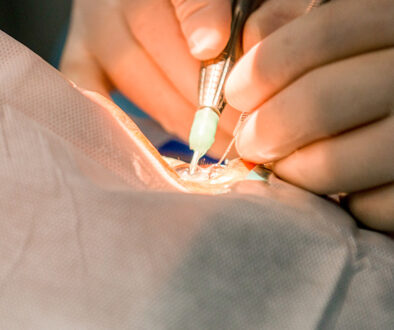
The procedure requires your surgeon to make a tiny incision in the cornea to allow access to the natural lens underneath. The ICL is then inserted through the incision and placed either in front of or behind the iris, which is the colored part of your eye, and in front of the natural lens. The incision into the cornea is able to heal naturally without stitches, and the entire process is extremely quick.
Will it hurt?
Your surgeon will give you an anesthetic, usually in the form of eye drops, ahead of the procedure, and therefore you should experience very little, if any, discomfort.
Pediatric Care: Setting Richmond’s Kids Up for Success
Vision issues in children can often be mistaken for reading difficulties or behavioral challenges. Because clear sight is fundamental to learning, we provide specialized care for our youngest neighbors in the Richmond, Pecan Grove, and Sugar Land areas.
-
Early Intervention: We offer gentle pediatric eye exams designed to be stress-free for both children and parents.
-
Myopia Management: For children whose vision is rapidly changing, our myopia control programs help slow the progression of nearsightedness to safeguard their future health.
-
Patient & Kind: Our staff is frequently praised for being exceptionally patient and kind with children, including those with special needs.
Am I a suitable candidate for implantable contact lenses?
Candidacy for ICL is assessed on a case-by-case basis. However, there are certain parameters that your surgeon will use to decide if ICL is a suitable corrective procedure for you. These include, but are not limited to:
- Age. Most ICL patients are between the ages of 21 and 45. This is because, around the age of 40, many people begin to develop a condition known as presbyopia, which is a progressive condition that interferes with near-vision.
- The severity of your refractive problems. ICLs can correct certain degrees of myopia, and if you are outside the recommended treatment range, then they might not provide the right solution for your vision problems.
- The stability of your prescription. ICLs are significantly less effective for people whose eyesight is changing regularly. Your surgeon will want your prescription to have been stable for at least 6-12 months.
- The health of your eyes. Your eyes need to be healthy to support the new lens. This means not having any diseases such as glaucoma or macular degeneration.
- The amount of space in your eyes’ anterior chamber. This is the part of your eye that is between your iris and cornea, and needs to be big enough to fit the ICL into.
- Your general health. People with autoimmune conditions, such as Lupus, can experience flare-ups as a result of the surgery.
Your surgeon will be able to go through your ocular and medical history with you to advise whether ICL surgery is a suitable option for you.
The EVO ICL Revolution: Why the “Central Port” is a Game-Changer
Transitioning to permanent vision correction used to involve a laser procedure to create tiny “pressure-relief” holes in the iris, known as a peripheral iridotomy. At Frame & Focus Eye Care, we utilize the EVO ICL, which features patented CentralFLOW™ technology. This microscopic “central port” allows the eye’s natural fluids to flow freely, eliminating the need for extra laser work and making the procedure faster and more comfortable.
-
Why it matters: It preserves your natural eye structure and maintains ocular health.
-
The “Wow” Factor: Many patients report striking clarity almost immediately because the cornea remains untouched.
Targeted Relief for Dry Eye and Digital Strain
Do your eyes feel like the Sahara Desert after a long day at the computer? Chronic dryness and “sandpaper” discomfort are more than just an inconvenience—they can lead to chronic headaches and neck pain.
-
Root Cause Treatments: We offer specialized dry eye treatment that goes beyond basic drops to address the underlying causes of discomfort.
-
Neurolens Therapy: For those suffering from headaches and digital eye strain, we offer Neurolens, a breakthrough contoured prism technology.
-
Emergency Care: If you experience a sudden change in vision or a painful infection, our emergency eye care offers same-day appointments for immediate peace of mind.
Quality Eyewear: Engineering the Perfect Fit
We reject the false economy of “one-size-fits-all” online frames that slide down your nose and cause distorted vision. Your eyewear should be both a medical necessity and a personal style statement.
-
Professional Fitting: Our contact lenses and frames are fitted by experts to ensure they are built to last and function perfectly for your unique face shape.
-
Specialty Lenses: For hard-to-fit patients, we provide specialty contact lenses to ensure comfort even for those with complex prescriptions.
-
Accessible Quality: We make high-quality vision affordable with our unique promotions, ensuring style and clinical precision are available to everyone in our community.
Precision Sizing: How Dr. Zaver Uses “The Vault” for Your Safety
A successful ICL procedure isn’t just about the surgery; it’s about the mathematics of the fit. Dr. Zaver focuses on a critical metric called “The Vault”—the precise safety gap between your new ICL and your eye’s natural lens.
Using advanced diagnostic imaging during your initial consultation, we create a 3D map of your eye’s internal “architecture.” This allows us to select a lens that fits your unique “optical fingerprint,” ensuring:
-
Optimal Fluid Circulation: Preventing pressure buildup.
-
Lens Stability: Ensuring the lens stays perfectly centered, even during high-impact sports.
-
Long-Term Clarity: Minimizing risks by using the most precise measurement tools available.
ICL vs. LASIK: The Definitive “Dry Eye” Decision Matrix
A frequent question Dr. Zaver receives in our Richmond office is: “If I have dry eyes, is LASIK still an option?” For many, the answer is a shift toward ICLs.
While LASIK is a fantastic procedure, it requires reshaping the cornea, which can temporarily disrupt the nerves responsible for tear production. EVO ICLs are “additive,” not “subtractive.” Because we aren’t removing any corneal tissue, the procedure has a significantly lower risk of inducing or worsening chronic dry eye syndrome.
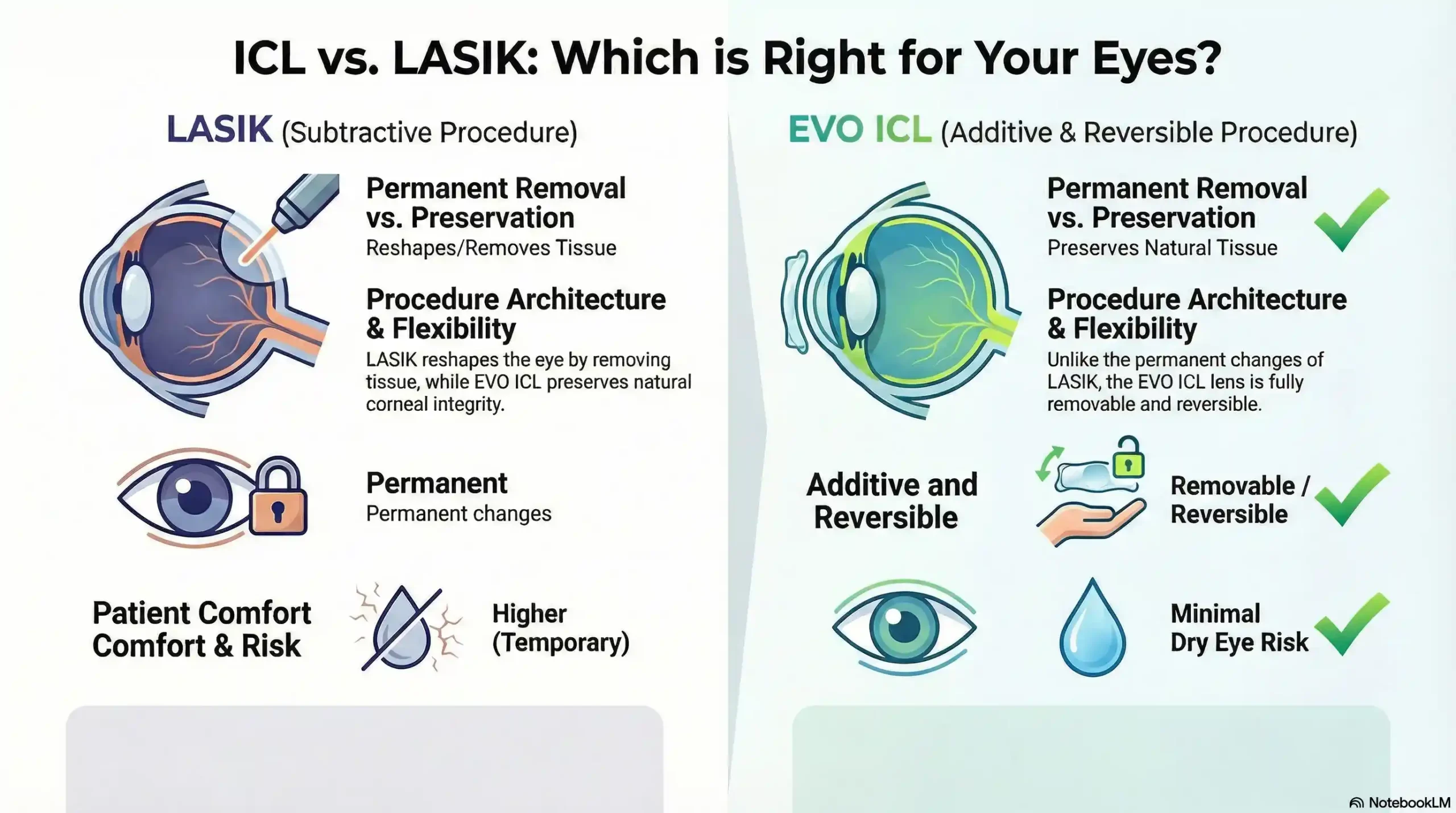
| Feature | LASIK | EVO ICL |
| Corneal Impact | Reshapes/Removes Tissue | Preserves Tissue |
| Dry Eye Risk | Higher (Temporary) | Minimal |
| Reversibility | Permanent | Removable/Reversible |
| Prescription Range | Limited for High Myopia | Ideal for -3D to -20D |
How much does ICL surgery cost?
The exact cost of your implantable contact lens surgery will vary depending on the surgeon that you choose and the area in which you live. However, costs can range from $1,500 to $5,000 per eye. While looking at it as a total amount seems expensive, many people find that when they consider the amount of money spent on regular glasses or contact lenses over the years, the cost of ICL is very reasonable.
Also, many surgeons offer a range of payment options, including low-interest or zero-percent financing. Make sure you shop around to find the best rates and payment plan for you before committing to your surgery.
Resources & Citations:
-
Coastal Eye Surgeons, “What Is Visian ICL?” – Describes the Visian ICL as a phakic intraocular lens implanted “behind the iris and in front of the eye’s natural lens” (working like a permanent contact lens) to correct vision without altering the cornea
-
NVISION Eye Centers, “ICL Surgery: Costs, Side Effects & What to Expect” – Notes that ICLs generally cost significantly more than LASIK, with reported prices “from $1,500 to $5,000 per eye” (out-of-pocket)
Future-Proofing Your Sight: The Reversibility Advantage
Life changes, and your eyes do too. One of the most comforting aspects of the ICL is that it is completely reversible. Unlike laser surgeries that permanently alter your eye’s shape, an ICL can be safely removed or upgraded if your vision needs shift significantly in the future or if you require cataract surgery later in life.
Think of it as “future-proofing” your vision. You get the high-definition clarity you need today while keeping every medical door open for tomorrow. This flexibility is a cornerstone of Dr. Zaver’s patient-first philosophy: providing solutions that respect your long-term health as much as your current lifestyle.
Ready to See the Difference?
Don’t wait for a headache or blurred vision to prioritize your health. Join the hundreds of Richmond families who trust Dr. Zaver and the Frame & Focus team for clear, compassionate care.
Ready to see if you are a candidate? Schedule Your Consultation with Dr. Zaver Today or call us at (832) 930-7797.
FAQs
-
ICLs are advanced micro-lenses surgically placed inside the eye, working with your natural lens to provide permanent correction for nearsightedness, farsightedness, and astigmatism.