
EnChroma Lens Technology
EnChroma lens technology uses patented spectral filters to help individuals with red-green color blindness distinguish vibrant colors by eliminating “wavelength overlap.” Whether for classroom learning or daily safety, these specialized lenses provide the clarity needed to experience the world in full technicolor.
Schedule a Color Vision Consultation in Richmond
Key Takeaways
-
Color Vision Clarity: Color blindness (red-green deficiency) is highly common, affecting up to 8% of men, and is a differentiation issue, not an absence of color.
-
Safety & Daily Impact: This visual impairment can create real-world challenges, particularly in identifying colors critical for safety, such as traffic lights and medication.
-
Innovative Solution: EnChroma lens technology specifically counters red-green deficiency by selectively filtering light wavelengths to create greater contrast between confusing colors.
-
Premium Quality: Beyond color correction, the lenses are made with leading-edge Trivex material, ensuring exceptional clarity, strength, and 100% UV light protection.
-
Life in Technicolor: This spectral lens technology offers patients the life-changing ability to successfully distinguish colors and experience the world in full vibrancy.
If you find it difficult to tell colors apart, you may be color blind. Color blindness, or color deficiency, is estimated to affect around 8% of men and about 1% of women, but for those affected, it can significantly impact the quality of their day-to-day life. Contrary to popular belief, being color blind doesn’t mean that you can’t see any color at all. Instead, patients simply struggle to differentiate between certain colors. The vast majority of people who are color blind find it impossible to tell the difference between varying shades of red and green. You may hear this referred to as red-green color deficiency. However, this doesn’t only mean that they mix up red and green. They can also mix up colors that have some green or red light as part of their whole colors, for example, purple and blue. This is because they are unable to see the red light that forms part of the color purple.
As you can probably imagine, this type of visual impairment can be a problem for things like traffic lights, taking medication, and even looking at signs and directions. For example, someone who is color blind may find that the green on a traffic light may appear white or even blue.
EnChroma lens technology is specifically designed to counteract red-green color deficiency and enable patients to better identify the difference in these colors or shades. They do this by selectively filtering out the red and green wavelengths of light at the exact point where the color sensitivities overlap before hitting the retina, creating far greater contrast between the colors so that the patient can distinguish between them successfully. Most cases of color blindness respond well to EnChroma’s innovative spectral lens technology, giving patients the ability to experience life in bright, vibrant technicolor.
EnChroma lenses are made from leading-edge Trivex material, and this helps to give them the best possible quality and clarity of vision. These lenses are also extremely light, strong, and offer patients 100% protection against UV light, helping to keep your eyes healthy as well as improving your vision.
To prepare this for publication on the Frame & Focus Eye Care website, I have polished the text for flow, humanized the tone, and strategically embedded internal links to your existing service pages (based on your uploaded site map).
This version is optimized for 2025 SEO standards, focusing on topical authority and the “Search Generative Experience” (SGE).
Beyond Tinted Glass: The Patented Spectral Notch Technology
Many patients ask Dr. Sarah Zaver, “Can’t I just use red-tinted sunglasses?” The answer is a firm no. Standard tinted lenses simply dim the world; they don’t fix the underlying overlap of light.
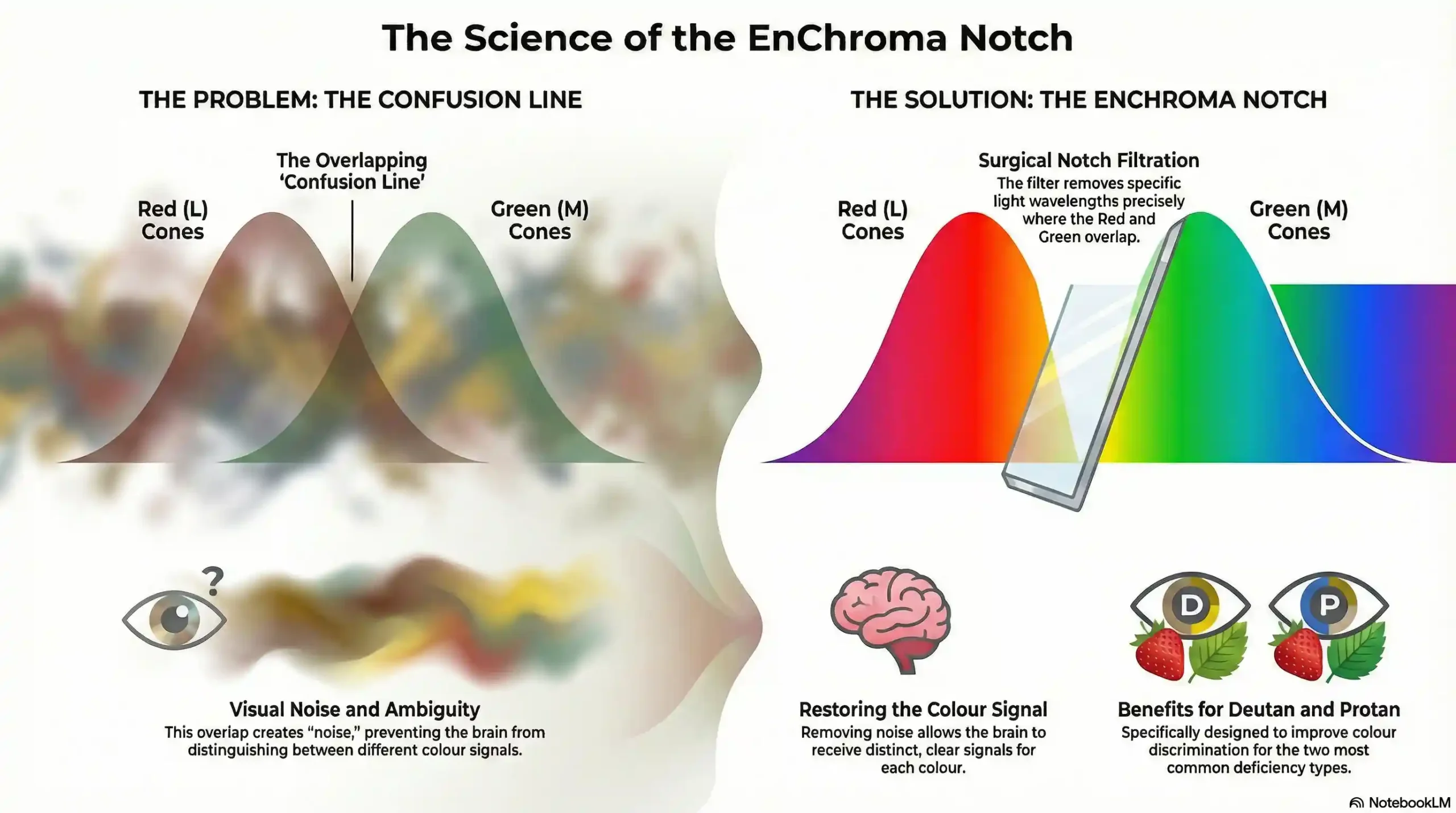
At our clinic, we explain it like this: your eyes are receiving “noisy” data. EnChroma acts as a high-tech filter that mutes the “noise” so the “signal” (the true color) can get through.
-
The “Confusion Line”: In red-green deficiency, your “M” (green) and “L” (red) retinal cones overlap too much. Your brain can’t tell where one ends and the other begins.
-
The EnChroma “Notch”: This technology uses a spectral notch filter. It surgically removes specific wavelengths of light right at that overlap point.
Deutan or Protan? Finding Your Specific Lens Match
Color blindness isn’t “one size fits all.” Identifying your specific “type” is the difference between a “cool gadget” and a life-changing medical tool.
-
Deutan (Deuteranomaly): The most common form. If you struggle with muted greens and yellows, EnChroma’s Deutan-specific lenses offer an incredibly high success rate.
-
Protan (Protanomaly): If reds appear dark or brown, you likely have Protan-type deficiency. These lenses shift the spectrum to bring “vibrant red” back into your vocabulary.
The 80% Rule: This technology works for about 4 out of 5 people with red-green deficiency. We ensure you are in that 80% bracket by performing specialized testing during our routine eye exams.
The “EnChroma Effect”: Training Your Brain
One of the most fascinating things we see in our Richmond office is that the EnChroma experience often gets better over time. This is due to neuroplasticity.
-
The Adjustment Period: Your brain has spent years “ignoring” certain color signals. Most patients need 10 to 15 minutes for the initial “pop,” but the most profound changes happen after 2–3 weeks of consistent use.
-
Persistent Benefits: Some studies suggest that after wearing EnChroma lenses regularly, patients report better color awareness even after they take the glasses off.
-
Dr. Zaver’s Tip: Always test your new lenses in bright, natural sunlight first. The brain needs high-quality light “fuel” to process these new colors. If you also suffer from dry eye syndrome, ensure your eyes are well-lubricated to maintain the best visual clarity through the lenses.
EnChroma for Kids: Success in a Color-Coded Classroom
As a parent, you might not realize how much of your child’s education is color-coded. From “the green folder is for math” to “highlight the verbs in red,” a child with color deficiency faces hidden hurdles.
-
Confidence in the Classroom: EnChroma helps a child follow directions without hesitation, boosting their academic confidence.
-
The Trivex Advantage: Kids are active. We provide EnChroma in Trivex material—the gold standard for pediatric eye care. It’s virtually unbreakable, ultra-lightweight, and provides 100% UV protection.
Spotting the Signs: If your child struggles with purple vs. blue or seems frustrated during art class, it may not be a learning issue. Schedule a kids’ eye exam to see if EnChroma is the right fit.
Resources & Citations
-
EnChroma Official Website: Learn more about the science behind the spectral lens technology and see product options.
-
National Eye Institute (NEI) on Color Blindness: Official information on the causes, prevalence, and types of color vision deficiency.
If you or someone you know is color blind or color-deficient and could benefit from EnChroma lenses, Ready to see the difference? Contact us today to schedule your consultation and experience life in technicolor.
FAQs
-
They use special optical filters to selectively remove light wavelengths overlapping between red and green photoreceptors, increasing color contrast.